
Best Practice
Personalize This
Get insights for your role
A best practice is a method or technique that has consistently shown superior results and is used as a benchmark for others to adopt.
Definition
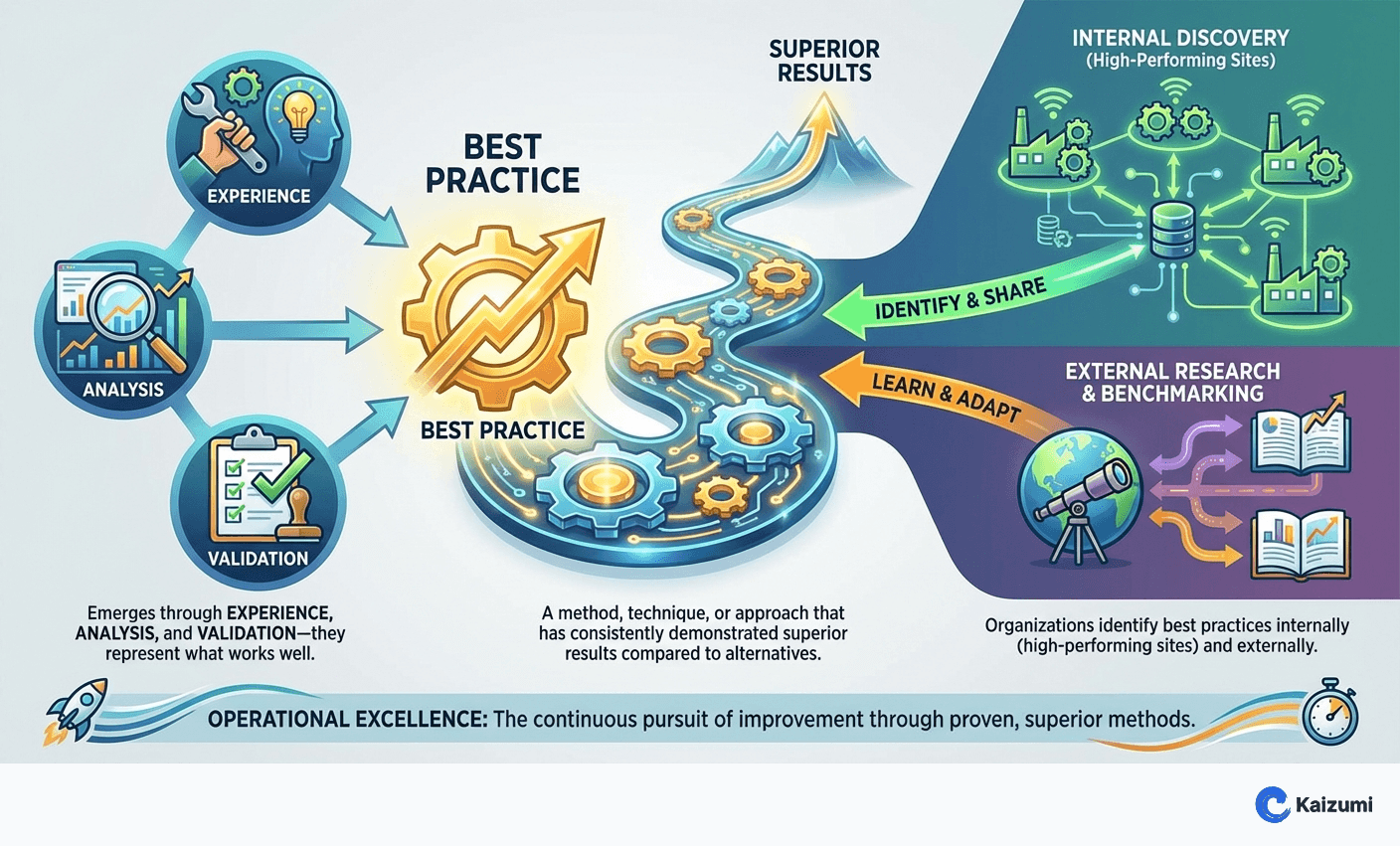
A best practice is a method, technique, or approach that has consistently demonstrated superior results compared to alternatives. Best practices emerge through experience, analysis, and validation—they represent what works well. Organizations identify best practices internally (high-performing sites or teams) and externally (industry leaders, research) then adapt and deploy them broadly. The goal is learning from success rather than repeating failures or reinventing solutions that already exist.
Examples
A company identified that one plant had 40% fewer changeover-related defects. Investigation revealed specific practices: verification checklists, first-piece inspection, setup validation. These became documented best practices deployed across all plants.
Key Points
- Methods proven through demonstrated superior results
- Can be internal (high performers within organization) or external (industry leaders)
- Must be documented and standardized for deployment
- Should be adapted to context, not blindly copied
Common Misconceptions
Best practice means one right way. "Best practice" is current best known method—always subject to improvement. What's best practice today may be superseded tomorrow. Continuous improvement applies even to best practices.
External best practices always transfer. Practices that work in one context may not transfer directly. Successful adoption requires understanding why the practice works and adapting it to local conditions, not copying mechanically.