
Lean Dictionary
Your free guide to Lean, Six Sigma, TPM, Theory of Constraints, and Continuous Improvement terminology.
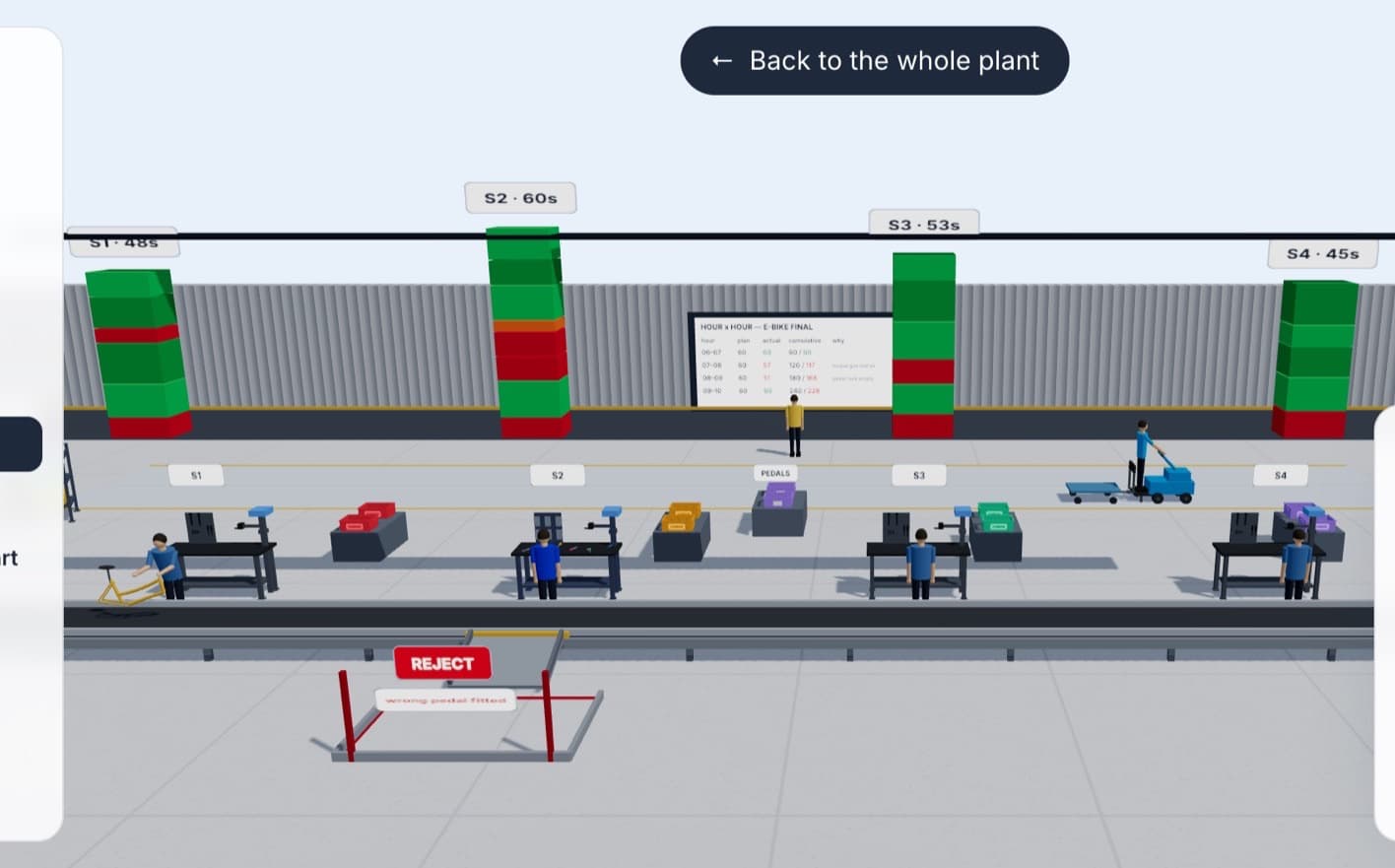
The dictionary, brought to life
Watch the terms happen
Eighteen of the terms below are demonstrated by a running e-bike factory rather than defined — a value-stream map of the whole plant, and one assembly line you can step inside. Nothing is staged: the queue forms at the bottleneck because that station’s work genuinely sums to takt.
5
5 Whys
なぜなぜ分析 (naze naze bunseki)
5 Whys is an iterative root cause analysis method that traces an observed problem back to an actionable systemic cause by repeatedly asking why.
5S
5S is a lean methodology for workplace organization that uses five sequential stages to build an efficient, visual, and standardized work environment.
A
A3 Problem Solving
A3 problem solving is a structured Lean methodology developed by Toyota that maps the complete PDCA problem-solving cycle onto a single standard sheet.
Andon
行灯 (andon)
Andon is a visual signaling system that alerts teams to abnormal conditions. Pulling the cord triggers an amber response window; the line halts only at the fixed-position stop line.
B
C
Catchball
Catchball is the bidirectional negotiation process in hoshin kanri used to align strategic targets with frontline operational feasibility.
Cellular Manufacturing
Cellular manufacturing organizes workstations and machines by product family into dedicated cells to achieve continuous flow and eliminate batch queues.
Condition Monitoring
Condition monitoring tracks machine parameters like vibration and temperature to identify developing faults before equipment fails.
Continuous Improvement
Continuous improvement is the practice of making many small frontline changes to how work is done and standardizing the ones that succeed.
Control Chart
A control chart is a time-series graph tracking process data against statistical limits to distinguish between common-cause and special-cause variation.
Corrective Action
Corrective action is the process of eliminating the root cause of an identified defect to prevent it from happening again.
Cpk
Cpk is a process capability index that measures how well a stable process meets specification limits by accounting for both variability and centering.
Cycle Time
Cycle time is the actual time required to complete work on one unit at a station. The slowest station’s cycle time sets the pace of the whole line.
D
DMAIC
DMAIC is a structured, five-phase Six Sigma methodology designed to eliminate defects and reduce process variation through data-driven problem-solving.
DPMO
Defects per million opportunities (DPMO) measures Six Sigma process capability by standardizing defect counts across total error opportunities.
E
F
FIFO (First In, First Out)
First-In, First-Out (FIFO) is an inventory management discipline that preserves the arrival sequence of materials to prevent stagnation and defects.
First Pass Yield
First pass yield measures the percentage of units completing a process step correctly on the initial attempt without requiring rework, repair, or scrap.
Fishbone Diagram
A fishbone diagram is a structured problem-solving tool that visualizes and categorizes potential causes of a defect to assist in root cause analysis.
FMEA
Failure Mode and Effects Analysis (FMEA) is a structured risk assessment method used to identify, score, and prevent potential failures in designs or processes.
G
Gage R&R
Gage R&R is a statistical study evaluating the measurement system variation caused by device repeatability and operator reproducibility.
Gemba
現場 (gemba)
Gemba is the Japanese lean management term for the actual place where work occurs, value is created, and direct observation reveals operational reality.
Gemba Walk
現場 (genba)
A gemba walk is a structured visit by leaders to the place where work happens to observe conditions, engage frontline staff, and identify improvements.
H
Heijunka
平準化 (heijunka)
Heijunka is the lean manufacturing practice of leveling production volume and mix to eliminate unevenness and create a smooth, predictable workflow.
Histogram
A histogram is a bar chart that displays the distribution and frequency of continuous numerical data grouped into equal-width intervals called bins.
Hoshin Kanri
方針管理 (hōshin kanri)
Hoshin kanri is a strategic planning and execution methodology that aligns an organization's daily work with breakthrough strategic objectives.
Hourly Production Board
An hourly production board is a visual management tool used to track planned versus actual output every hour, enabling rapid response to shop-floor.
J
Jidoka
自働化 (jidōka)
Jidoka is the lean manufacturing practice of autonomation, building quality into processes by stopping immediately when an abnormality is detected.
Job Instruction
Job instruction is a four-step training method developed to teach workers how to do a job safely, correctly, and consistently.
Just-in-Time
Just-in-time is a lean production principle of making and delivering items only when needed, driven by actual consumption rather than forecasts.
K
Kaizen
改善 (kaizen)
Kaizen is a frontline-led continuous improvement methodology that uses small, reversible changes and standard work to achieve cumulative operational gains.
Kaizen Event
A kaizen event is a focused, multi-day workshop where a dedicated cross-functional team analyzes, redesigns, and implements improvements for a single process.
Kamishibai
紙芝居 (kamishibai)
Kamishibai is a visual audit system in lean management that uses two-sided cards to confirm process compliance and sustain operational standards.
Kanban
看板 (kanban)
A kanban is a physical or electronic signal that authorizes the production or withdrawal of material to control inventory in a pull system.
Kano Model
A quality framework that classifies product features based on how their execution influences customer satisfaction and emotional responses.
Kata
型 (kata)
Kata is two linked routines from Toyota for continuous improvement through daily scientific experiments and coaching.
L
Lead Time
Lead time is the total elapsed time from order placement to final delivery, covering every processing step and all the waiting between them.
Leader Standard Work
Leader standard work is a structured daily routine of fixed tasks, process audits, and coaching that maintains operational stability across management tiers.
Lean
Lean is an operational philosophy focused on maximizing customer value while eliminating waste through continuous improvement and respect for people.
M
Milk Run
A milk run is a lean material-delivery method operating on a fixed route and schedule to replenish parts and collect empty containers.
MTBF
Mean time between failures (MTBF) measures the average operating uptime a repairable system delivers between unscheduled breakdowns.
MTTR
Mean time to repair (MTTR) measures the average duration needed to troubleshoot, fix, and restore failed equipment to normal operating condition.
Muda
無駄 (muda)
Muda is the lean concept representing any activity or resource consumption that consumes capacity without creating value for the customer.
Mura
Mura refers to unevenness or irregularity in production volume, demand, or cycle times within lean manufacturing and the Toyota Production System.
Muri
Muri is a lean concept referring to overburden or operating beyond capacity, causing errors, injuries, machine breakdowns, and systemic waste.
N
O
Obeya
大部屋 (ōbeya)
An obeya is a dedicated collaborative workspace where cross-functional teams manage projects and strategy using visual management tools.
OEE
Overall Equipment Effectiveness (OEE) measures the proportion of planned production time an asset spends producing good units at maximum design speed.
One-Piece Flow
One-piece flow is a lean manufacturing method where products move through operations one unit at a time without accumulating work-in-process inventory.
Out-of-Cycle Work
Out-of-cycle work is any task an operator must perform that doesn't occur every cycle, disrupting standard work rhythm and timing.
P
Pareto Chart
A Pareto chart combines descending bars and a cumulative percentage line to distinguish the vital few causes of defects from the trivial many.
PDCA
The Plan-Do-Check-Act (PDCA) cycle is an iterative four-stage management method used for continuous process control, problem-solving, and improvement.
Pitch
Pitch is the operational pacing increment representing the time needed to fill a standard container of product based on takt time and pack-out quantity.
Poka-Yoke
ポカヨケ (poka-yoke)
Poka-yoke is a lean manufacturing technique that uses physical or procedural safeguards to prevent errors or detect them before defects can occur.
Product Family
A product family is a group of products that share similar processing steps and equipment, enabling flow cell design and value stream focus.
Pull System
A pull system is a lean production control method where upstream workstations produce only in response to signals triggered by downstream consumption.
R
Red Tagging
Red tagging is a visual 5S sorting technique where questionable items are tagged and moved to a holding area for evaluation before final disposition.
Root Cause Analysis
Root cause analysis is a structured methodology that identifies underlying physical and procedural defects to permanently prevent problem recurrence.
S
Safety Stock
Safety stock is extra inventory held above cycle stock to absorb unexpected variations in customer demand and replenishment lead times.
Six Sigma
Six Sigma is a data-driven quality methodology designed to reduce variation and eliminate defects using statistical tools and structured frameworks.
SMED
SMED (Single-Minute Exchange of Die) is a lean methodology created by Shigeo Shingo to reduce machine changeover times to under ten minutes.
Spaghetti Diagram
A visual mapping method tracing the physical path of people, products, or documents through a workspace to expose motion waste and layout inefficiencies.
Standard Work
Standard work is the documented, current best method to execute an operation, defined by takt time, work sequence, and standard work-in-process.
Supermarket
A supermarket is a dedicated buffer that manages controlled inventory between decoupled manufacturing processes in a pull-based just-in-time system.
T
Takt Time
Takt time is the pace required to match customer demand, calculated by dividing available operating time by the number of units required during that period.
Team Leader
A team leader is a floor-level manufacturing role supporting four to six operators by maintaining flow, standard work, and rapid andon response.
Theory of Constraints
The theory of constraints is an operations management methodology focused on identifying and managing bottlenecks to maximize total system throughput.
Time Study
A time study is the direct observation and timing of discrete work elements across multiple cycles to determine repeatable baselines for standard work.
Total Productive Maintenance
Total Productive Maintenance is a plant-wide equipment care system designed to achieve zero breakdowns, zero defects, and zero accidents.
Toyota Production System
An integrated socio-technical management system developed by Toyota to eliminate waste and optimize quality, cost, and lead time.
V
Value Stream Mapping
Value stream mapping is a lean method used to document and optimize material and information flows required to deliver a product to customers.
Visual Management
Visual management uses physical cues and visual controls to communicate operational status and expose abnormal conditions at a glance.
Y
Ready to put Lean into practice?
Get AI-personalized training built for your industry, role, and company — on demand.