
Run Chart
Personalize This
Get insights for your role
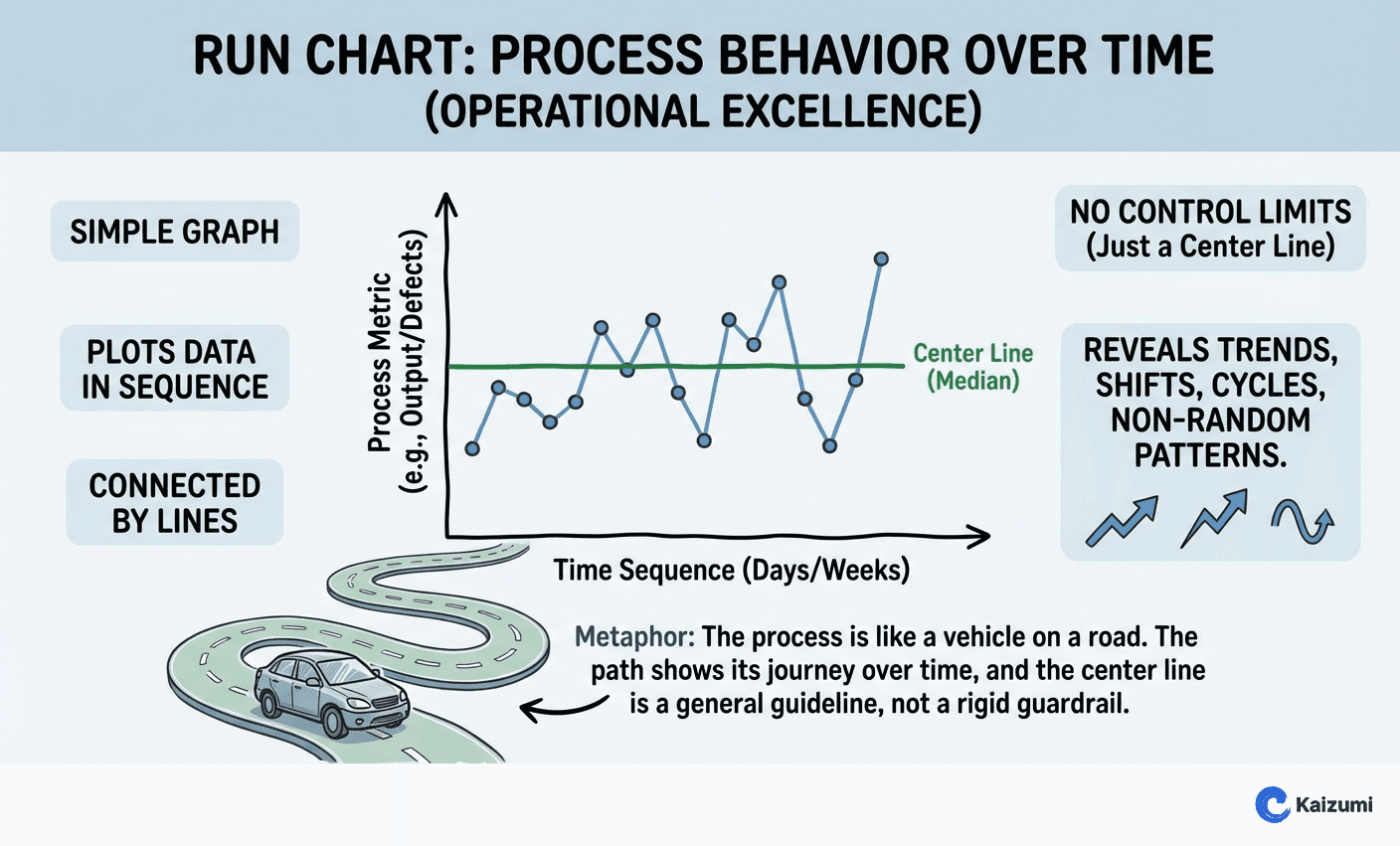
A run chart plots data points in time sequence to reveal trends, shifts, cycles, or patterns that indicate process changes.
Definition
A run chart is a simple graph that plots data points in time sequence, connected by lines to show process behavior over time. Unlike control charts, run charts don't have statistically calculated control limits—just a center line (usually the median). They reveal trends, shifts, cycles, and non-random patterns that suggest process changes. Run charts are often used as a simpler alternative to control charts, especially when starting to understand a process or when statistical rigor isn't required.
Examples
Before implementing a formal SPC system, a team tracked daily defect counts on a run chart. The visual pattern immediately revealed a weekly cycle—defects spiked every Monday. This non-random pattern triggered investigation that found weekend maintenance activities were causing the Monday problems.
Key Points
- Simpler than control charts—no statistical limit calculations required
- Reveals trends, shifts, and cycles through visual inspection
- Rules detect non-random patterns: runs above/below median, trends, too few/many crossings
- Often used before control charts or when statistical sophistication isn't needed
Common Misconceptions
Run charts and control charts are interchangeable. Control charts provide statistical basis for distinguishing common and special cause variation. Run charts show patterns but don't quantify statistical significance. Control charts are more powerful for ongoing process control.
Any pattern on a run chart means something is wrong. Random data produces apparent patterns. Run chart rules (too few runs, trends of 6+ points) help distinguish meaningful patterns from random noise. Don't overinterpret visual patterns without applying rules.