
Training Within Industry
Personalize This
Get insights for your role
Training Within Industry (TWI) is a structured methodology for developing supervisory skills in job instruction, job methods, and job relations.
Definition
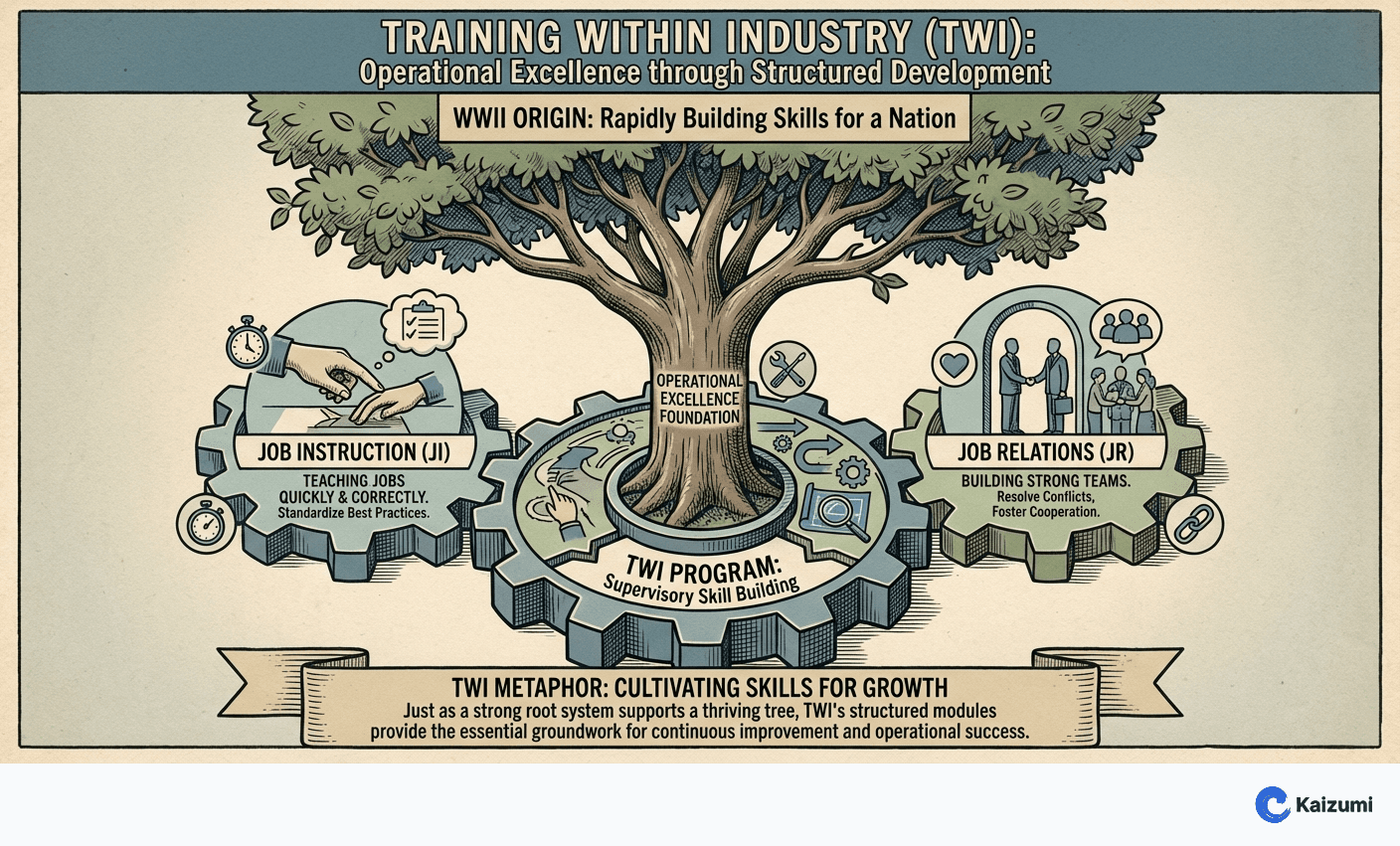
Training Within Industry (TWI) is a structured program for developing supervisory skills, originally created during World War II to rapidly train war production workers. TWI consists of three modules: Job Instruction (JI) for teaching jobs quickly and correctly, Job Methods (JM) for improving how work is done, and Job Relations (JR) for building productive working relationships. The programs use a standardized "4-step method" approach and 10-hour training format. Toyota adopted TWI as a foundation of its production system, and it remains highly relevant today.
Examples
New supervisors completed TWI Job Instruction training. They learned to break jobs into key points, teach using the 4-step method (prepare, present, try out, follow up), and verify learning. Training time for new operators dropped 40%, and new-hire quality defects decreased significantly.
Key Points
- Three modules: Job Instruction, Job Methods, Job Relations
- Job Instruction: Teach jobs quickly and correctly using 4-step method
- Job Methods: Improve work methods systematically
- Job Relations: Build productive working relationships
Common Misconceptions
TWI is outdated 1940s training. The core methods are timeless—structured job breakdown, teaching methodology, improvement questioning. Modern applications update examples while preserving the proven approaches.
TWI is only for manufacturing. TWI principles apply wherever people need to learn jobs, improve methods, or lead others. Healthcare, service, administrative—any work with teachable skills benefits from TWI structure.