
Andon
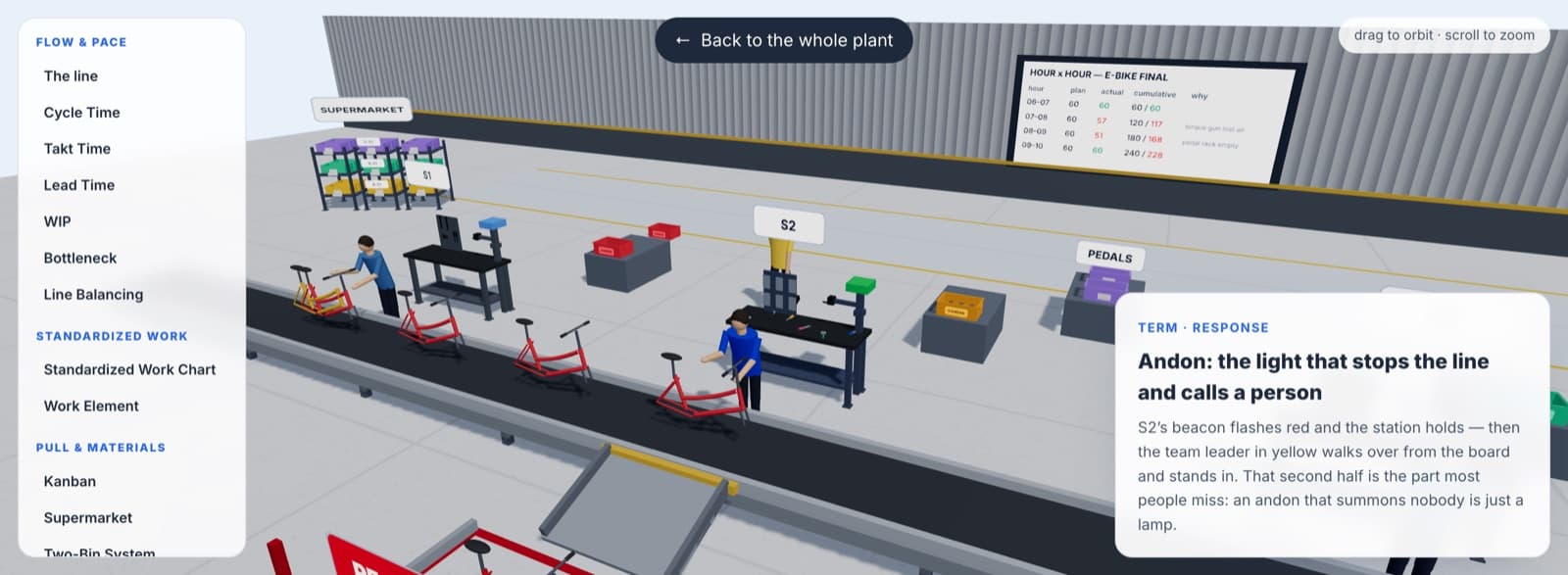
Andon is a visual signaling and response system that alerts team leaders to abnormalities in real time. Originating at Toyota (from the Japanese word for paper lantern), pulling the cord illuminates an amber station beacon and begins a response countdown while the conveyor continues moving. The line halts only if the vehicle reaches the red fixed-position stop line before the issue is resolved.
- Pull the cord
- The operator signals the abnormality without leaving the station. Pulling the cord asks for help; it does not immediately stop the whole line.
- Station 03 turns amber
- The overhead matrix makes the exact problem location visible across the bay and calls the team leader to Station 03.
- The team leader responds
- A dedicated team leader comes to help solve the problem shoulder-to-shoulder with the operator. The signal is useful only because a response is guaranteed.
- The vehicle keeps moving
- During the amber response window, the conveyor continues toward the station boundary. The team has the rest of the cycle to recover the work safely.
- Fixed-position stop line
- If the issue is still open when the vehicle reaches this red threshold, the conveyor stops here. The boundary prevents incomplete work from escaping downstream.
Key facts
- Meaning
- 行灯 — paper lantern, signaling lamp
- Origin
- Toyota Production System · 1950s
- Mechanism
- Pull cord → amber alert → team-leader response
- Takt pace
- 60s station cycle window
- Stop rule
- Halt conveyor only at fixed-position boundary
- Pairs with
- Jidoka, standard work, takt time
By Matthew Savas — Founder of Kaizumi. Reviewed 29 August 2026.
What is andon?
Andon is a visual management tool and real-time signaling system used in lean manufacturing to indicate the operational status of a workstation and alert support staff to abnormalities. The term originates from the traditional Japanese paper lantern (andon, 行灯). In modern production environments, an andon system typically consists of overhead display boards, audible chimes, status lights, and activation mechanisms such as pull cords or buttons accessible to line operators.
The concept is a core element of jidoka (autonomation, or "automation with a human touch"), one of the two foundational pillars of the Toyota Production System. In a jidoka-driven production environment, workers are empowered and required to signal abnormalities immediately rather than letting defective parts pass to subsequent workstations.
How the fixed-position stop mechanism works
A common misconception regarding andon systems is that pulling the activation cord immediately halts the entire production line. In a standard Toyota Production System assembly line, the system operates on a fixed-position stop principle, which coordinates the pacing of the moving conveyor with designated physical zones at each workstation.
When an operator detects an abnormality—such as a defective component, a cross-threaded fastener, or falling behind the station cycle relative to takt time—the operator pulls the overhead cord. This activation initiates three simultaneous actions:
- An overhead status board illuminates a caution signal showing the exact workstation location.
- A distinct, non-jarring chime plays to notify support personnel audibly.
- The conveyor continues moving while a station pacing timer begins counting down a response window.
Workstations operating under this system are physically structured into three progressive boundaries:
- Zone 1: Normal Work Span (0.0 to 2.5 meters). The operator carries out standard cycle work in synchrony with the moving conveyor.
- Zone 2: Response Buffer (2.5 to 4.5 meters). If the cord is pulled within the normal cycle (for example, at 35 seconds into a 60-second cycle), the product enters this buffer zone. The team leader has the remaining window (such as 25 seconds) to reach the station and assist the operator.
- Zone 3: Fixed-Position Stop Line (4.5 meters). This boundary marks the physical end of the workstation's cycle at 60 seconds. If the issue is resolved before the product reaches this line, the system is reset, the caution signal clears, and the conveyor continues without interruption. If the issue remains unresolved when the product reaches the 4.5-meter mark, the line halts automatically at the fixed boundary.
By stopping the line only at defined cycle boundaries, the fixed-position stop system prevents the sudden mid-stroke stoppages that cause ergonomic strain, misaligned tooling, and erratic line balance.
Andon vs. emergency stop systems
An andon pull cord serves a fundamentally different purpose from an emergency stop (E-stop) switch:
- Andon cord: Designed to manage quality, timing, and process abnormalities. It provides a structured response buffer, maintains line flow during problem resolution, and stops the system only at fixed positions when a cycle cannot be completed safely within standard work parameters.
- Emergency stop (E-stop): Designed purely for immediate life safety and mechanical protection. Activating an E-stop cuts power instantly and halts all machinery mid-cycle, leaving components stranded in partial states of completion.
Treating routine process hiccups with emergency stop mechanisms creates operational instability and discourages operators from raising issues. An andon system provides a controlled, predictable method to resolve difficulties without causing unnecessary factory-wide downtime.
The response protocol and organizational culture
The physical signaling hardware is only one half of an andon system; the response protocol and supporting culture constitute the other. A signaling mechanism that does not trigger a rapid, standardized response provides little operational value.
In lean production environments, frontline team leaders do not carry direct assembly quotas. Instead, their primary responsibility is to remain stationed at the gemba near visual control boards and respond rapidly—typically within 15 seconds—whenever a workstation beacon activates.
When a team leader arrives at an active andon station, the intervention follows a standardized sequence:
- Immediate containment: The team leader works shoulder-to-shoulder with the line operator to complete the necessary tasks before the product reaches the fixed-position stop line.
- Signal reset: Once the work is safely completed or contained, the team leader resets the signal, returning the status indicators to normal and keeping the line in continuous motion.
- Root cause analysis: After the shift, team leaders and supervisors review all logged andon events to identify underlying failure modes using methods such as the 5 Whys, preventing recurring issues.
An effective andon culture relies on strict psychological safety. Operators must never face blame, reprimand, or questioning for pulling an andon cord. When pulling the cord carries negative social or professional consequences, workers are incentivized to conceal defects or push incomplete assemblies downstream. In a healthy lean culture, pulling the cord is treated as a responsible act of teamwork that safeguards quality for the end customer.
Frequently asked questions
- How often should an andon cord be pulled on a healthy assembly line?
- In an effective lean plant, andon cords are pulled hundreds or even thousands of times per shift. A line where the andon never lights up is not perfect—it is hiding problems and accumulating defect escapes.
- Why doesn't the line stop the instant the cord is pulled?
- Halting a moving line mid-cycle strands operators in awkward postures and disrupts line balance. The fixed-position stop gives the team leader a full cycle window (e.g., 20–30 seconds) to fix the issue while the line stays in motion.
- Can andon be applied to non-manufacturing environments?
- Yes. In healthcare, andon principles power nurse call escalation and rapid response teams. In software engineering, broken CI/CD pipeline builds and automated alert thresholds act as digital andon cords that halt releases until fixed.