
Jidoka
Jidoka, or autonomation, is the lean manufacturing practice of building quality directly into a production process rather than relying on downstream inspection. As one of the two foundational pillars of the Toyota Production System alongside just-in-time, jidoka empowers machines and operators to detect abnormalities, halt work immediately, signal for assistance, and resolve root causes. By stopping production the moment an error occurs, jidoka prevents defective parts from moving downstream, protects equipment, and separates human labor from machine runtime.
- The broken warp
- One cotton thread breaks. In an ordinary loom, the shuttle could keep weaving the flaw into yards of cloth.
- The drop wire
- Each warp thread holds up a small metal wire. When this thread loses tension, its wire falls—turning a nearly invisible defect into a mechanical signal.
- The trip bar
- The fallen wire touches the moving detector bar. The loom detects the abnormality at the exact place it occurs.
- Motion arrested
- The trip releases the drive. Flywheel, reed, and shuttle stop together—automatically, before another bad pick is woven.
- Quality contained
- The cloth roll holds one visible interruption, not a hidden run of defective fabric. Jidoka makes the process stop and ask for help.
Key facts
- Literal translation
- Automation with human intelligence (自働化)
- Historical origin
- Sakichi Toyoda's Type G automatic loom (1924)
- TPS foundational pillars
- Jidoka and just-in-time
- Four cycle stages
- Detect, stop, signal, solve
- Operational objective
- Separation of human work from machine time
By Matthew Savas — Founder of Kaizumi. Reviewed 20 August 2026.
Jidoka is the lean manufacturing practice of building quality directly into a process rather than relying on downstream inspection. In Japanese, the term is written as 自働化, which translates literally to "automation with human intelligence" or autonomation. Alongside just-in-time production, jidoka forms one of the two foundational pillars of the Toyota Production System. Under a jidoka system, equipment and operators are given the autonomy and mechanical means to detect an abnormality, stop the process immediately, signal for assistance, and solve the root cause so the issue cannot recur. By halting production at the exact moment an error happens, jidoka prevents defective units from flowing to downstream processes, protects production machinery from damage, and exposes hidden process instabilities that would otherwise remain unnoticed in a high-volume environment.
Origins and historical development
The concept of jidoka originated in the Japanese textile industry during the early twentieth century. In 1924, inventor Sakichi Toyoda developed the Type G automatic loom. At the time, conventional power looms continued to run even when a warp or weft thread snapped, weaving flawed fabric until an operator noticed the defect and manually intervened. Toyoda designed a mechanical mechanism consisting of small metal drop wires suspended from each warp thread. If a single thread broke, its corresponding drop wire fell into a rotating gear mechanism, instantly tripping a brake that stopped the loom.
This innovation eliminated the production of defective cloth and radically changed factory economics. A single operator no longer needed to stand beside a running loom to monitor its output. Instead, a single worker could supervise dozens of automated looms simultaneously, stepping in only when a machine stopped and flagged an error. When Sakichi Toyoda's son, Kiichiro Toyoda, founded the Toyota Motor Corporation, and production engineer Taiichi Ohno developed its manufacturing methodology, they adapted this principle from textile weaving to automotive assembly and machining. Within modern lean manufacturing, jidoka applies equally to automated equipment and manual assembly workstations.
The four stages of the jidoka cycle
A complete jidoka cycle consists of four distinct stages:
- Detect the abnormality automatically or manually.
- Stop the process immediately to prevent passing the error forward.
- Signal for assistance and highlight the condition across the work area.
- Solve the root cause of the problem and implement permanent countermeasures.
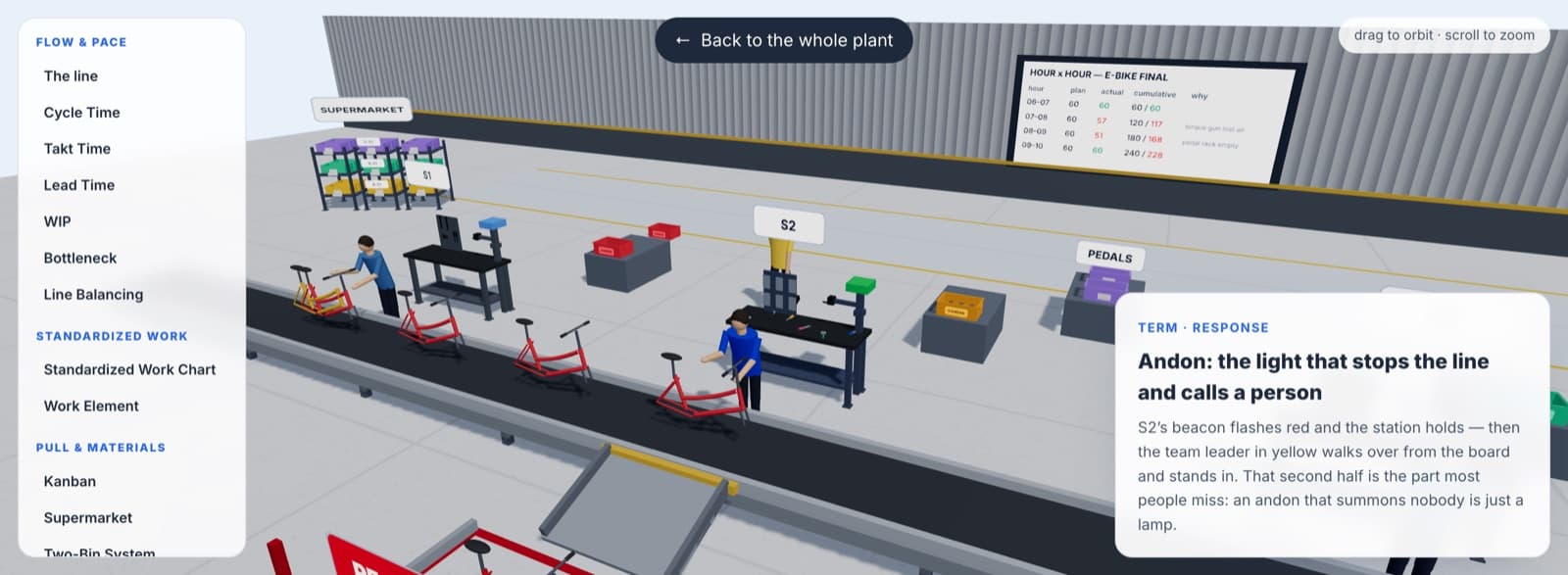
The first stage relies on sensors, limit switches, optical cameras, or vigilant operators to detect non-standard conditions such as dimensional variances, missing parts, abnormal motor torque, or broken tooling. As soon as the detection mechanism trips, the second stage is triggered: the machine halts or the operator pauses the assembly process. Operating under the strict rule to not make, accept, or pass a defect, the line refuses to produce another unit until the abnormal condition is understood.
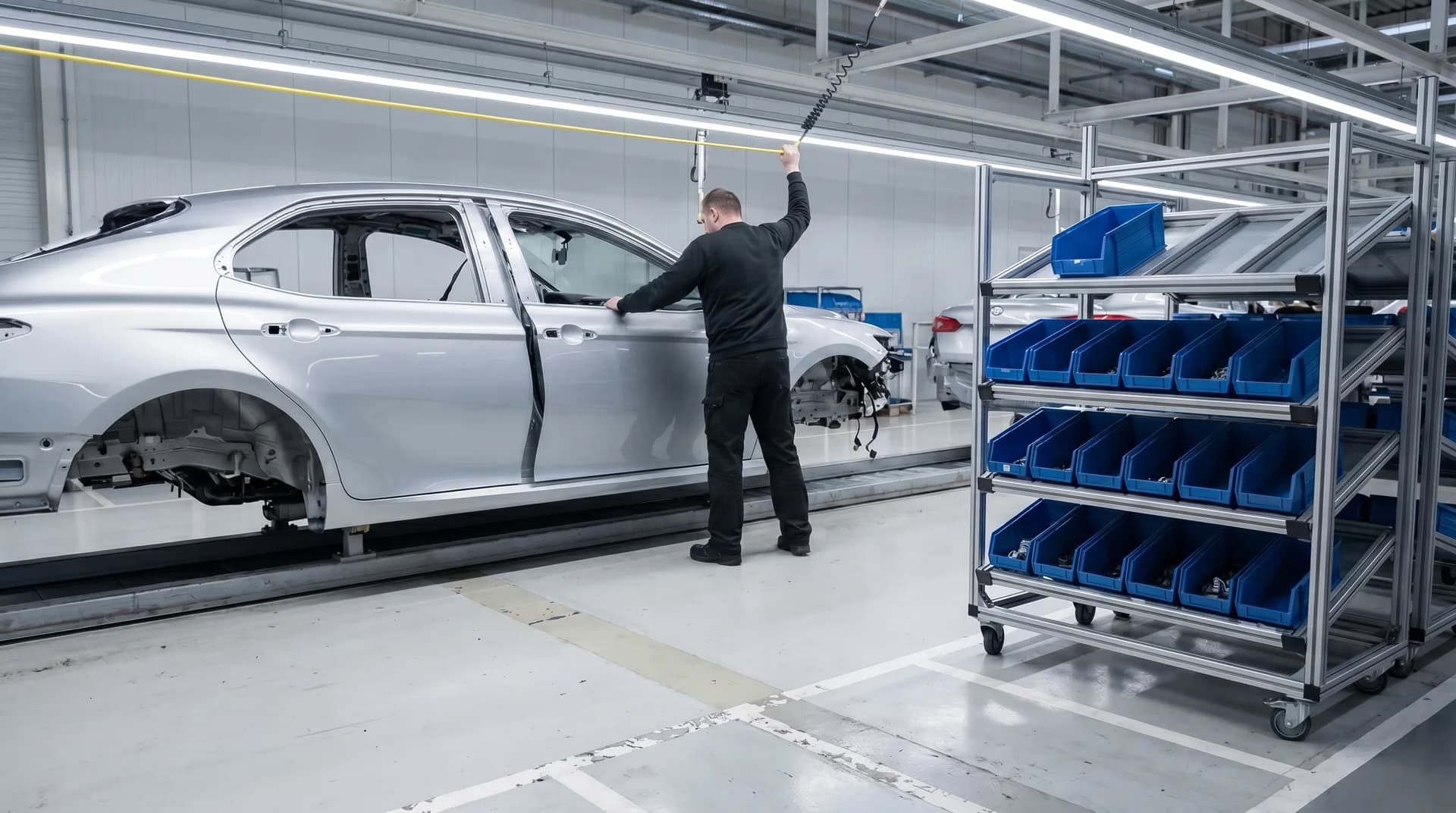
The third stage communicates the stoppage to team leaders and maintenance personnel. In manual environments, this is frequently managed through an andon board, audible chime, or warning light triggered by the operator pulling a cord.
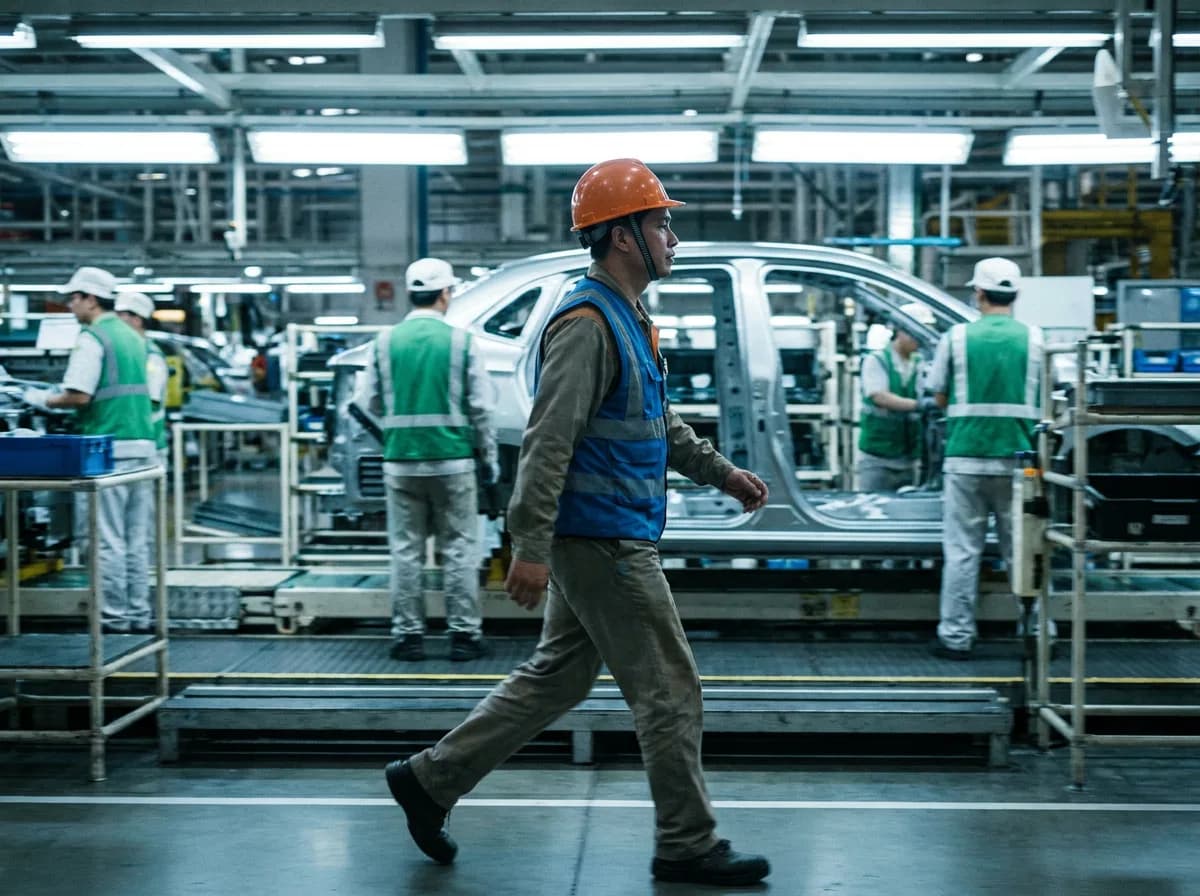
The final stage is problem-solving. A stoppage under jidoka is treated not as an operational failure, but as an opportunity to improve. Team leaders and engineers inspect the stopped process immediately, analyze the root cause using methods such as the five whys, and introduce physical or procedural countermeasures to guarantee the failure mode never repeats. To understand how operators communicate these stoppages, read Andon: the call for help.
Separation of human and machine work
A primary operational objective of jidoka is the separation of human work from machine processing time. A hanedashi, an auto-eject device that pushes the finished part clear when the cycle ends, is one of the mechanisms that makes the separation possible. In traditional manufacturing setups without autonomation, human operators are tied directly to machines. They load raw materials, press a start button, watch the machine perform its cycle to ensure it does not jam or produce scrap, unload the finished piece, and manually inspect the dimensions. The time spent watching a properly running machine represents pure waste.
This separation transforms the operator's workflow:
- The operator loads the raw part into the fixture and engages the cycle.
- The machine clamps the part, verifies orientation, begins the automated operation, and unclamps the part upon successful completion.
- The operator departs immediately to load or unload the next machine in the cell.
- The machine monitors its own cutting forces, dimensions, and tool integrity, halting autonomously only if an abnormality is detected.
Consider a work cell where an automated machining process takes 90 seconds, while human loading, unloading, and inspection take 25 seconds. If the operator must watch the machine cycle, they spend 65 seconds waiting during every cycle, resulting in one finished unit every 90 seconds.
With jidoka mechanisms installed, that same operator can manage a sequence of 4 machines arranged in a U-shaped layout. The operator spends 25 seconds servicing the first machine, moves to the second, continues to the third, and tends to the fourth. By the time they return to the first machine, its 90-second cycle is complete, the part has passed internal quality checks, and the machine is ready for unloading. Decoupling machine runtime from labor enables high-efficiency one-piece flow cells, significantly reducing cycle time and labor costs without increasing line speeds. To explore how this structure outperforms traditional manufacturing, see Batch versus one-piece flow. Plant supervisors can evaluate cell productivity and uptime using an OEE calculator.
Error-proofing and defect containment
Jidoka depends heavily on poka-yoke, or mistakeproofing mechanisms, to catch mistakes before they turn into defects. These devices act as physical, electrical, or optical gates within the workstation. A poka-yoke device may be a guide pin that prevents a bracket from being loaded backward, a photo-eye that verifies an operator reached into the correct parts bin, or a torque-controlled nutrunner that refuses to release until a bolt reaches its target tension. Practical industrial examples of these devices are detailed in Poka-yoke in manufacturing.
By incorporating detection directly into the tool or fixture, jidoka ensures that defects are contained at the point of creation. In high-mix assembly environments, establishing standardized handling protocols is critical for keeping error rates low; teams often implement this through standard work principles and guidelines found in Standardized work in manufacturing. When non-conformances do occur, engineers use structured methods to categorize the failure mode, as outlined in How to classify a defect.
The economic impact of early defect detection
The financial justification for jidoka rests on the steep cost escalation of defects discovered downstream. A fault caught at source by the machine affects a single part, whereas a fault caught later at final inspection leaves forty parts already made and evidence that has gone cold.
If a drill bit breaks during a boring operation:
- Detected at the station by the machine: The machine senses spindle resistance drop, halts instantly, and illuminates a warning signal. The fault affects 1 part.
- Detected at the downstream assembly station: The broken tool goes unnoticed at the drill station, and parts continue to travel down the line until an assembly worker discovers that a pin will not seat in the unbored hole. In the time taken to transfer parts, 8 parts have been completed.
- Detected at final quality inspection: The batch moves through drilling, washing, deburring, heat treatment, subassembly, and final testing. By the time the batch reaches end-of-line verification, 40 parts have been manufactured and packed into storage containers.
Catching the broken drill bit after 40 parts requires quarantining warehouse inventory, disassembling finished units, scrapping heat-treated assemblies, and conducting extensive investigations to guess when the tool broke. In contrast, catching the failure at part 1 keeps the physical evidence intact on the drill table, isolates the rework to a single casting, and allows maintenance to fix the spindle runout immediately.
Preventing batch contamination improves first-pass yield across the factory. Quality teams can monitor the stability of automated detection systems using a Control chart builder and verify tolerance limits with a Process capability calculator.
Integrating jidoka with continuous improvement
Stopping an entire assembly line or high-speed machining center appears counterintuitive to traditional plant managers focused solely on machine utilization metrics. In mass production environments, workers are routinely incentivized to bypass minor machine faults, set aside questionable parts for later rework, and keep the line running at all costs.
Jidoka rejects this philosophy. Under lean manufacturing, running a defective process is considered worse than shutting down production. Running with defects creates hidden inventories of defective stock, obscures the real health of the equipment, and desensitizes workers to abnormalities. When a line stops under jidoka, the problem becomes visible to the entire plant floor. Management is forced to allocate resources to fix the underlying mechanical, material, or design flaw immediately. Over time, as each root cause is addressed with foolproof countermeasures, line stoppages decrease, overall line efficiency rises, and product quality becomes an inherent feature of the process rather than a probabilistic outcome of inspection.
Frequently asked questions
- Who invented jidoka and what was its original application?
- Sakichi Toyoda originated the concept in 1924 by developing the Type G automatic loom. He designed mechanical drop wires suspended from warp threads that dropped into a gear mechanism and tripped a brake if a thread broke. This stopped the loom instantly before it could weave flawed fabric, allowing a single worker to oversee dozens of running machines instead of monitoring just one.
- What are the four steps of the jidoka cycle?
- The jidoka cycle begins when a machine sensor or human operator detects an operational abnormality. Production halts immediately at the workstation to prevent the defect from moving downstream. The system signals team leaders for assistance across the floor, and responders identify the root cause to implement permanent countermeasures that prevent recurrence.
- How does jidoka separate human labor from machine processing time?
- In conventional operations, workers must stand beside running equipment to watch for jams and manually inspect parts. Jidoka equips machinery with automated self-monitoring tools and hanedashi ejector devices so the machine can run and unload independently. Operators only intervene when equipment halts for an abnormality, freeing them to manage multiple workstations across a manufacturing cell.
- What is the relationship between jidoka and poka-yoke?
- Jidoka represents the overall operating philosophy of stopping a process immediately to contain defects and address root causes. Poka-yoke devices are the specific mistake-proofing mechanisms—such as guide pins, photoelectric sensors, and torque limits—installed at workstations to detect those errors. Jidoka relies on poka-yoke devices to automatically trigger process stoppages at the exact moment a mistake occurs.
- Why does jidoka require halting production instead of sorting defects later?
- Allowing a defective line to run multiplies scrap downstream, hides machine wear, and destroys the physical evidence needed to diagnose the failure. Stopping immediately isolates the issue to a single piece rather than contaminating entire production batches. It forces management and engineering to fix the mechanical or procedural root cause on the spot before resuming operations.