
Black Belt
Personalize This
Get insights for your role
A Black Belt is a full-time Six Sigma practitioner who leads complex improvement projects and mentors Green Belts.
Definition
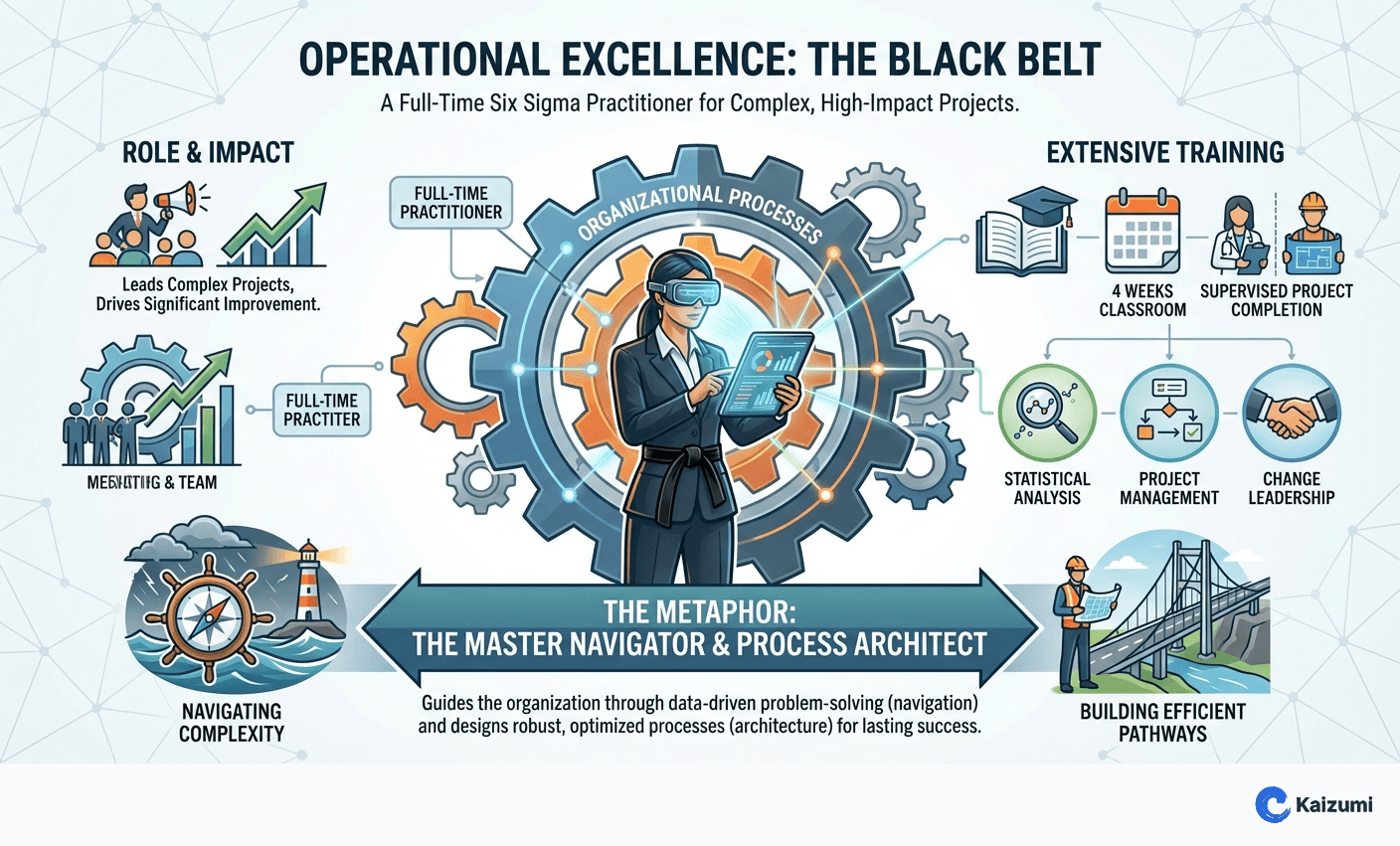
A Black Belt is a full-time Six Sigma practitioner who leads complex, high-impact improvement projects. Black Belts receive extensive training in statistical analysis, project management, and change leadership—typically four weeks of classroom instruction plus supervised project completion. They serve as project leaders for DMAIC initiatives, mentors to Green Belts, and internal consultants on statistical methods. Most organizations expect Black Belts to complete 2-4 projects annually, each delivering significant financial or quality benefits.
Examples
A Black Belt led a project to reduce scrap in a stamping operation. Using design of experiments, she identified optimal press settings that reduced scrap from 4.2% to 0.8%. The project saved $1.2 million annually and became a model for other plants. She then mentored three Green Belts on similar projects.
Key Points
- Black Belts typically dedicate 100% of their time to Six Sigma projects
- Training covers statistical tools, DMAIC methodology, and change management
- Expected to deliver $500K-$1M+ in annual project savings
- Serve as mentors and coaches to Green Belt project leaders
Common Misconceptions
Black Belt certification guarantees project success. Certification confirms training completion, not competence. Effective Black Belts combine statistical skills with business acumen, stakeholder management, and implementation ability. Training is necessary but not sufficient.
Black Belts work alone on projects. Black Belts lead cross-functional teams and depend heavily on subject matter experts, process owners, and sponsors. Their role is to bring methodology and analytical rigor, not to be the expert on the process being improved.