
Constraint
Personalize This
Get insights for your role
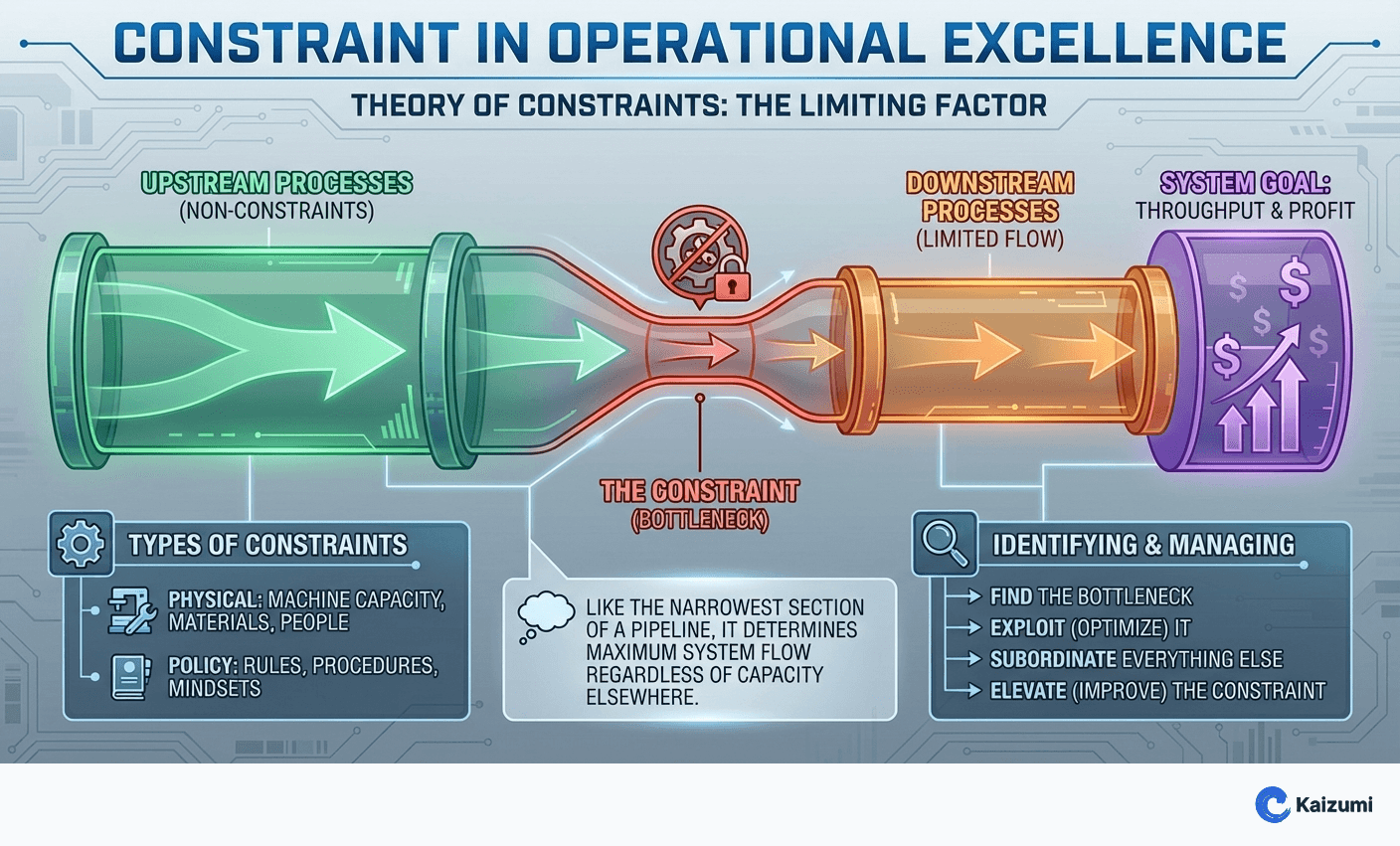
A constraint is the single factor that most limits a system's ability to achieve its goal, determining overall throughput.
Definition
In Theory of Constraints, a constraint is the factor that most limits a system's ability to achieve its goal—typically throughput or profit. Like the narrowest section of a pipeline, the constraint determines maximum system flow regardless of capacity elsewhere. Constraints can be physical (machine capacity, material availability) or policy (rules, measurements, behaviors). Identifying the true constraint—not just any problem—is essential because improving anything else yields no system benefit while the constraint remains unchanged.
Examples
A plant manager assumed purchasing was the constraint because materials often arrived late. TOC analysis revealed the real constraint was a heat treatment operation—material delays only mattered because heat treatment had no protective buffer. With proper buffer, material timing became irrelevant.
Key Points
- The constraint determines maximum system output
- Only one constraint limits the system at any time
- Constraints can be physical (resources) or policy (rules, behaviors)
- Improving non-constraints doesn't improve system performance
Common Misconceptions
Any bottleneck is a constraint. Resources with less capacity than demand are capacity-constrained but may not be the system constraint. Only the resource that actually limits system throughput right now is the constraint.
Constraints are always bad. Every system has a constraint—that's physics. The goal is to choose where the constraint should be (ideally where you have most control) and manage it effectively, not eliminate the concept of constraints.