
Five Focusing Steps
Personalize This
Get insights for your role
The Five Focusing Steps are TOC's continuous improvement cycle: Identify the constraint, Exploit it, Subordinate to it, Elevate it, and Repeat.
Definition
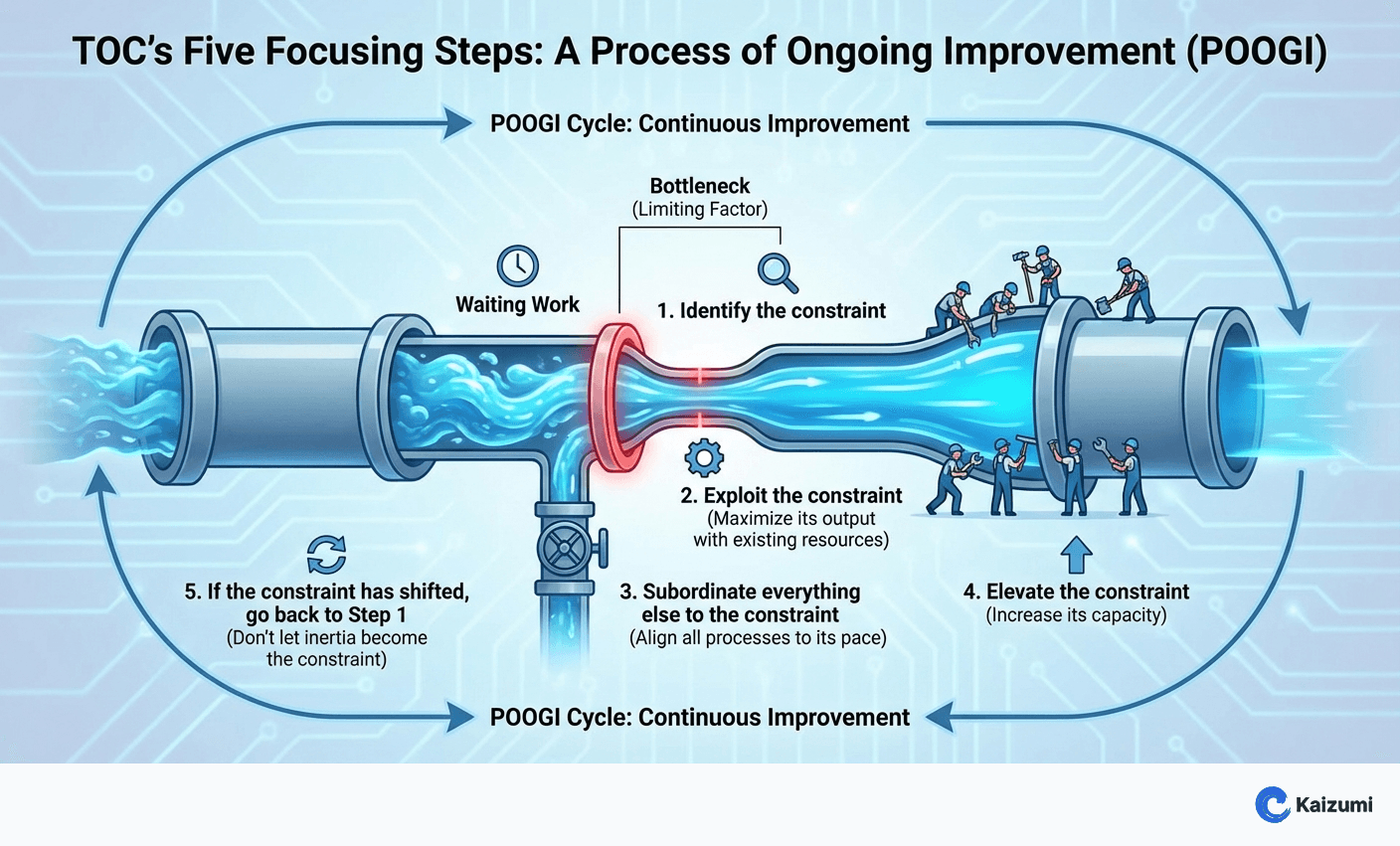
The Five Focusing Steps are TOC's Process of Ongoing Improvement (POOGI), providing a systematic approach to managing system constraints. Step 1: Identify the constraint. Step 2: Exploit the constraint (maximize its output with existing resources). Step 3: Subordinate everything else to the constraint (align non-constraints to support constraint performance). Step 4: Elevate the constraint (invest to increase capacity if still limiting). Step 5: If the constraint has moved, return to Step 1—don't let inertia become the new constraint.
Examples
Step 1: Heat treatment identified as constraint. Step 2: Exploit—reduced changeovers, staggered lunches, preventive maintenance during low demand. Step 3: Subordinate—scheduled upstream work to match heat treatment needs. Step 4: Elevate—purchased second furnace when exploitation was maximized. Step 5: Assembly became the new constraint—restart the process.
Key Points
- Step 1: Identify—find the system constraint (not just any problem)
- Step 2: Exploit—get maximum output from existing constraint capacity
- Step 3: Subordinate—align non-constraints to support the constraint
- Step 4: Elevate—add capacity only after exploitation is maximized
- Step 5: Repeat—don't let inertia become the constraint
Common Misconceptions
Jump straight to Elevate (adding capacity). Most constraints are poorly exploited—20-50% of capacity may be recoverable through better utilization before any capital investment. Skipping Exploit and Subordinate wastes money.
Subordinate means slow down non-constraints. Subordinate means aligning non-constraint behavior to support the constraint—which might mean speeding up, maintaining buffers, or changing priorities. It's not about slowing everything to match.