
Constraint Management
Personalize This
Get insights for your role
Constraint management focuses improvement on the system bottleneck to maximize throughput with minimal investment.
Definition
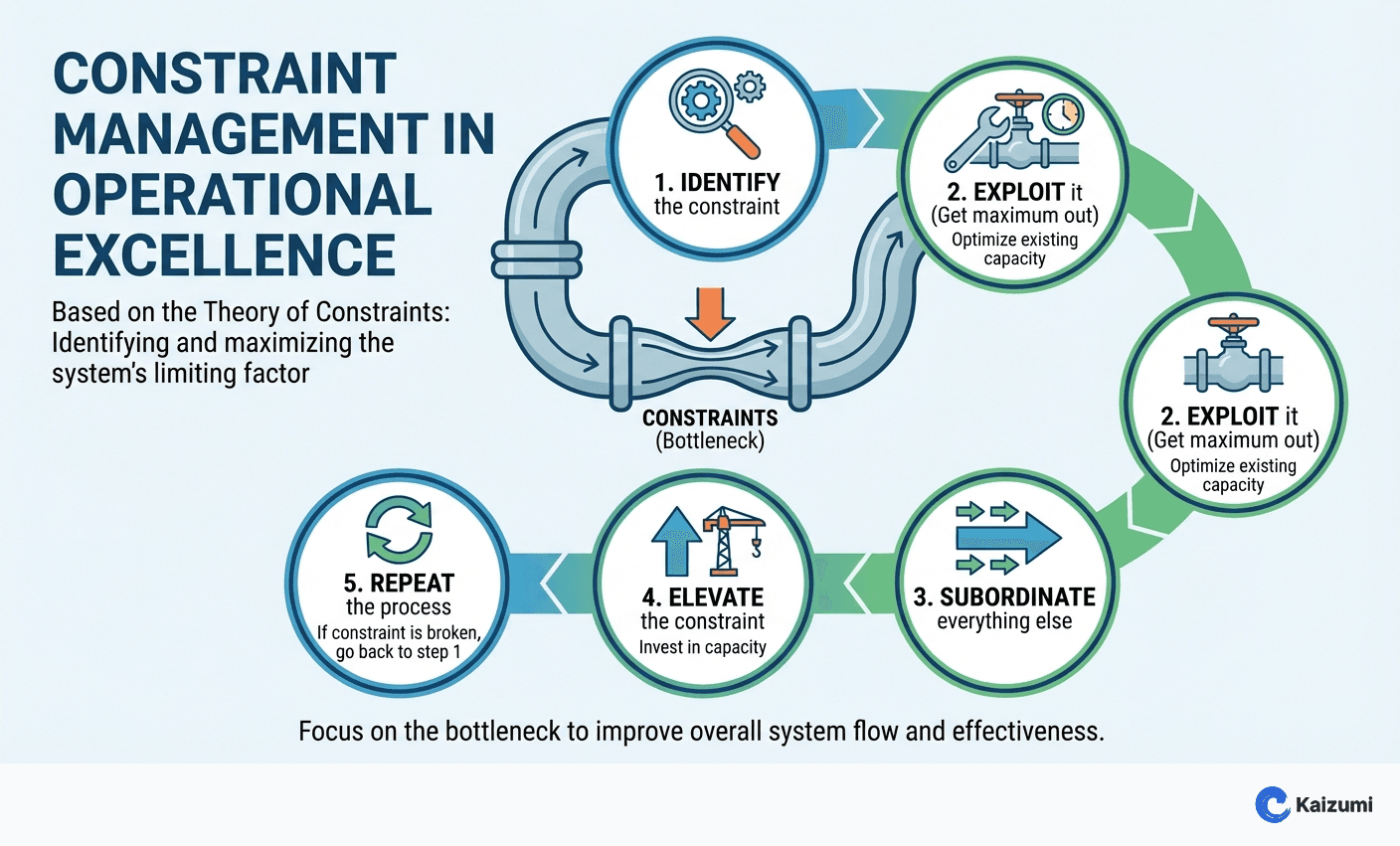
Constraint management is the practice of identifying the system bottleneck (constraint) and managing operations to maximize that constraint's effectiveness. Drawing from the Theory of Constraints, constraint management follows five focusing steps: identify the constraint, exploit it (get maximum output from current capacity), subordinate other resources (pace non-constraints to the constraint), elevate if necessary (add constraint capacity), and repeat when the constraint shifts. This focus prevents the common mistake of optimizing everywhere while the true bottleneck limits system performance.
Examples
An expensive CNC machine is the constraint. Constraint management ensures it never waits for materials (subordination), runs through breaks (exploitation), has preventive maintenance to prevent downtime (protection), and receives investment when more capacity is truly needed (elevation).
Key Points
- Focus on the constraint—improvements elsewhere don't increase system output
- Exploit current constraint capacity before adding more
- Other resources subordinate to the constraint's pace
- When the constraint is elevated, a new constraint emerges—repeat the process
Common Misconceptions
Every resource should be fully utilized. Non-constraints should have spare capacity to support the constraint. Full utilization everywhere creates queues and problems without increasing output.
Constraint management is only for bottleneck equipment. Constraints can be policies, skills, market demand, or supplier capacity—not just equipment. Constraint thinking applies to any limiting factor.