
Current Reality Tree
Personalize This
Get insights for your role
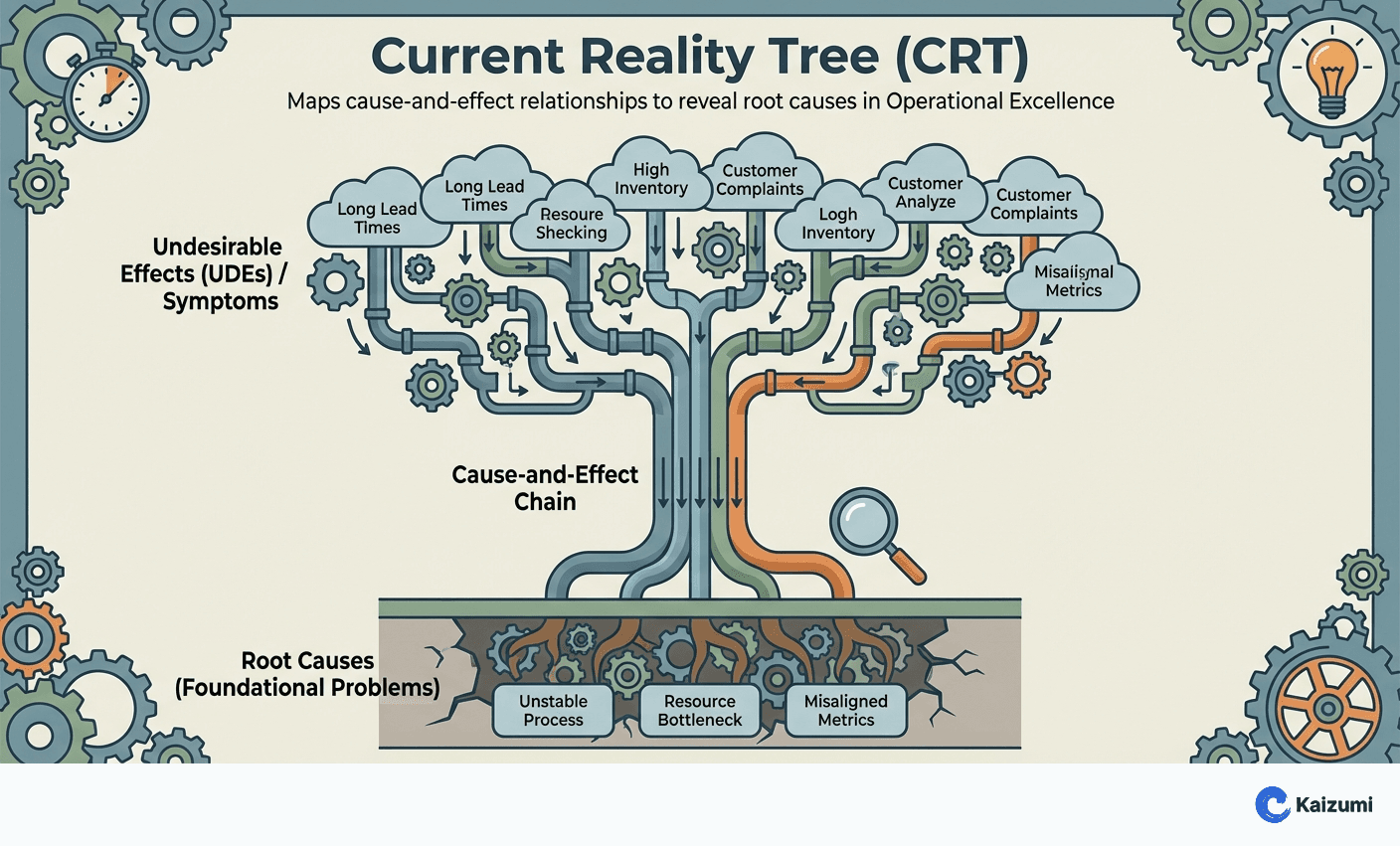
The Current Reality Tree is a TOC logic diagram that maps cause-and-effect relationships to identify core problems underlying multiple symptoms.
Definition
The Current Reality Tree (CRT) is a TOC thinking tool that maps the cause-and-effect relationships underlying current undesirable effects (UDEs). Starting with observed problems (symptoms), the CRT traces causal chains downward to reveal root causes. When multiple symptom chains converge on a single factor, that's likely the core problem—the one change that would relieve multiple symptoms. The CRT answers "What to change?" by revealing the leverage point hidden beneath surface problems.
Examples
A plant had multiple UDEs: late deliveries, high overtime, excess inventory, quality issues, and stressed employees. The CRT revealed all traced to one core problem: using machine utilization as the primary metric. This drove overproduction, which caused everything else. Changing the metric was the leverage point.
Key Points
- Maps cause-and-effect relationships from symptoms to root causes
- Undesirable Effects (UDEs) are symptoms; core problem is the leverage point
- Convergence of multiple chains suggests core problem location
- Uses Categories of Legitimate Reservation to validate logic
Common Misconceptions
The longest chain leads to the core problem. Chain length doesn't indicate importance. The core problem is where multiple significant chains converge—the factor that, if changed, would relieve multiple symptoms. It might be found after few steps or many.
Every UDE must connect to the core problem. Most significant UDEs should connect, but some symptoms may have independent causes. The goal is finding the highest-leverage change, not creating a diagram that connects everything artificially.