
Thinking Processes
Personalize This
Get insights for your role
Thinking Processes are TOC logic tools for analyzing complex situations, identifying root causes, and developing effective solutions.
Definition
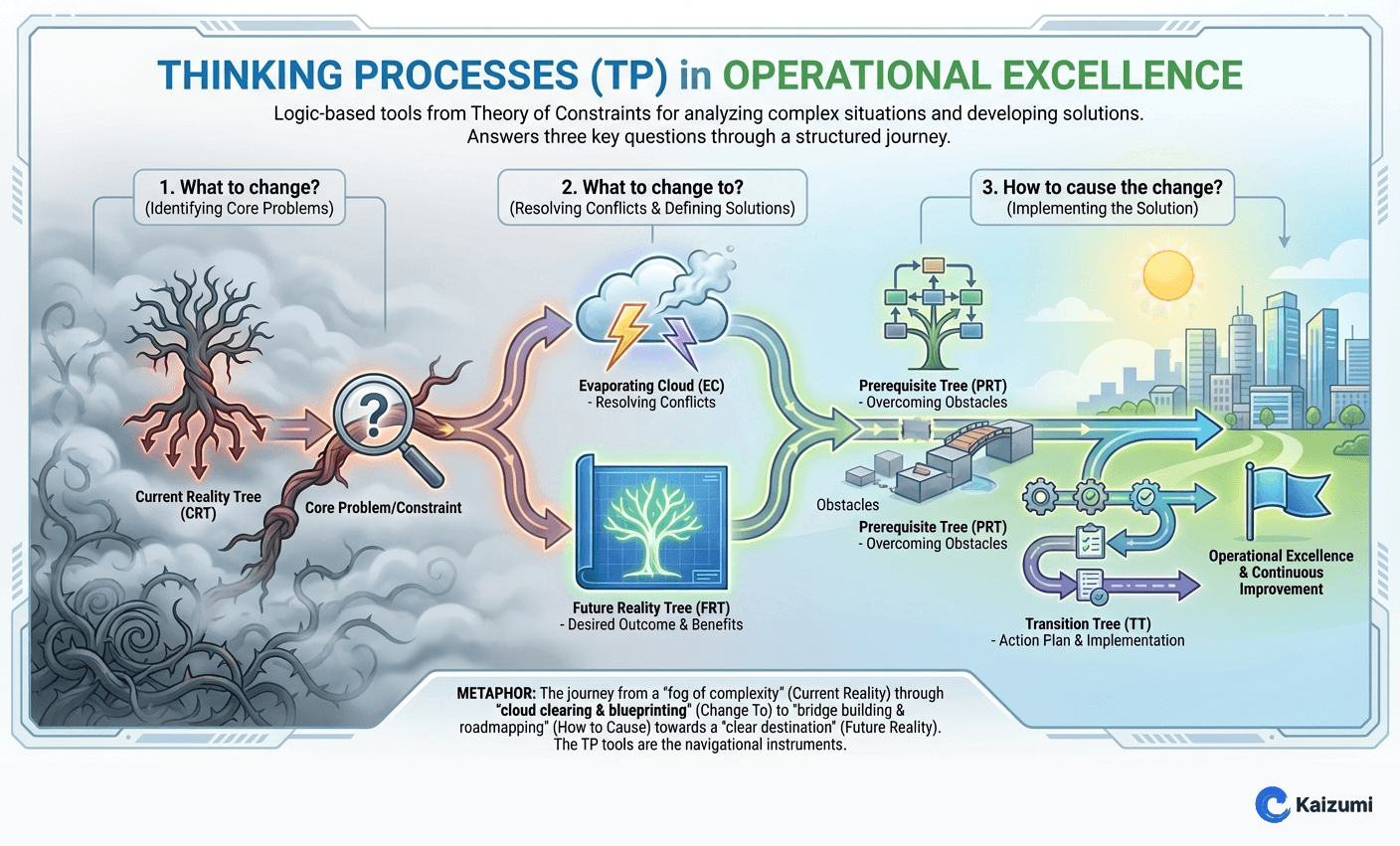
The Thinking Processes (TP) are a set of logic-based tools from Theory of Constraints for analyzing complex situations and developing solutions. They answer three questions: What to change? (Current Reality Tree identifies core problems), What to change to? (Evaporating Cloud resolves conflicts; Future Reality Tree validates solutions), and How to cause the change? (Prerequisite and Transition Trees plan implementation). The TP use cause-and-effect logic with specific validity checks to ensure rigorous analysis.
Examples
A plant struggled with both inventory costs and delivery performance—seemingly in conflict. The Evaporating Cloud revealed an underlying assumption: "we must batch to be efficient." Challenging this assumption led to single-piece flow solutions that improved both metrics simultaneously.
Key Points
- Current Reality Tree: identifies core problems causing multiple symptoms
- Evaporating Cloud: surfaces hidden assumptions behind conflicts
- Future Reality Tree: validates that proposed solutions actually work
- Prerequisite/Transition Trees: plan implementation sequence
Common Misconceptions
Thinking Processes are just for strategy. While powerful for strategic analysis, TP tools apply to any complex problem—operational issues, conflicts, change management. The logic structure works at any scale.
TP diagrams must be complex. Effective TP analysis reaches clarity, not complexity. A clear Evaporating Cloud might fit on a napkin. Complexity in diagrams often indicates muddled thinking rather than thorough analysis.