
DOE
Personalize This
Get insights for your role
DOE (Design of Experiments) is a statistical method for systematically testing multiple factors simultaneously to determine their effects on outcomes.
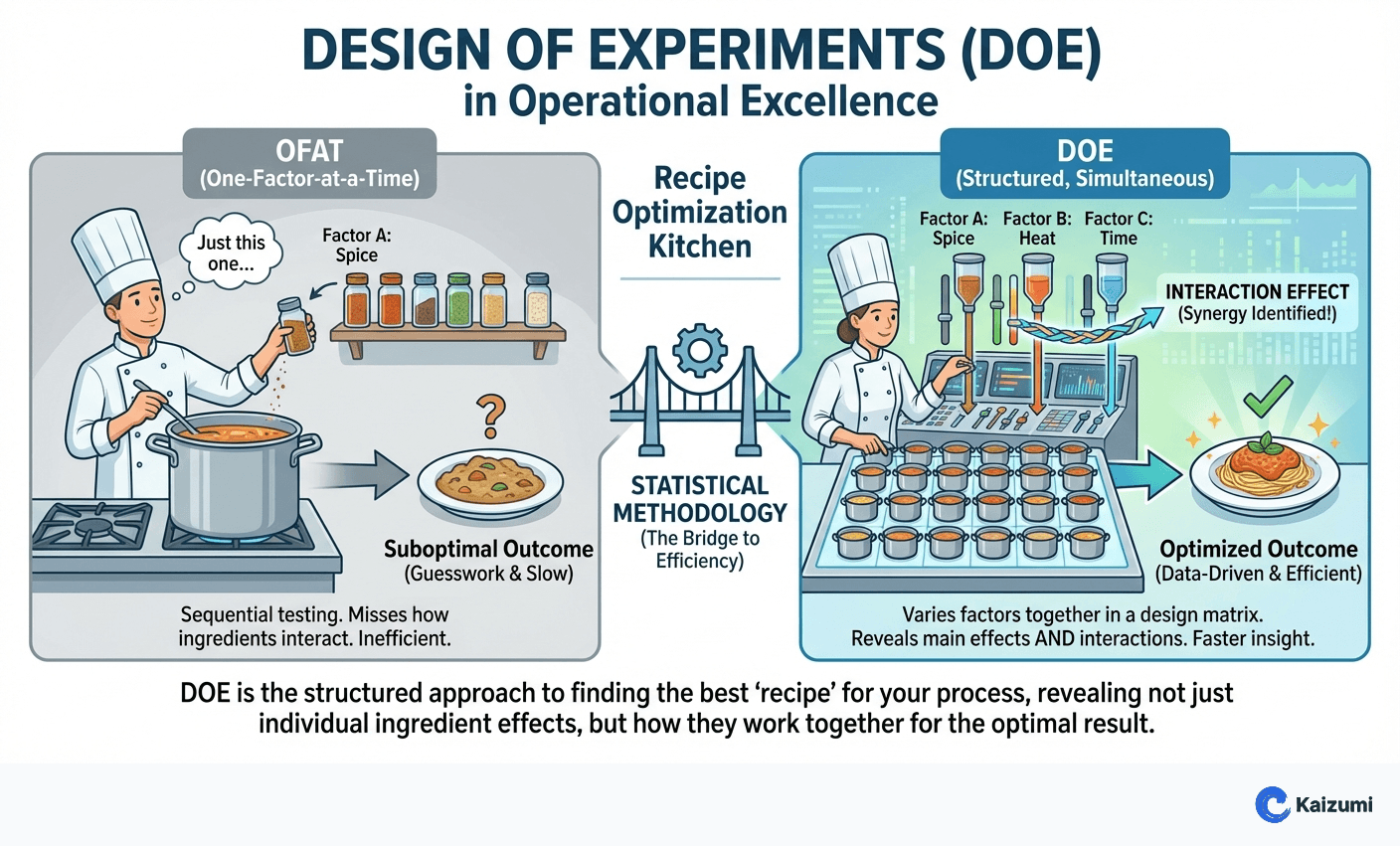
Definition
Design of Experiments (DOE) is a statistical methodology for efficiently determining how multiple input factors affect an output. Rather than testing one factor at a time (OFAT), DOE varies multiple factors simultaneously using structured experimental designs. This approach reveals not only main effects but also interactions between factors—insights impossible to obtain from one-factor-at-a-time testing. DOE dramatically reduces the number of experiments needed while providing more comprehensive understanding of process behavior.
Examples
An injection molding process had inconsistent part quality. Traditional troubleshooting tested temperature, pressure, and cycle time one at a time without improvement. A DOE testing all three factors simultaneously in 8 runs revealed a strong interaction: optimal settings depended on the combination, not individual factors. The result reduced defects by 90%.
Key Points
- DOE tests multiple factors simultaneously, revealing interactions
- Factorial designs provide complete information; fractional factorials offer efficiency
- Response Surface Methodology (RSM) optimizes continuous factors
- Proper randomization and replication are essential for valid conclusions
Common Misconceptions
DOE requires huge sample sizes. Well-designed experiments can provide significant insights with modest runs. A full factorial with 3 factors at 2 levels requires only 8 runs. Fractional factorials reduce this further when interactions are less critical.
DOE is only for manufacturing. Any process with controllable inputs and measurable outputs benefits from DOE—service processes, software testing, marketing campaigns. The challenge is often defining measurable outputs, not the methodology itself.