
Improvement Kata
Personalize This
Get insights for your role
The Improvement Kata is a four-step practice routine for developing scientific thinking and systematic problem-solving skills.
Definition
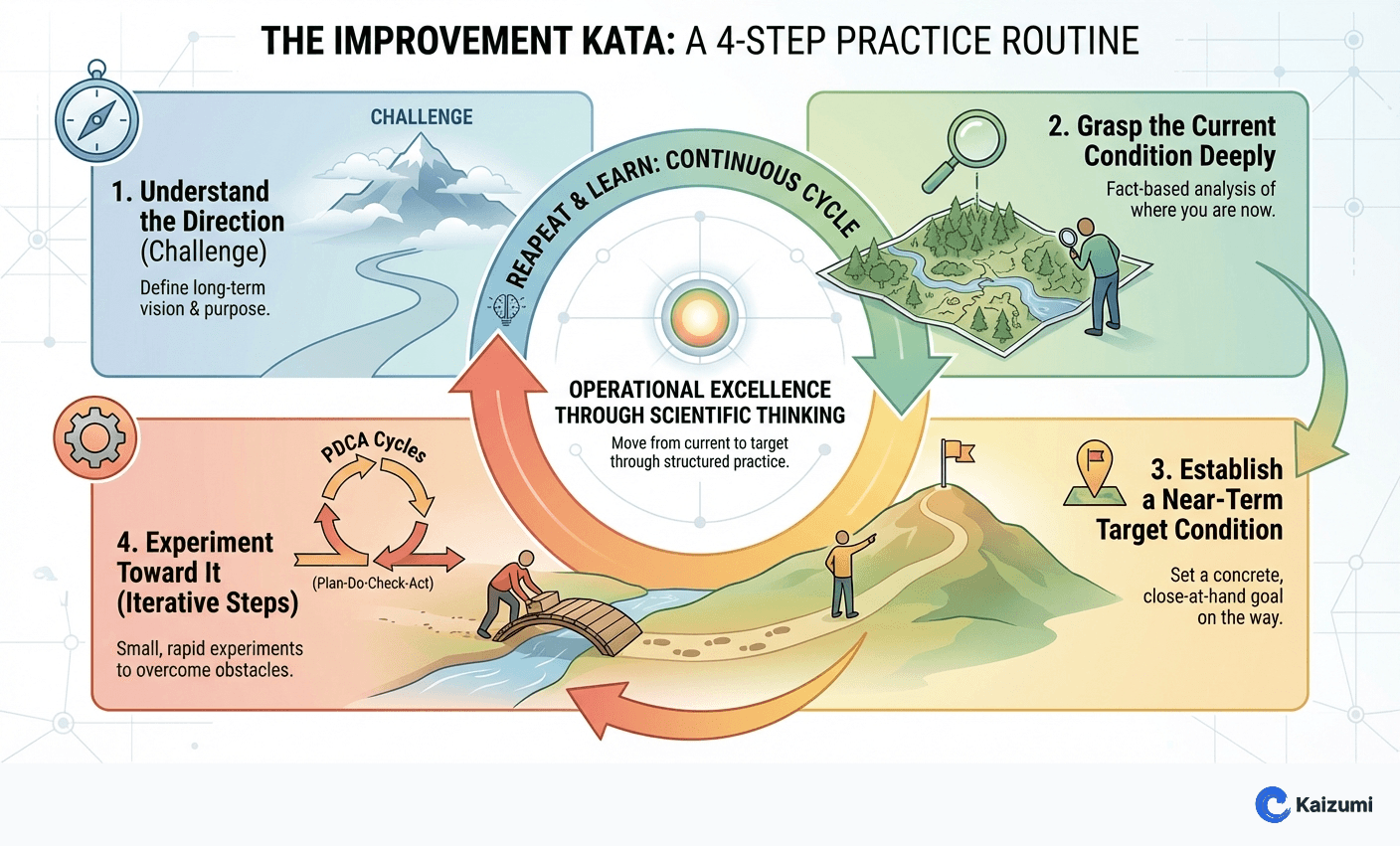
The Improvement Kata is a four-step practice routine for moving from current condition toward a target condition through experimentation. Step 1: Understand the direction (challenge). Step 2: Grasp the current condition deeply. Step 3: Establish a near-term target condition. Step 4: Experiment toward the target, learning from each cycle. The pattern builds scientific thinking habits through deliberate practice—like scales for musicians. Developed by Mike Rother from studying Toyota, the Improvement Kata makes improvement capability teachable.
Examples
A team used Improvement Kata to reduce changeover time. Direction: support mixed-model production. Current condition: 45-minute changeovers (deeply analyzed). Target condition: 15-minute changeovers within 90 days. Experiments: external setup conversion, standardized sequences, quick-connect fixtures. Daily cycles of try-measure-learn achieved the target.
Key Points
- Four steps: Understand direction, grasp current condition, establish target condition, experiment
- Target conditions are specific, measurable, near-term (1-4 weeks)
- Progress through rapid experiments, not giant leaps
- Practice builds scientific thinking habits
Common Misconceptions
Improvement Kata is another problem-solving method. It's a practice routine that builds thinking capability. The goal isn't just solving today's problem—it's developing the skill to solve any problem. The routine, practiced repeatedly, creates habits.
Target conditions should be safe and achievable. Target conditions should stretch—they should be uncertain whether you can achieve them. Easy targets don't build capability. The practice of working through obstacles builds skill.