
Coaching Kata
Personalize This
Get insights for your role
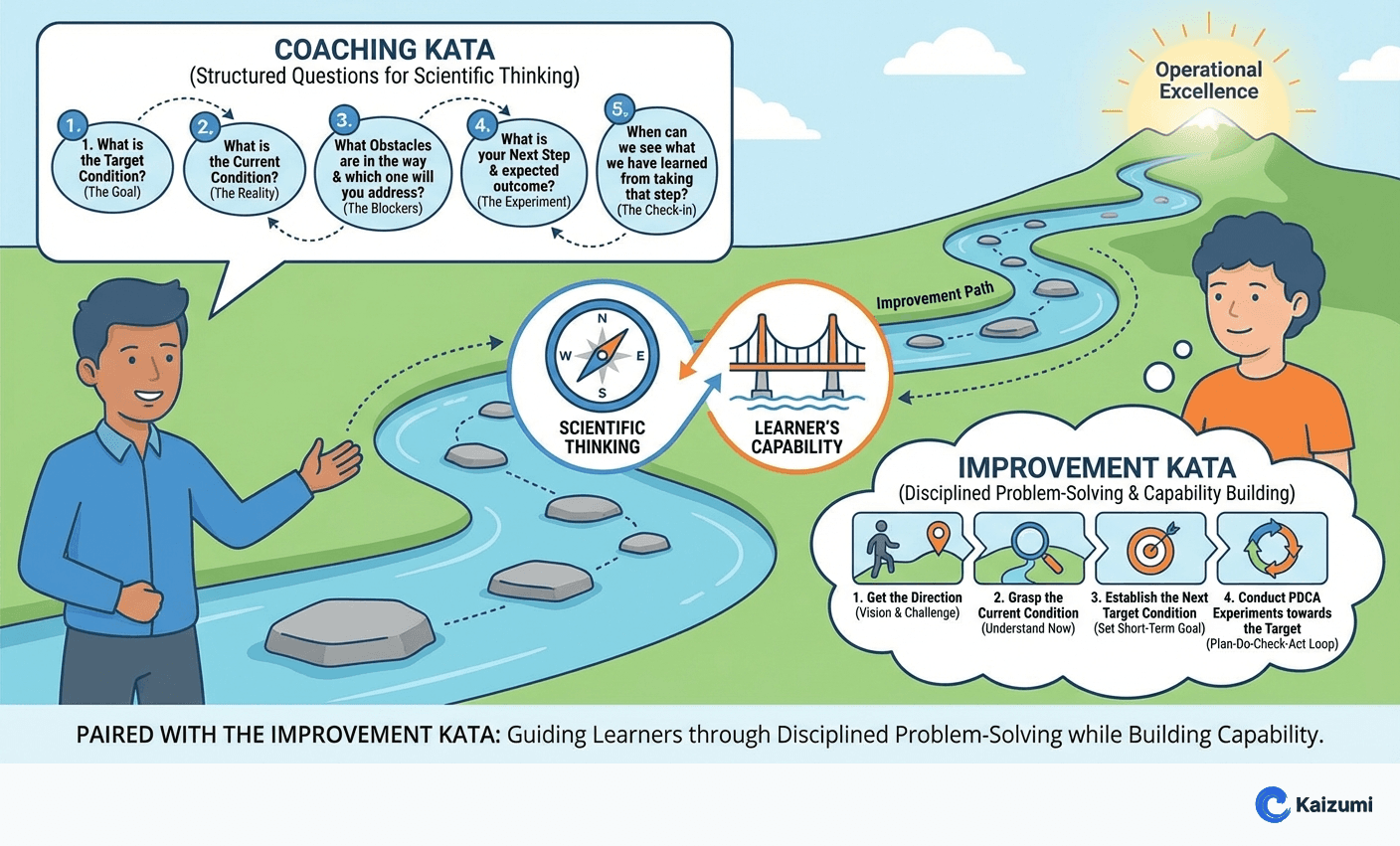
The Coaching Kata is a structured pattern of questions that develops scientific thinking in others through guided practice.
Definition
The Coaching Kata is a structured pattern of five questions that coaches use to develop scientific thinking in others. Paired with the Improvement Kata, it guides learners through disciplined problem-solving while building their capability. The questions follow the learner's progress: What is the target condition? What is the actual condition? What obstacles are preventing progress? What is your next step? When can we see what we learned? Through repeated practice, learners internalize scientific thinking habits.
Examples
A supervisor coached a team lead daily at the improvement board. "What's your target condition?" "95% first-pass yield by month end." "What's actual now?" "88%." "What obstacles are you working on?" "Operator technique variation." "What's your next experiment?" "Standardized training with practice station." "When can we check results?" "Friday's quality report." The five-minute daily cycle built the team lead's capability.
Key Points
- Five questions: Target condition? Actual condition? Obstacles? Next step? When to check?
- Daily or frequent cycles for rapid learning
- Develops scientific thinking through practice, not instruction
- Coach's job is asking questions, not providing answers
Common Misconceptions
The five questions are just a checklist. The questions are a thinking pattern to internalize, not a form to complete. Effective coaching adapts questions to the learner's development while maintaining the underlying pattern.
Coaching Kata is for novices only. The pattern works at all levels—executives coach directors, directors coach managers. The discipline of asking questions rather than giving answers requires ongoing practice.