
Ishikawa Diagram
Personalize This
Get insights for your role
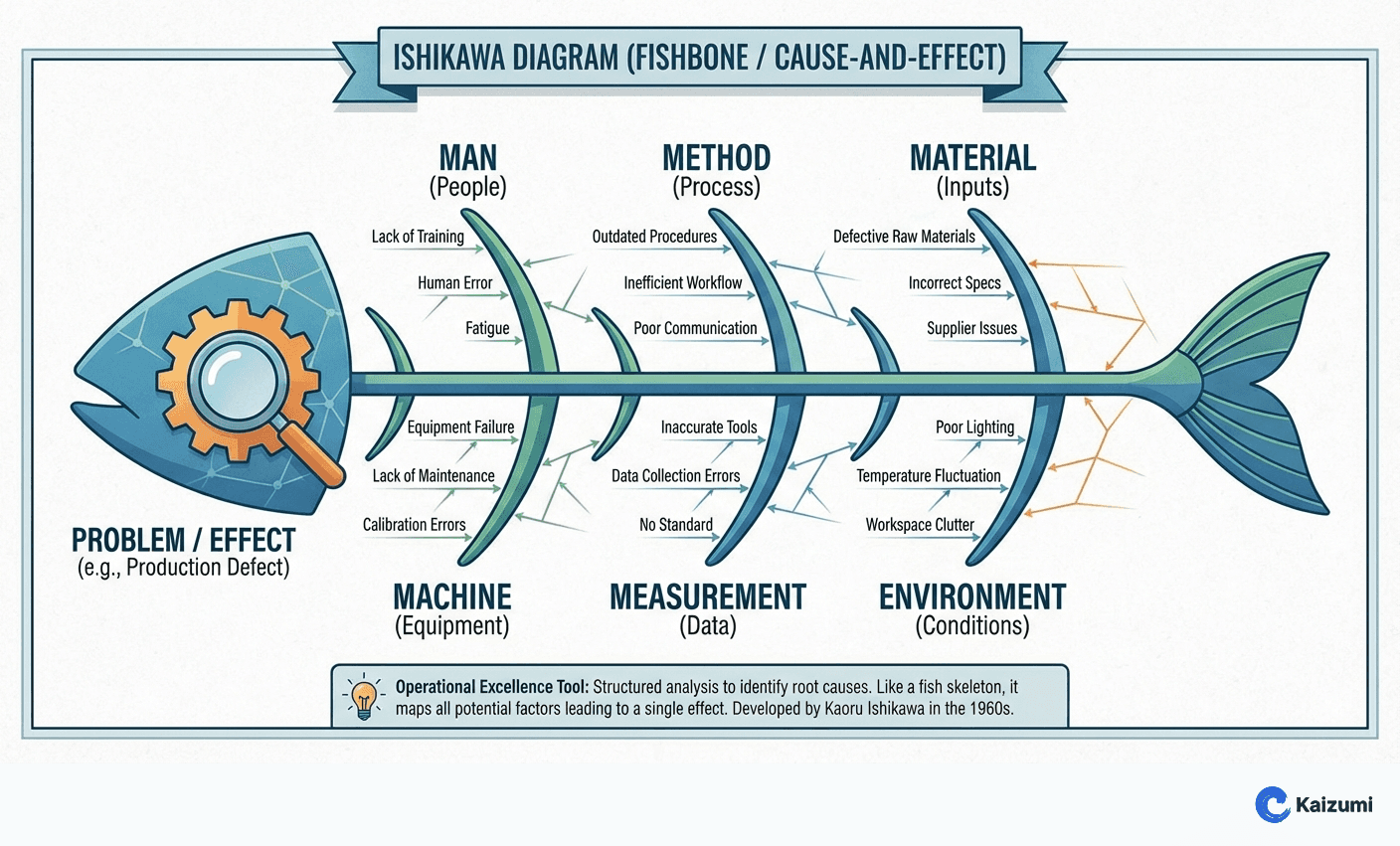
An Ishikawa diagram is a cause-and-effect diagram developed by Kaoru Ishikawa for systematic root cause analysis.
Definition
The Ishikawa diagram, named after its creator Kaoru Ishikawa, is a structured tool for identifying potential causes of a problem. Also known as the fishbone diagram or cause-and-effect diagram, it was developed in the 1960s as part of the quality movement at Kawasaki shipyards. Ishikawa emphasized that the diagram should be created by the people closest to the work, in teams, to leverage collective knowledge. The diagram's structure—with the effect (problem) at the head and causes branching from the spine—ensures systematic exploration rather than jumping to conclusions.
Examples
Kaoru Ishikawa originally used these diagrams to organize quality circle discussions at Kawasaki. Workers closest to the process would brainstorm causes in categories, contributing their direct knowledge of actual conditions that engineers might not see from data alone.
Key Points
- Ishikawa emphasized team-based creation with those closest to the work
- The visual structure prevents premature conclusions
- Named after Kaoru Ishikawa, a pioneer of quality management in Japan
- Sometimes called fishbone diagram due to its appearance
Common Misconceptions
Ishikawa diagrams are only for manufacturing. Ishikawa himself extended the technique beyond manufacturing. Any problem with multiple potential causes benefits from structured cause-effect analysis.
The diagram should be created by quality specialists. Ishikawa advocated for creation by the workers themselves. Their direct knowledge of actual conditions is essential for identifying real causes rather than theoretical ones.
Try It
Build your own right here. Map causes across the six M's, then use 5-Whys to drill from a cause down to a root cause. (Also available as a standalone tool.)
See Also
- Fishbone Diagram - Another name for Ishikawa diagram