
Poka-Yoke
Poka-yoke is a mistake-proofing mechanism designed to eliminate errors at the source by making mistakes physically impossible or immediately detectable. Developed by industrial engineer Shigeo Shingo within the Toyota Production System, the method distinguishes between inevitable human mistakes and avoidable product defects. Poka-yoke relies on control methods to block incorrect actions entirely, as well as warning systems to alert operators to abnormalities, ensuring zero-defect quality across manufacturing processes.
Rotate the same part, then try the fit.
Key facts
- Literal meaning
- Mistake-proofing or error prevention
- Originator
- Shigeo Shingo (1960s)
- System origin
- Toyota Production System (TPS)
- Primary goal
- Zero defects at the point of creation
- Operating functions
- Control (prevention) and warning (detection)
- Common forms
- Keyed fixtures, counters, and interlocks
By Matthew Savas — Founder of Kaizumi. Reviewed 14 September 2026.
Poka-yoke is a physical or procedural safeguard that makes a specific error impossible, or catches it before the work moves on. The strongest devices remove the choice: a keyed fixture accepts a part only in the correct orientation. Originating within the Toyota Production System (TPS), poka-yoke focuses on eliminating human and mechanical errors directly at the point of creation rather than relying on statistical post-process inspection. By transforming processes so that failure modes are physically blocked or instantly signaled, organizations can achieve near-zero defect rates while respecting the cognitive limits of human operators.
Meaning and origin
The term poka-yoke (ポカヨケ) translates literally to "mistake-proofing" or "error prevention" (poka meaning inadvertent mistake or error, and yoke derived from yokeru, meaning to avoid or prevent).
The concept was formalized in the 1960s by industrial engineer Shigeo Shingo, one of the primary architects of modern industrial quality engineering. Shingo initially termed the approach baka-yoke, which translates to "fool-proofing" or "idiot-proofing." However, after a female worker at an Arakawa Auto Body plant became visibly distressed upon hearing that her workstation had been made "fool-proof", implying that she was considered a fool, Shingo revised the terminology to poka-yoke. This shift underscored a fundamental lean tenet: workers are capable, diligent, and valuable, but human cognition is inherently vulnerable to fatigue, distraction, and monotony. The responsibility of the manufacturing system is to protect the operator from the inevitability of human error.
Poka-yoke emerged as a practical countermeasure to the traditional Western reliance on statistical quality control (SQC). Shingo recognized that while SQC provides valuable trend data, it fundamentally accepts a baseline percentage of defects as inevitable. In high-volume production, even a 0.1% defect rate results in thousands of defective products reaching customers. Poka-yoke aims instead for zero defects by designing the process so that defects cannot occur in the first place or cannot escape the workstation where they originate.
Core distinctions
Pokayoke relies on two fundamental distinctions:
- The distinction between an error and a defect: An error is an operational deviation or mistake, such as picking the wrong bolt, skipping a step, or misaligning a bracket. A defect is the resulting non-conforming product. Errors are inevitable human actions; defects are the avoidable consequences of unintercepted errors. Poka-yoke focuses on neutralizing the error before it can materialize as a defect.
- The distinction between prevention and detection mechanisms: Prevention mechanisms (control poka-yoke) make the incorrect action physically impossible to perform. Detection mechanisms (warning poka-yoke) permit the initial error to occur but immediately trigger an alarm, halt the machine, or isolate the workpiece before the unit advances to the next step.
Hierarchy of effectiveness
To evaluate the strength of an error-proofing design, practitioners evaluate systems against clear operational criteria:
- Meaning: Mistake-proofing; error prevention
- Best level: Prevent the error entirely
- Next best: Detect it before work moves on
- Location: At the source of the error
- Test: Can the wrong action still happen?
- Common forms: Keyed fixture · counter · interlock
The ultimate test of any poka-yoke device is binary: Can the wrong action still happen? If an operator can bypass, ignore, or override the safeguard during standard operating conditions, the device is classified as a warning system rather than an absolute control.
Classification of poka-yoke methods
Poka-yoke mechanisms are categorized both by their operating function (how they respond to an error) and by their sensing method (how they identify that an error has occurred).
Operating functions
- Control method (Prevention): The mechanism physically stops the process or prevents the physical execution of an incorrect operation. For example, a machine will not cycle if an optical sensor detects that a component is absent, or a jig will not close if a stamped plate is inserted backwards. Control methods represent the highest standard of mistake-proofing because they do not rely on operator interpretation or vigilance.
- Warning method (Detection): The mechanism alerts the operator through auditory alarms, flashing lights, or digital prompts when an irregularity occurs. Warning devices inform the operator of an error, but the operator must actively choose to stop and rectify the situation. Because human beings can experience alarm fatigue or sensory overload, warning methods are considered secondary in effectiveness to control methods.
Sensing methods
- Contact method (Physical/Geometric): Devices that detect abnormalities in the physical shape, dimensions, weight, or orientation of a part using direct mechanical, optical, or electronic contact. Examples include guide pins, asymmetric positioning blocks, limit switches, and load cells.
- Fixed-value method (Quantitative): Mechanisms used in operations where a specific, fixed number of actions or components are required. If an assembly requires four screws, a fixed-value system might employ a photoelectric beam across a parts bin that must be broken four times before releasing the workpiece clamp to the next station.
- Motion-step method (Sequential): Systems that ensure operations are carried out in a strictly defined chronological order. If an adhesive must be applied before a seal is pressed, a motion-step poka-yoke will lock the mechanical press until the dispensing tool has completed its full stroke and returned to its cradle.
Integration with lean systems
Poka-yoke does not exist in isolation; it functions as a critical enabler of broader lean disciplines:
- Jidoka (Autonomation): Poka-yoke is the primary tactical mechanism for executing jidoka, the principle of building quality into the process. Jidoka demands that when an abnormality occurs, the line stops immediately to prevent the propagation of defects. Poka-yoke provides the automated sensing and physical interlocks that make this stoppage automatic and instantaneous.
- Standard work: Standardized work outlines the most efficient, safe sequence of production tasks. When variation or compliance drift threatens standard work, poka-yoke devices serve as physical guardrails, ensuring that operators adhere strictly to the established takt time and task sequence.
- Fishbone diagram (Ishikawa): When recurring defects are investigated using a fishbone diagram, cross-functional teams analyze root causes across machinery, methods, materials, and human factors. Poka-yoke devices are frequently the definitive countermeasure chosen to permanently close off the causal pathways identified during fishbone analysis.
Implementation methodology
Designing effective poka-yoke devices requires a systematic, data-driven approach that addresses the true root cause rather than symptoms.
- Identify the defect and target process: Examine defect logs, customer warranty claims, or scrap data to isolate operations with high scrap rates or high defect risk.
- Map the error sequence: Use process mapping and the 5 Whys technique to trace the exact physical and cognitive steps that permit the error to happen.
- Determine the mechanism type: Prioritize control-style prevention over warning-style detection. Seek solutions that make incorrect assembly physically impossible.
- Design for simplicity and low cost: The most robust poka-yoke solutions are rarely complex digital systems; they are typically simple mechanical guides, microswitches, or gravity-fed gates built directly into tooling.
- Test under boundary conditions: Subject the poka-yoke to intentional misuse, extreme part tolerances, and speed variations to verify that the safeguard cannot be inadvertently bypassed.
- Standardize and monitor: Update standard work sheets to include verification of the poka-yoke mechanism at the start of each shift.
Follow our guide to test interactive stations and build one in two shifts.
Worked example and practical application
Consider a high-volume bicycle assembly cell. Operators must install left and right pedal assemblies into crank arms. The left pedal features a reverse (left-hand) thread to prevent it from unscrewing during pedaling, while the right pedal features a standard right-hand thread. Despite color-coded bins and operator training, cross-threading errors and mixed installations routinely cause line stoppages and field failures.
A cross-functional lean team designs a multi-tiered poka-yoke system across the assembly cell:
- Station 1 (Component Preparation): Pedals are loaded onto a gravity track. The left pedal spindle features an integrated groove. A mechanical gate on the left-side track physically blocks any pedal spindle lacking the groove, preventing right pedals from entering the left-side staging area (Contact Method / Control).
- Station 2 (Assembly and Fastening): The pneumatic torque driver will not receive air pressure until two conditions are met: the operator draws the pedal from the correct bin (monitored by an infrared pick-to-light sensor) and an optical camera confirms the pedal orientation on the crank arm. If the operator attempts to force an incorrect thread, a digital torque-angle monitoring tool detects abnormal resistance before the thread engages and instantly disengages drive power.
In the following simulation, the reject mechanism is located at Station 2, where pedals are installed.
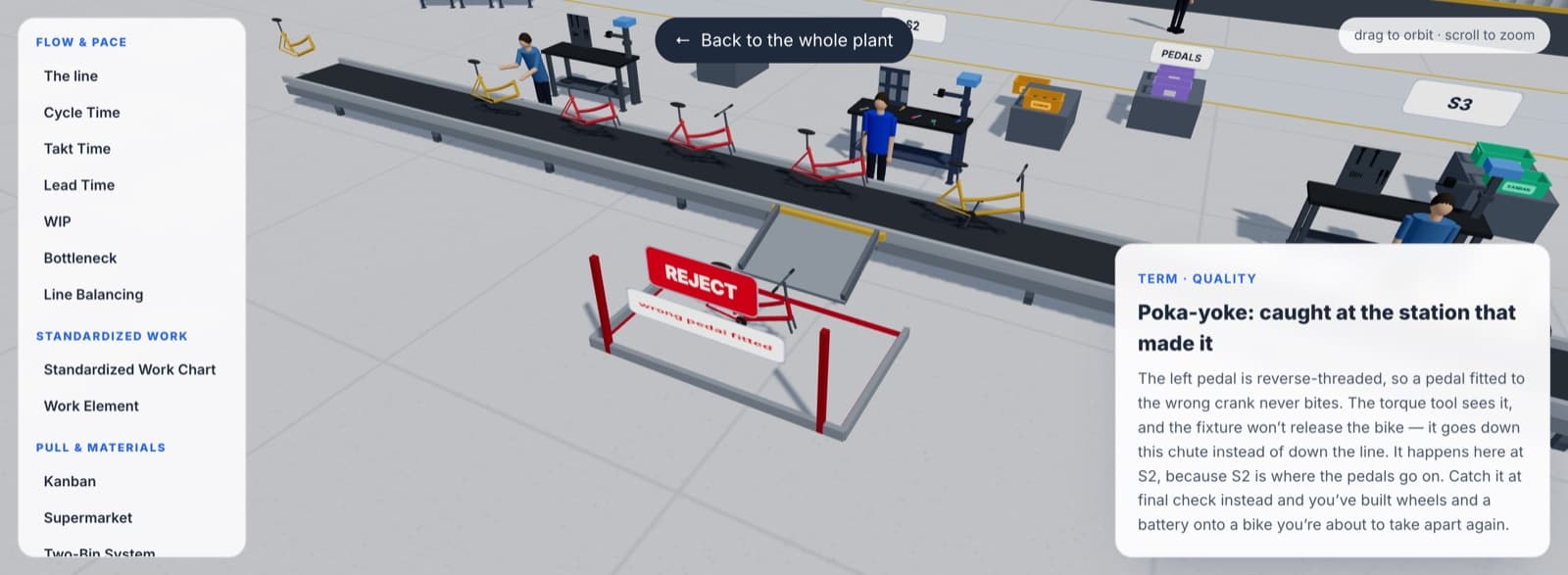
By installing this system, the station eliminates cross-threading defects entirely, protects the operator from repetitive strain injuries caused by jammed fasteners, and guarantees that no misassembled crankset can leave the cell.
Everyday examples
Outside industrial manufacturing, poka-yoke mechanisms are integrated throughout modern consumer products and infrastructure:
- Automotive transmissions: Modern vehicles require the driver to depress the brake pedal before shifting out of the "Park" position, preventing sudden unintended acceleration.
- Fuel dispensing nozzles: Diesel fuel nozzles are manufactured with a larger diameter than unleaded gasoline nozzles, and diesel vehicle filler necks are sized accordingly. A diesel nozzle physically cannot fit into a standard gasoline vehicle's fuel neck, preventing catastrophic engine misfueling.
- SIM and SD card slots: Subscriber Identity Module (SIM) cards and SD memory cards feature an asymmetrical beveled corner. The receiving slot is shaped identically, making it physically impossible to insert the card upside down or backwards.
- Elevator doors: Optical light curtains across elevator doorways project invisible infrared beams. If an entering passenger breaks the beam, the door circuit reverses immediately, preventing mechanical entrapment.
- Microwave ovens: An electromechanical interlock switch cuts all electrical power to the magnetron the instant the door latch is released, preventing harmful microwave radiation from operating while the door is open.
Frequently asked questions
- Why did Shigeo Shingo rename baka-yoke to poka-yoke?
- Shigeo Shingo originally referred to mistake-proofing as baka-yoke, which translates to fool-proofing or idiot-proofing. In the 1960s, an operator at an Arakawa Auto Body plant was visibly distressed by the term because it implied the company viewed her as a fool. Shingo renamed the methodology poka-yoke to emphasize that workers are skilled and valuable, but human cognition is naturally vulnerable to fatigue and distraction.
- How does poka-yoke differ from statistical quality control?
- Statistical quality control monitors defect trends through post-process inspection, which inherently accepts a baseline rate of product defects as inevitable. In contrast, poka-yoke targets zero defects by blocking or intercepting errors at the specific workstation where they occur. This eliminates the risk of defective items reaching customers, which still occurs under statistical sampling in high-volume production.
- What are the three sensing methods used in poka-yoke devices?
- Poka-yoke devices identify abnormalities using contact methods, fixed-value methods, and motion-step methods. Contact methods use physical or optical tools like guide pins and limit switches to verify a part's shape, weight, or orientation. Fixed-value methods confirm that a required count of actions or components has been met, while motion-step methods ensure that sequential tasks are executed in strict chronological order.
- How does poka-yoke support the lean principle of jidoka?
- Jidoka requires an assembly line or process to stop immediately whenever an abnormality occurs so defects cannot travel downstream. Poka-yoke provides the direct hardware, such as sensors, mechanical gates, and electrical interlocks, that triggers this stoppage automatically. Together, they build quality directly into the process rather than relying on manual human surveillance.
- What are examples of poka-yoke mechanisms in everyday consumer products?
- Common everyday examples include SIM card slots, microwave ovens, and vehicle transmissions. A SIM card features an asymmetrical beveled corner that physically prevents it from being loaded into a tray backwards or upside down. Similarly, microwave ovens use electromechanical interlock switches to immediately shut off power to the magnetron if the door latch is released while running.