
Leveling
Personalize This
Get insights for your role
Leveling is the practice of smoothing workload over time to eliminate peaks and valleys that cause waste and overburden.
Definition
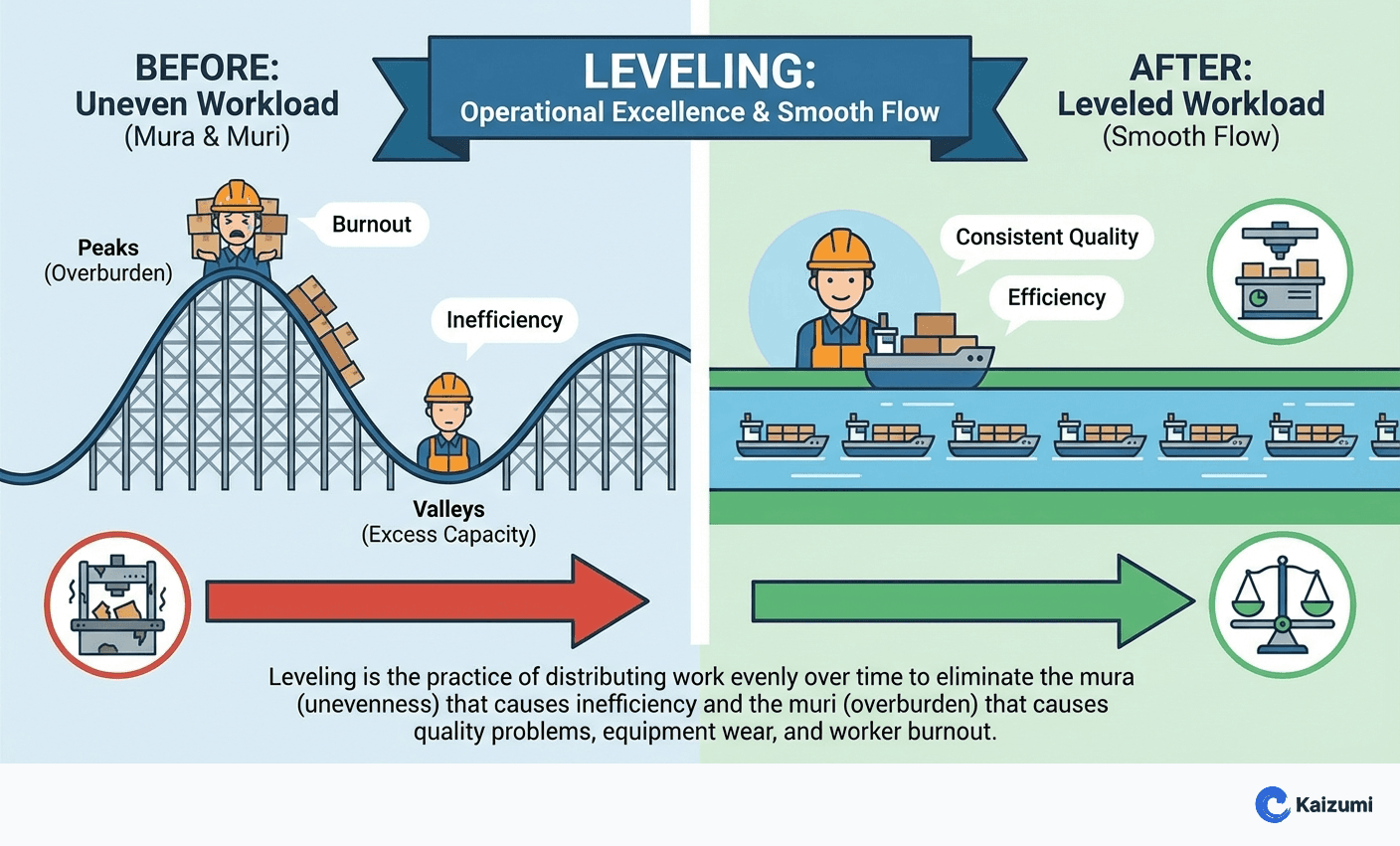
Leveling is the practice of distributing work evenly over time to eliminate the mura (unevenness) that causes inefficiency and the muri (overburden) that causes quality problems, equipment wear, and worker burnout. Uneven workloads—peaks followed by valleys—require either excess capacity for peaks (waste during valleys) or insufficient capacity that can't handle peaks (overburden and missed commitments). Leveling smooths demand and production to enable sustainable pace and consistent resource utilization.
Examples
A plant received orders heavily weighted toward month-end as customers tried to meet their own targets. Rather than scrambling at month-end and idling early month, they negotiated with customers to spread orders throughout the month. Leveled demand enabled stable production schedules and reduced overtime.
Key Points
- Leveling addresses both volume variation and product mix variation
- Uneven workload is wasteful even if average demand matches capacity
- Leveling requires coordination with customers, scheduling, and upstream processes
- Leveled workload enables sustainable pace and reliable delivery
Common Misconceptions
Leveling reduces flexibility. Leveling actually increases flexibility by eliminating the chaos of peaks. Resources aren't exhausted during peaks, so they're available for genuine urgent needs.
Customer demand can't be influenced. Many demand patterns are created by business practices—billing cycles, promotion timing, deadline structures. Analyzing demand drivers often reveals opportunities for leveling.
Try It
Leveling depends on the capacity left over once setups are paid for. Enter available minutes per day below, then each item with its demand, run time, and setup time. The tool separates daily run time from the capacity available for changeovers and returns the shortest interval that still fits. A shorter interval means smaller lots, and smaller lots are what make a level schedule possible.
See Also
- Heijunka - The Japanese term for production leveling