
Takt Time
Takt time is the production pace required to match customer demand, calculated by dividing available operating time by the number of units required. Derived from the German word for a musical beat, it paces operational activities without relying on machine speeds or internal capacity. Lean manufacturing uses takt time to balance lines, determine workforce sizes, and set planned cycle times. Tracking production against takt time or pitch intervals ensures organizations consistently fulfill customer order rates without overproducing.
- Available time
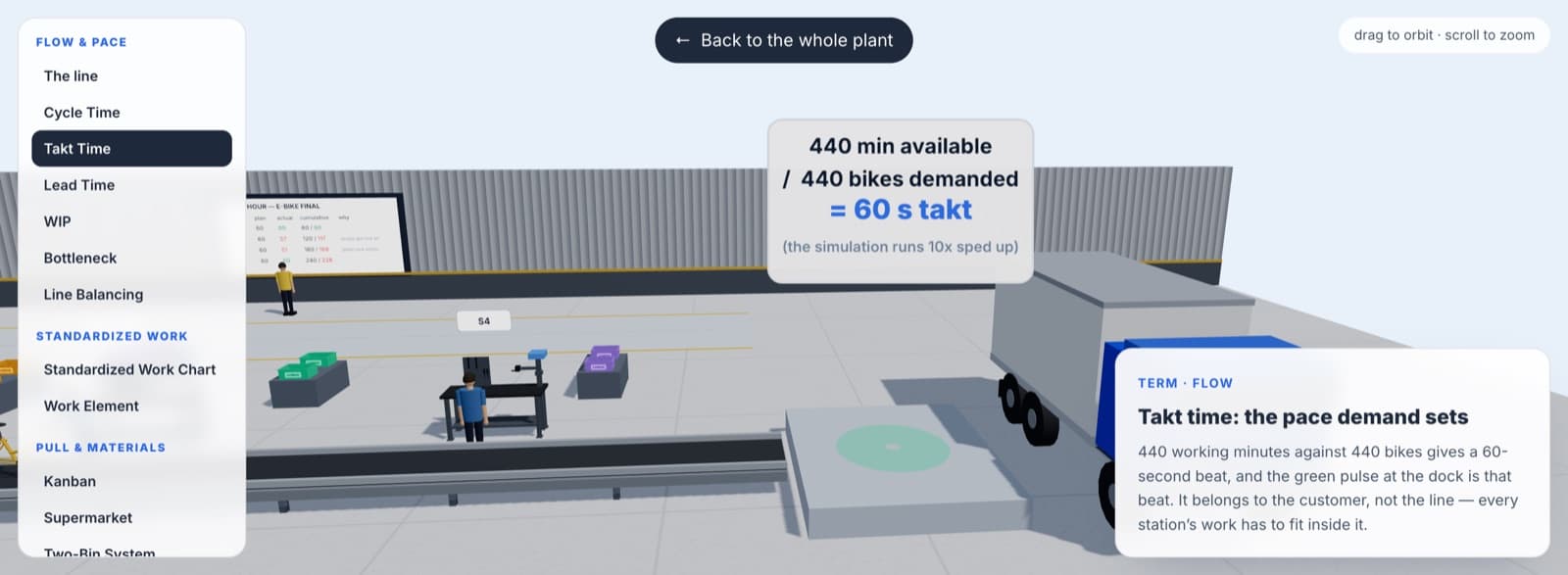
- The shift minus everything that is not working time — breaks, meetings, cleanup. 480 scheduled minutes lose 40 to planned stops, leaving 440. Teams argue about this input more than any other.
- Customer demand
- How many units the customer needs from this shift — 440 here. Demand belongs to the customer: you cannot negotiate takt with a stopwatch.
- The division
- Available time over demand — 26,400 seconds ÷ 440 units = 60 seconds. That is the entire calculation. Machine speed appears nowhere in it.
- The beat
- One full sweep of the watch is one takt: a unit must leave every 60 seconds to exactly meet demand — no faster, no slower. Cycle time is what your process actually does; the gap is where improvement points.
Key facts
- Formula
- Available operating time / Customer demand
- Etymology
- German word for musical beat or measure
- Industrial origin
- German aircraft builders (1930s)
- Key determinant
- External customer demand and available working time
- Pitch formula
- Takt time × Container pack quantity
By Matthew Savas — Founder of Kaizumi. Reviewed 17 August 2026.
Takt time is the pace required to match customer demand, calculated by dividing available operating time by the number of units required during that period. For example, a shift with 440 available minutes and demand for 440 units produces a takt time of 60 seconds per unit. Takt time is determined entirely by external customer demand and available working time rather than by internal equipment speeds or capacity targets. Derived from the German word Takt, meaning a musical beat or measure, the concept was first applied to industrial manufacturing by German aircraft builders in the 1930s to synchronize airframe movement through fixed assembly stations. Toyota subsequently integrated the mechanism into the Toyota Production System to size crews, balance lines, and pace all operational activities to a single rhythm.
Calculation and available time definitions
The mathematical calculation of takt time requires dividing the available operating time by the customer demand for that specified time frame. Takt time changes only when customer demand changes or when planned working hours are adjusted; it does not change based on machine speeds or internal processing difficulties. To determine the takt time for a line, engineers use a Takt time calculator to evaluate operating parameters against customer order rates.
Try it yourself
While shift schedules provide a baseline, operational definitions of available time vary across organizations:
- Total shift time: Measuring the entire duration of a shift without deductions, such as an 8-hour shift recorded as 480 minutes.
- Available operating time: Measuring the planned working time by deducting scheduled, non-productive events from the total shift time. For a 480-minute shift with 20 minutes of breaks, 10 minutes of handover, and 10 minutes of scheduled changeover, available operating time is 440 minutes, which equals 26,400 seconds.
- Net operating time: Deducting both planned stops and historical unplanned downtime, such as 30 minutes of machine breakdowns and 10 minutes of rework, leaving 400 minutes.
Deducting unplanned losses from available time produces an artificially shortened takt time (54.5 seconds instead of 60.0 seconds for a 440-unit demand). Subtracting breakdown time or quality losses masks operational problems and forces the line to work faster to compensate for waste. Lean manufacturing practice dictates using available operating time (440 minutes in this scenario) to maintain a true takt time of 60.0 seconds per unit.
Takt time versus cycle time and lead time
Takt time must not be confused with cycle time or lead time. A detailed comparison is outlined in Cycle time vs takt time vs lead time. Takt time represents the rate of customer consumption. Cycle time is the time it takes an operator or machine to complete all assigned work elements on a single unit. Lead time is the total latency required for a single unit to travel from the beginning of a process to the end, including processing time and intermediate waiting periods.
Because manufacturing lines do not operate at 100 percent reliability throughout a shift, designing workstations to match takt time exactly will lead to missed production targets. For example, if a line has a takt time of 60 seconds and experiences an unplanned downtime rate of 15 percent (meaning 85 percent operational uptime), the line actually operates for only 22,440 seconds of the 26,400 available seconds. Producing at 60 seconds per unit yields 374 finished units, creating a 66-unit shortfall against the 440-unit demand.
To ensure customer demand is met despite downtime, engineers design workstations to a planned cycle time rather than the nominal takt time. Designing to planned cycle time (51 seconds) involves multiplying the takt time of 60 seconds by the 0.85 uptime factor, which gives a target cycle time of 51.0 seconds. Producing at 51.0 seconds over the 22,440 seconds of actual running time delivers the required 440 units. Implementing Takt time on a production line requires this distinction between demand-driven takt and equipment-adjusted planned cycle times.

Line balancing and workforce sizing
Takt time provides the baseline constraint for line balancing and workforce sizing. To determine the number of operators required on a line, engineers calculate total work content, the sum of all manual work elements required to build one product, and divide it by takt time.
For example, if total manual work content is 215 seconds and takt time is 60 seconds, 215 divided by 60 equals 3.58, rounding up to 4 operators. Three operators cannot do it: at 60 seconds each they absorb 180 seconds, leaving 35 seconds unassigned. Four operators carry 240 seconds of capacity, enough for all 215 seconds of work.
That count is the floor, and it assumes the line never stops. Size the same work to the 51-second planned cycle time and four operators absorb only 204 seconds, 11 seconds short of the 215 required. The fifth operator is what the 15 percent downtime costs you.
Industrial engineers use a yamazumi chart to visualize manual work elements at each workstation relative to the takt time or planned cycle time. To optimize labor allocations, practitioners follow the steps in Balance a line with a yamazumi. Tasks are documented on a standardized work chart to separate core cyclic work from out-of-cycle work. Operators and equipment are coordinated using principles described in Inside a Toyota assembly line.
Engineers can model staffing and balancing configurations through the interactive Line designer game or run scenarios in the E-bike factory simulation.
Responding to demand changes
When customer demand fluctuates, takt time changes inversely: higher demand reduces takt time, while lower demand increases takt time. If demand increases by 25 percent (from 440 to 550 units within a 440-minute shift), an organization has two primary operational adjustments:
- Rebalance work content to a faster cycle time: If available operating hours remain constant at 440 minutes (26,400 seconds), the new takt time becomes 48.0 seconds (calculated as 26,400 divided by 550). With 85 percent uptime, the planned cycle time drops to 40.8 seconds (calculated as 48 multiplied by 0.85). Workstations must be rebalanced to remove 10.2 seconds of work content per station (calculated as 51.0 minus 40.8) through waste elimination and task reallocation. This adjustment often requires adding operators to the production line.
- Expand available operating hours: If work content per station remains fixed at a 51.0-second planned cycle time, producing 550 units requires 28,050 seconds of running time (calculated as 550 multiplied by 51). Accounting for 85 percent uptime, the facility requires 33,000 scheduled seconds (calculated as 28,050 divided by 0.85), or 550 minutes. Adding 110 minutes through overtime or an adjusted shift pattern restores the original takt time of 60.0 seconds (calculated as 33,000 divided by 550).
To prevent frequent, disruptive rebalancing of manual assembly lines, organizations use heijunka to level demand volumes and product mixes over fixed planning intervals, such as monthly or bi-weekly cycles.
Pitch and operational pacing
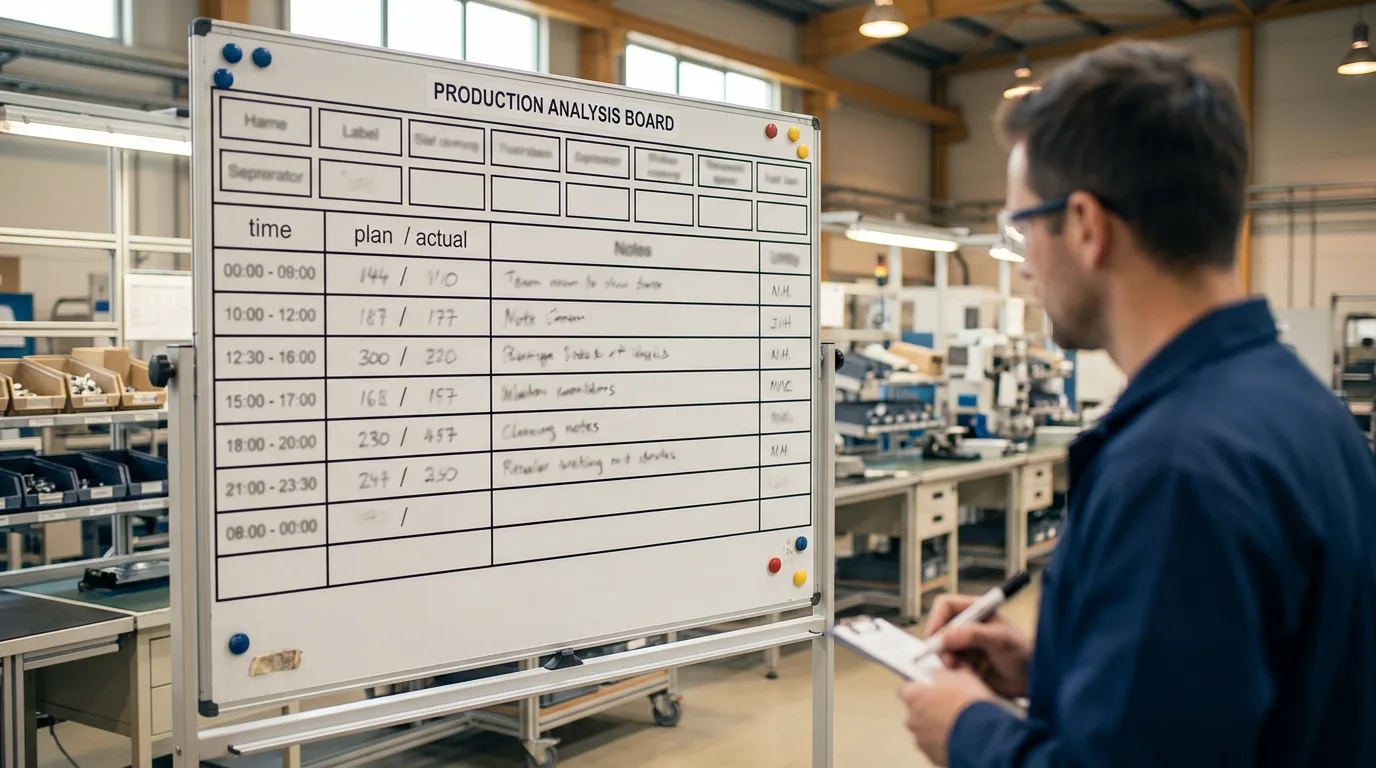
Tracking production on a unit-by-unit basis at brief takt intervals can be difficult to manage visually. Organizations group takt intervals by container quantities to establish pitch, which is calculated by multiplying takt time by the container pack quantity.
For a takt time of 60 seconds and a standard container size of 20 units, the pitch is 1,200 seconds (20 minutes). In a 440-minute shift, production is monitored across 22 pitch intervals (calculated as 440 divided by 20) corresponding to 22 containers.
Pitch creates a regular cadence for material logistics and management oversight:
- Material handlers perform paced withdrawal, delivering components and removing finished goods every 20 minutes.
- Supervisors check hourly production boards at each 20-minute pitch interval to identify deviations from the scheduled plan immediately.
- Upstream processes align their production releases to the takt image, creating an integrated production sequence where each process produces one container per pitch increment.
Application in non-manufacturing environments
Takt time applies equally to transactional, administrative, and service workflows where work can be quantified against available processing hours.
In an outpatient medical clinic, available operating time is 480 minutes per shift. With scheduled appointments for 32 patients, the clinic's takt time is 15 minutes (calculated as 480 divided by 32). Although a comprehensive patient visit may take 60 minutes, the clinic achieves its 15-minute throughput by operating 4 parallel examination rooms (calculated as 15 minutes multiplied by 4 rooms equals 60 minutes).
If one examination room is closed for maintenance, the allowable cycle time across the remaining 3 rooms must decrease to 45 minutes (calculated as 3 multiplied by 480 divided by 45 equals 32), or total capacity will drop to 24 patients (calculated as 3 multiplied by 480 divided by 60). Calculating service takt time allows administrators to match room availability and staffing levels to incoming patient appointments.
Frequently asked questions
- Does takt time calculation include planned breaks and unplanned downtime?
- Planned non-productive events such as breaks, shift handovers, and scheduled changeovers are deducted from total shift time to give available operating time. Unplanned downtime is not: deducting breakdowns and rework shortens takt time itself and hides the loss inside the number. You still have to account for it, in the planned cycle time rather than in takt — at 85 percent uptime a line paced to a 60-second takt delivers 374 units against demand for 440. Raising uptime is the objective; pacing as though you already had is not.
- What is the difference between takt time, cycle time, and lead time?
- Takt time represents the pace of customer consumption, determined entirely by customer order rates and available working hours. Cycle time is the time required for an operator or machine to complete all assigned work elements on a single unit. Lead time is the total duration required for a unit to travel from the beginning of a process to the end, including both processing time and intermediate waiting periods.
- How is takt time used to determine workforce sizing?
- Engineers divide the total manual work content needed to produce one unit by the takt time, rounding up to find the minimum number of operators. For example, dividing 215 seconds of work content by a 60-second takt time yields 3.58, which requires four operators. Sizing against a faster planned cycle time accounts for equipment downtime and indicates if additional staffing is required.
- What is the relationship between takt time and pitch?
- Pitch is calculated by multiplying takt time by the container pack quantity to group rapid single-unit intervals into manageable time blocks. Because pacing individual units every few seconds can be difficult to manage visually, pitch creates a standardized cadence for logistics and management reviews. Material handlers transfer containers and supervisors verify production tracking boards at each pitch increment.