
Line Balancing
Personalize This
Get insights for your role
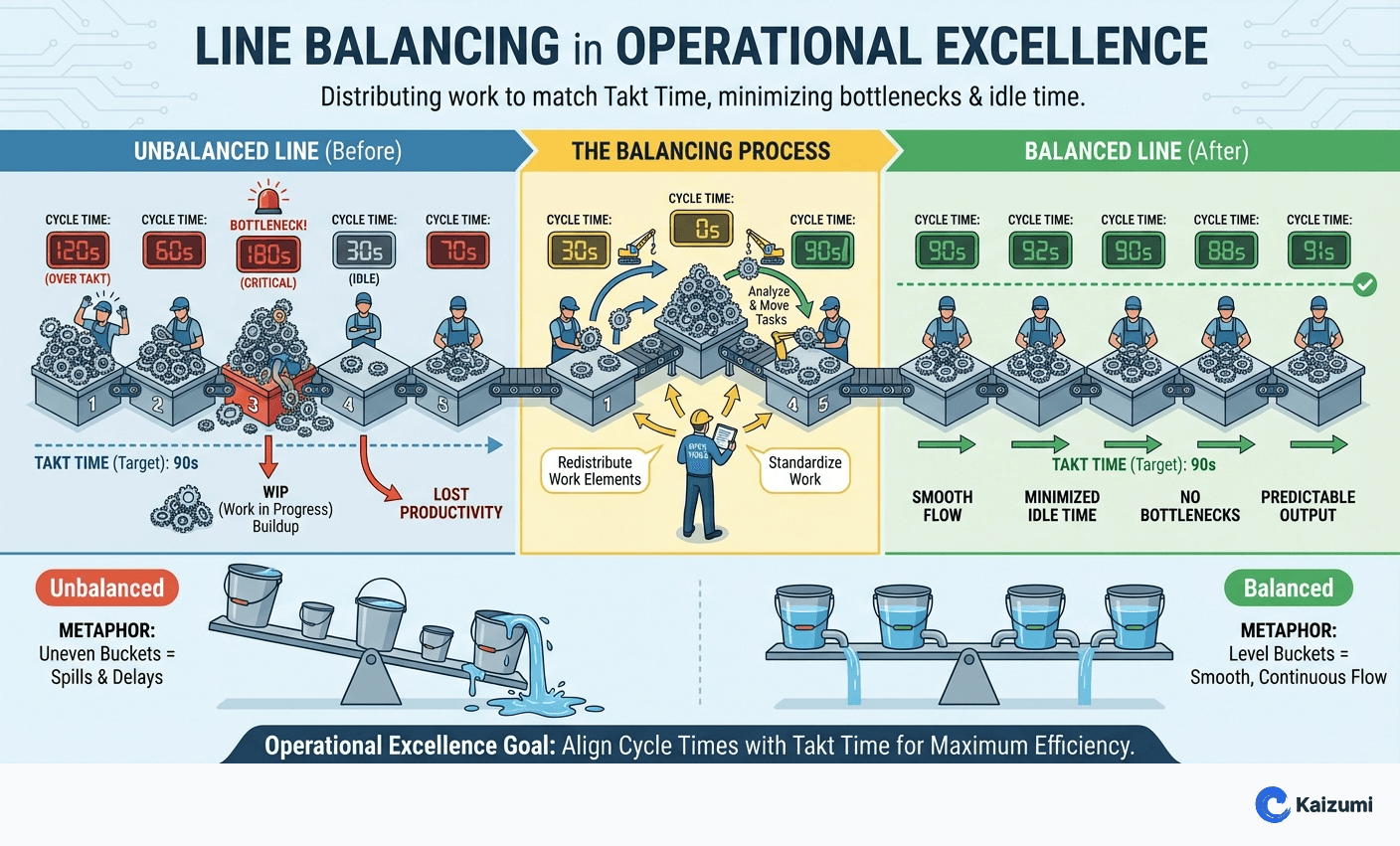
Line balancing distributes work elements across workstations to achieve even cycle times close to takt time.
Definition
Line balancing is the process of distributing work elements across workstations so that each station's cycle time is as close to takt time as possible and approximately equal to other stations. Poor balance creates bottlenecks (stations over takt time) and idle time (stations far under takt time). Good balance maximizes throughput, minimizes waiting waste, and enables smooth flow. Line balancing uses yamazumi charts to visualize current balance and guide redistribution of work elements. Watch a full rebalancing play out — from an over-takt bottleneck to a balanced line — in the interactive Yamazumi guide.
Examples
An assembly line had six stations with cycle times ranging from 35 to 68 seconds against 55-second takt time. Line balancing analysis redistributed work elements, moving tasks from the 68-second bottleneck to underloaded stations. After rebalancing, all stations operated between 50-54 seconds.
Key Points
- Balance to takt time, not to the fastest possible pace
- Some buffer below takt time provides cushion for variation
- Precedence constraints limit how work can be redistributed
- Cross-training enables flexible work distribution
Common Misconceptions
Perfect balance at takt time is the goal. Some buffer below takt time handles normal variation. Balance exactly at takt time provides no margin for problems.
Line balancing is a one-time activity. As demand changes (affecting takt time), as processes improve (affecting cycle times), or as product mix shifts, rebalancing may be needed. Balance should be periodically reviewed.
Try It
Balance your own line right here. Enter available time and demand to get takt, then add workstations to compare each one's cycle time against takt on a bar chart. (Also available as a standalone tool.)
Watch It Happen
A balance chart built from real work looks different from one built from estimates. In the factory simulation each bar is stacked from that station's actual steps — green where the step is a true work element, red where it is walking, orange where it is re-orienting parts. Only one station reaches the takt line, and only the green blocks can honestly be moved to another operator.
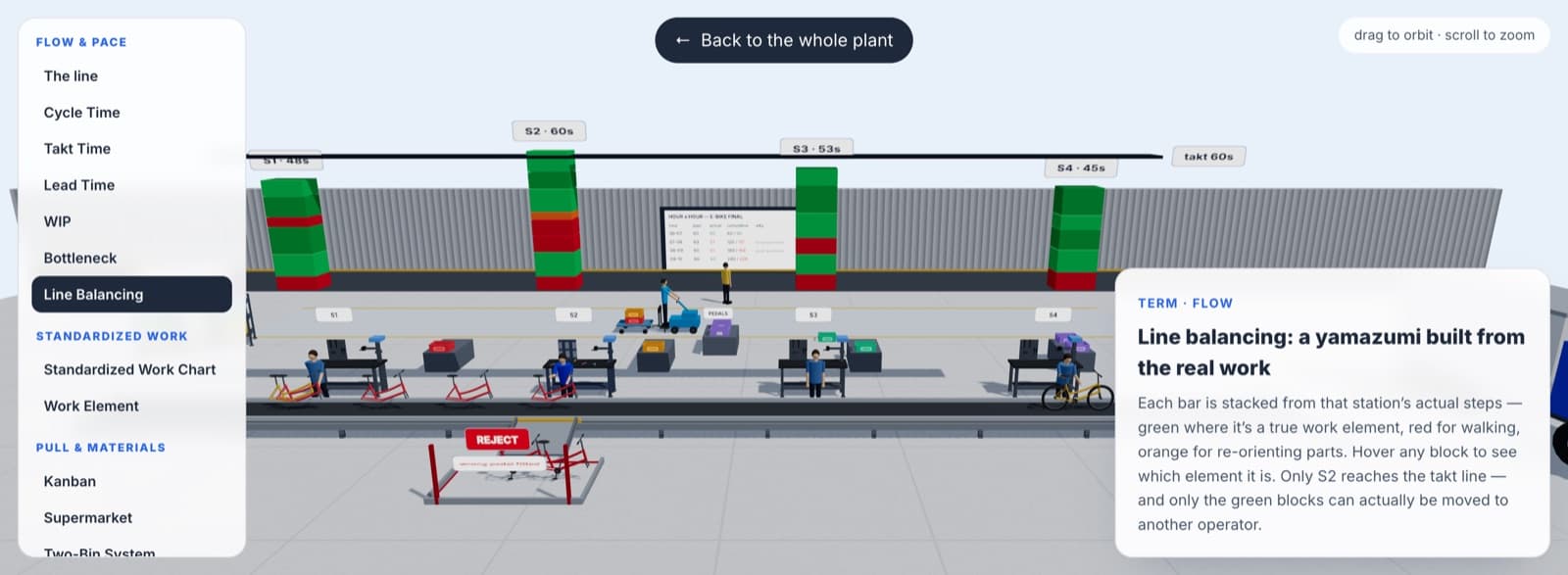
A yamazumi stacked from the station’s real steps — green for work, red for walking.
Open the simulation on this term →
See Also
- Yamazumi - The visual tool for line balancing