
Project Charter
Personalize This
Get insights for your role
A project charter is a document that formally authorizes an improvement project, defining its scope, goals, team, and expected benefits.
Definition
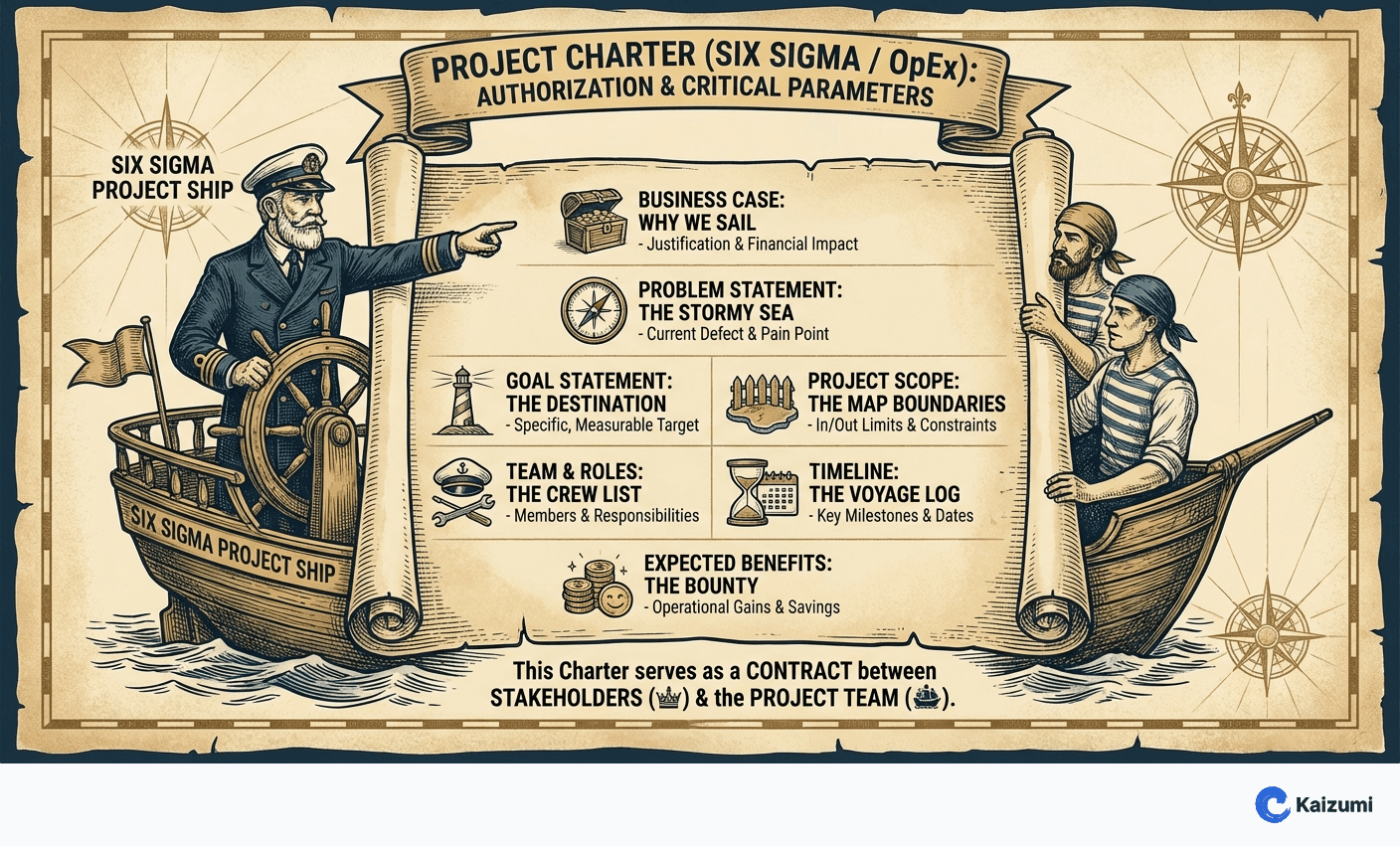
A project charter is a formal document that authorizes a Six Sigma project and defines its critical parameters. It typically includes the business case, problem statement, goal statement, project scope, team members and roles, timeline, and expected benefits. The charter serves as a contract between the project team and sponsoring leadership, ensuring alignment on what success looks like before work begins. In DMAIC, charter development is a key Define phase deliverable.
Examples
A scrap reduction project charter specified: Problem: 4.2% scrap rate costing $1.2M annually. Goal: reduce scrap to 1.5% within 6 months. Scope: stamping department only. Team: Black Belt lead, quality engineer, 3 operators. Expected savings: $800K annually. The clear boundaries prevented scope creep into other departments.
Key Points
- Charter elements: business case, problem statement, goal, scope, team, timeline, benefits
- Goals should be SMART: Specific, Measurable, Achievable, Relevant, Time-bound
- Scope defines boundaries—what's included AND what's excluded
- Champion and team sign off before project proceeds
Common Misconceptions
Charters can be modified anytime. Charter changes require formal approval from the Champion. Frequent changes suggest poor initial scoping. If significant changes are needed, the project may need to restart Define phase.
A good charter guarantees success. Charters set up projects for success but don't guarantee it. A perfect charter with poor execution fails; a modest charter with excellent execution often succeeds. The charter is necessary but not sufficient.