
Seiri (Sort)
整理·seiri·"sorting, organizing, putting in order"
Personalize This
Get insights for your role
Seiri is the first of the 5S steps - sorting through items to remove what is unnecessary from the workplace.
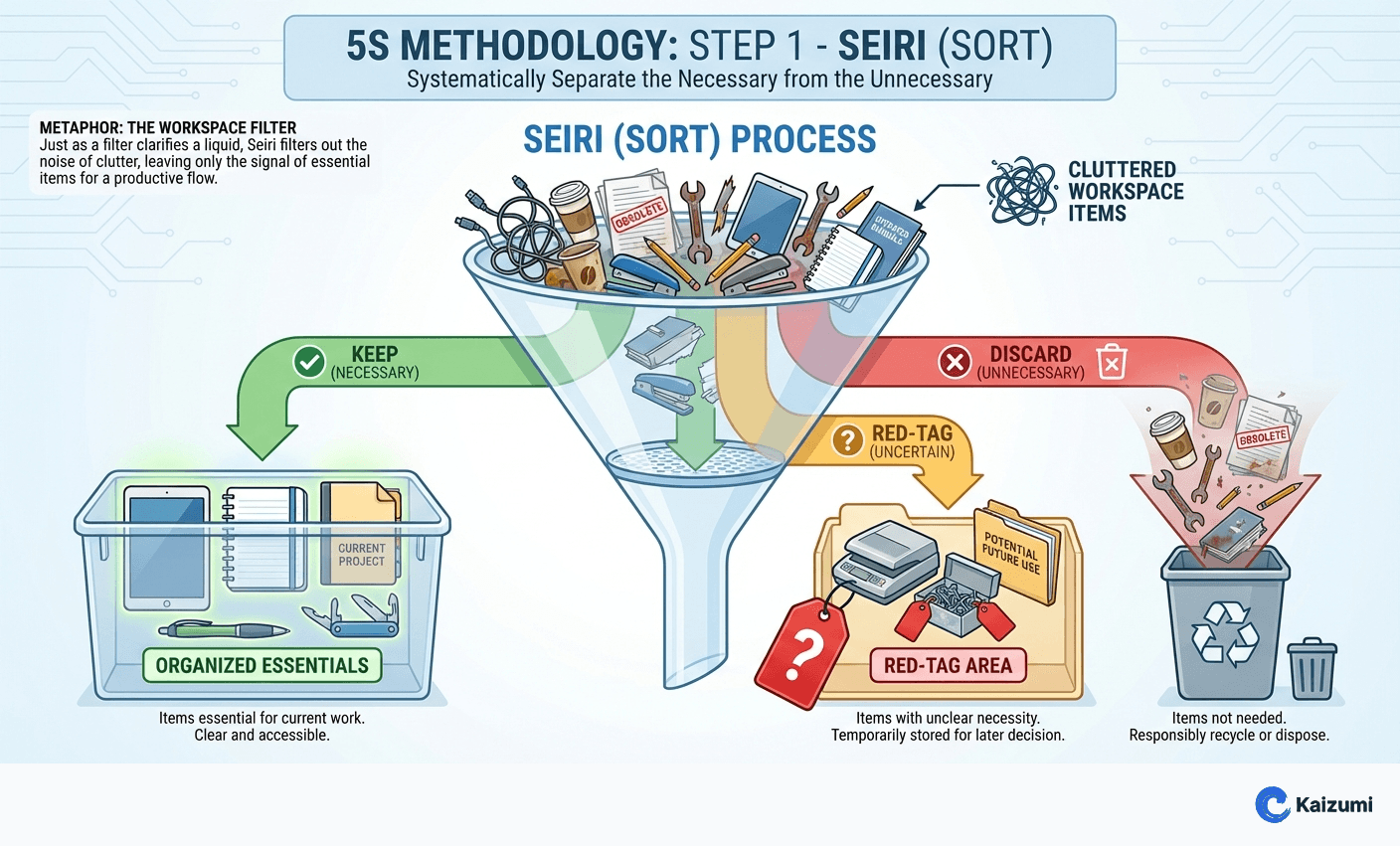
Definition
Seiri, meaning "Sort" in English, is the first step of the 5S methodology. It involves systematically going through all items in a workspace and removing everything that isn't needed for current work. Items are categorized as necessary (keep), unnecessary (discard), or uncertain (red-tag for later decision). The goal is to eliminate clutter that consumes space, hides problems, creates searching waste, and makes abnormalities invisible. Seiri creates the foundation for the subsequent 5S steps by reducing items to only what's truly needed.
Examples
A machining area accumulated years of "might need someday" items—obsolete tooling, spare parts for retired machines, materials for discontinued products. A seiri event removed two truckloads of unnecessary items, freeing significant floor space and revealing equipment that had been hidden and forgotten.
Key Points
- Seiri asks "Is this needed here, now?" not "Might this ever be useful?"
- Red-tagging quarantines uncertain items for timed decision
- Seiri often removes 30-50% of items from typical workplaces
- Removal requires authority—workers need permission to dispose
Common Misconceptions
Everything might be needed someday. The cost of keeping unneeded items (space, searching, confusion) usually exceeds the cost of re-acquiring if actually needed later. Sort aggressively.
Seiri is a one-time event. Items accumulate continuously. Seiri should be repeated periodically, though subsequent efforts are smaller once the initial accumulation is cleared.
Try It
Sort is the first of five sections in the audit below. Its items ask whether only needed items are present, whether floors and benches hold nothing but current work, and whether obsolete or broken items have been tagged and removed. Score one real area on a 0-5 scale and the radar chart puts Sort next to the other four S's. Anything you rate 1 or 2 comes back as an action list. (Also available as a standalone tool.)
See Also
- Seiton - The second S: Set in Order