
5S
5S is a systematic workplace organization methodology originating from the Toyota Production System. It establishes visual management across five sequential stages: Sort (seiri), Set in Order (seiton), Shine (seiso), Standardize (seiketsu), and Sustain (shitsuke). Rather than serving as a mere cleaning routine, 5S creates a self-explaining environment where normal operating conditions are visually obvious and abnormalities, missing items, or hazards are surfaced immediately. This foundational lean practice reduces search time, improves workplace safety, and stabilizes operations.
- Sort — bounded decisions
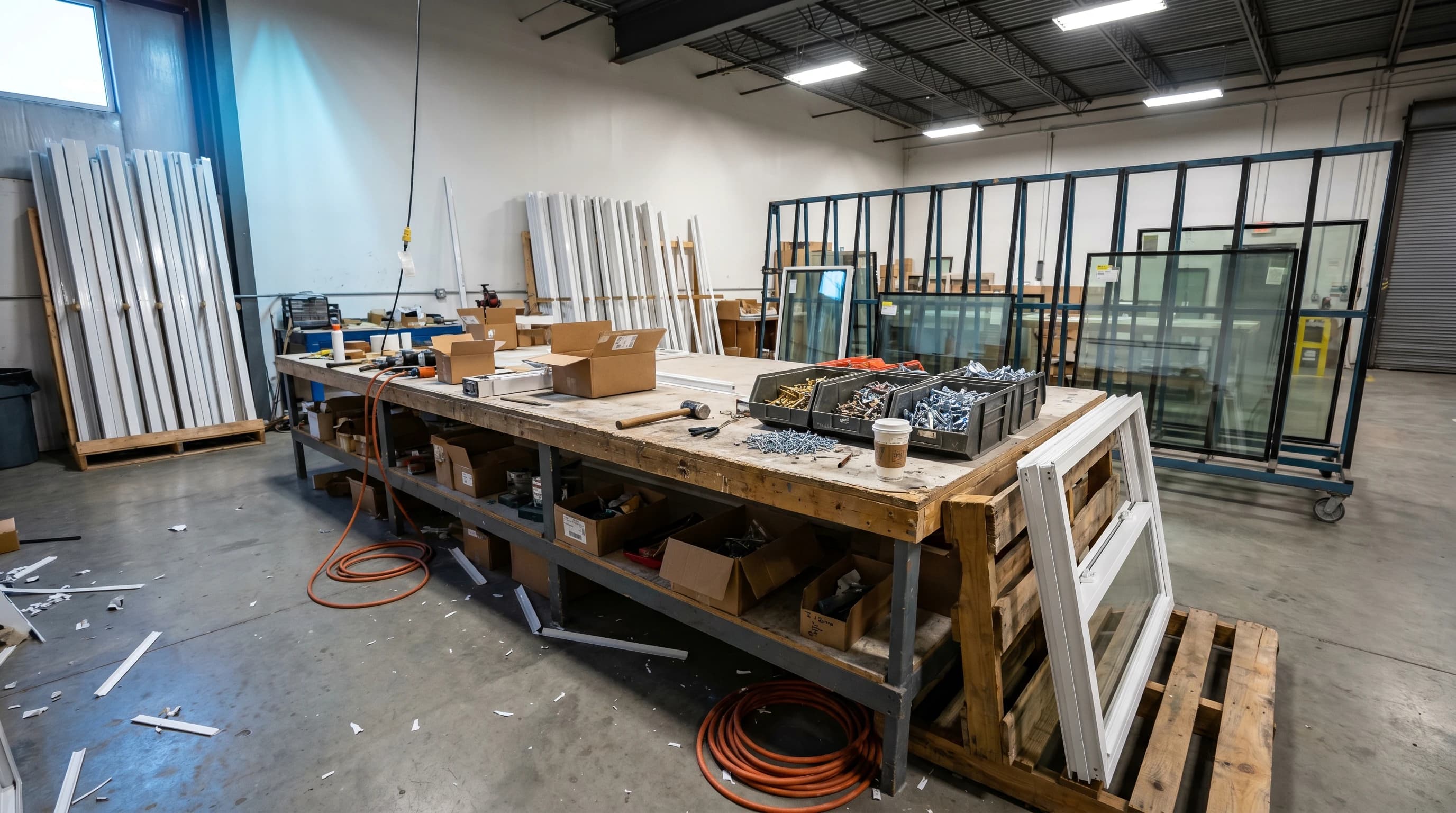
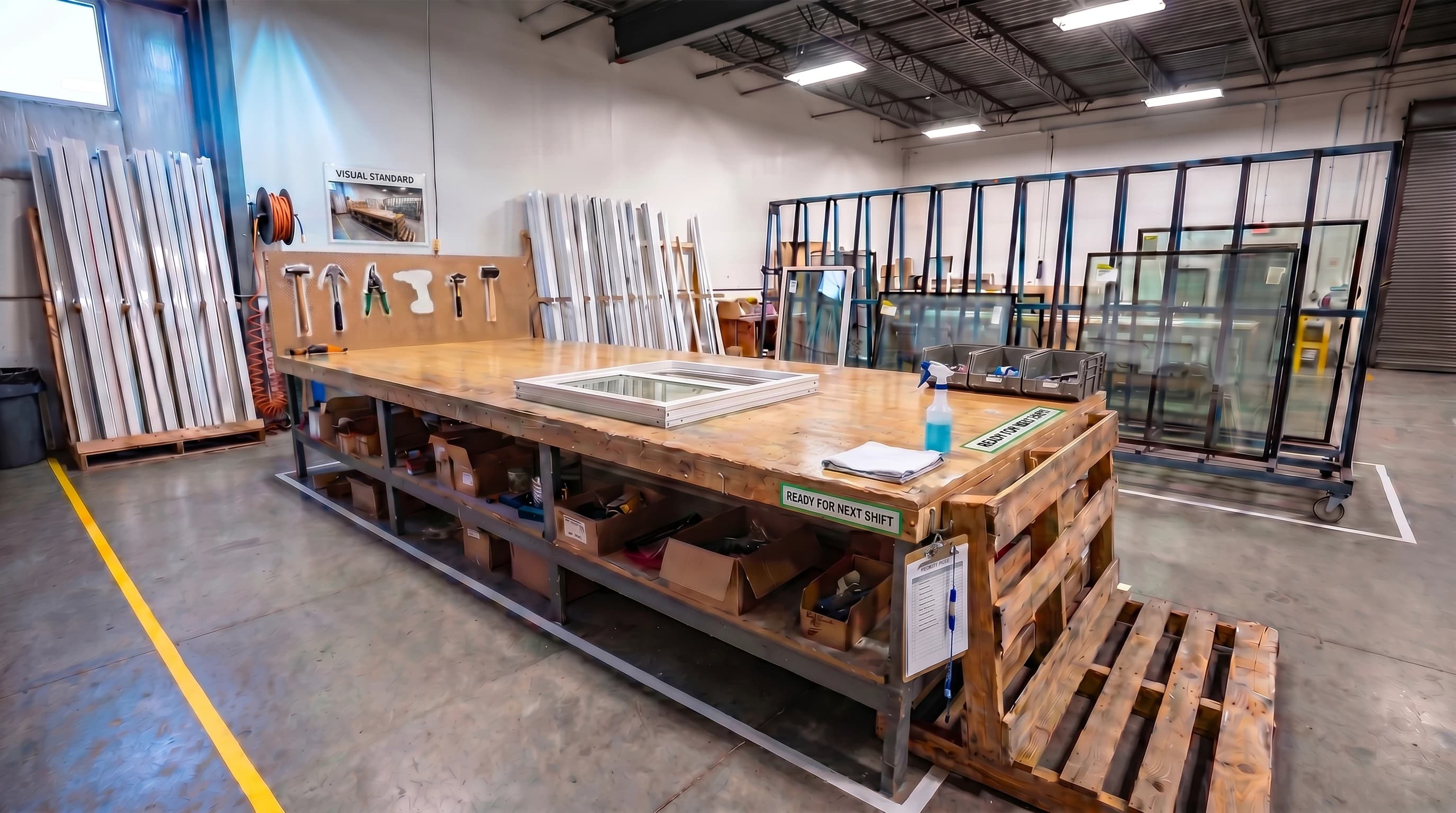
- The red-tag pocket is not storage. Every item has an owner and a decision date, and nothing stays longer than 30 days. Sort removes what today’s work does not need.
- Set in Order — one visible address
- Every surviving tool has one labeled home. The torque-driver outline is empty, so the abnormality is visible from the aisle at 06:58 — before an operator loses twenty minutes searching.
- Shine — clean to inspect
- The fixture was cleaned closely enough to check the joint for an oil weep. Shine produces findings, not a beauty score; the green witness mark records what somebody actually inspected.
- Standardize — show the good state
- A dated photo at eye level shows the expected arrangement and names the team that owns it. A stranger can compare the station with the standard without asking who cleaned yesterday.
- Sustain — attach the check to work
- The five-minute check rides on shift handover, a rhythm the team already has. Findings leave with an owner; the next check time is visible at the bench.
Key facts
- Origin
- Toyota Production System
- Five stages
- Sort, Set in order, Shine, Standardize, Sustain
- Primary objective
- Visual management
- Standard audit size
- 25 criteria (5 per stage)
- Maximum audit score
- 125 points
By Matthew Savas — Founder of Kaizumi. Reviewed 17 August 2026.
5S is a systematic methodology for workplace organization that creates and maintains an orderly, efficient, and standardized work environment. Originating in Japanese manufacturing as a foundational element of the Toyota Production System, 5S establishes a clear operational baseline so that any deviation from the standard becomes immediately noticeable. The primary objective of 5S is to implement visual management, a principle where operating standards, material levels, and tool locations are visually obvious to anyone entering the workspace. Under an effective 5S system, missing equipment, low inventory levels, or out-of-place items can be identified instantly without interrupting production or requiring search time.
A common misconception is that 5S is merely an industrial cleaning routine or housekeeping program. While cleaning removes dirt and debris, 5S creates a self-explaining workplace that eliminates ambiguity and guesswork. By establishing a visible standard of normal operations, 5S does not solve problems directly; rather, it surfaces abnormalities before they can escalate into delays, defects, or safety incidents. The governing baseline test for any 5S implementation is straightforward: can a stranger walk into the workspace and immediately distinguish normal conditions from abnormal conditions without asking questions?
The five stages of 5S
The methodology derives its name from five Japanese terms that each begin with the letter S: seiri, seiton, seiso, seiketsu, and shitsuke. These stages must be executed in sequential order because each stage provides the necessary foundation for the subsequent stage.
- Sort (seiri): The first stage separates necessary items from unnecessary items within the work area. Workers inspect every physical item, including tools, raw materials, spare parts, containers, paperwork, and personal belongings. Items required for daily operations remain in the work area, while unneeded or obsolete items are removed. The primary tool for this stage is the red-tagging protocol. The red-tag protocol establishes a holding area where unneeded items are assigned an owner and given a resolution window, typically 30 days, to be reassigned, sold, or recycled. Removing unnecessary items frees up floor space, clarifies workflow boundaries, and eliminates visual clutter.
- Set in order (seiton): The second stage arranges all necessary items in designated, visible, and ergonomic locations so they are easy to find, use, and return. The guiding rule of this stage is a place for everything and everything in its place. Tools and parts are arranged based on their frequency of use: items used multiple times per hour are placed within immediate arm reach, items used daily are stored within the workstation perimeter, and items used weekly or monthly are stored in centralized cabinets. Visual indicators such as color coding, floor tape boundaries, labels, and the use of a shadow board define exact storage positions and quantities.
- Shine (seiso): The third stage involves cleaning the work area, tools, machinery, and storage locations thoroughly. In lean operations, cleaning functions as a form of routine inspection rather than a simple janitorial task. As operators sweep floors, wipe down surfaces, and clean machinery, they inspect the equipment for oil leaks, loose bolts, frayed wiring, structural wear, or missing guards. By cleaning daily, operators identify equipment deterioration at an early stage before it results in unplanned downtime or safety hazards. Root causes of contamination are also investigated and eliminated during this stage to prevent recurring dirt and leaks.
- Standardize (seiketsu): The fourth stage establishes uniform procedures, schedules, and visual rules to maintain the gains achieved during the first three stages. Without clear operational standards, workstations rapidly revert to their prior disorganization. Standardization integrates sorting, setting in order, and shining into daily work routines by assigning explicit ownership, checklists, and time allocations to specific roles. Color-coding standards, border line definitions, and visual operating procedures are documented and posted in plain view.
- Sustain (shitsuke): The fifth stage builds the organizational discipline, training structures, and audit rhythms required to maintain established standards over time. Sustain is widely recognized as the most difficult stage because it requires ongoing adherence to defined routines. Sustain relies on regular audits, continuous training of new personnel, supportive leadership presence at the workplace, and corrective feedback cycles.
Practical implementations of these stages can be explored in the step-by-step case study Five steps on one workbench. The simulation System Shift demonstrates the direct operational impact of progressing through these workplace stages.
Play it yourself
Auditing and scoring methodology
A formal 5S audit evaluates a work area against 25 standard criteria, with five specific checkpoints for each stage. Each item is scored on a scale from 1 to 5, producing a maximum possible score of 125 points. Audits generate an average score from 0 to 5. Multiplying this average by 25 yields the overall score out of 125.
The diagnostic value of a 5S audit lies not only in the overall score, but in the variance between stages. Two separate work areas can earn an identical total score of 80 out of 125 (an average of 3.2 or 64 percent), yet represent entirely different operational realities:
- Area A exhibits high performance in initial stages but poor control in later stages. For instance, Area A may score 5.0 in Sort, 5.0 in Set in Order, 4.0 in Shine, 1.0 in Standardize, and 1.0 in Sustain. This pattern reveals an area that recently completed an intensive cleanup event but lacks the underlying systems, schedules, and audit cadence to prevent rapid operational decay.
- Area B exhibits a score spread of 0.0, with all five stages scoring an identical 3.2. This profile indicates a balanced, stable operating environment where organizational routines, standard practices, and audit cadences are functioning uniformly across all disciplines.
The standalone tool 5S audit, 25 items, scored allows organizations to assess workspaces across all 25 criteria and automatically convert low-scoring items into assigned corrective tasks.
Try it yourself
Why 5S programs fail
Because Sort, Set in Order, Shine, and Standardize involve project-based tasks, they can be completed systematically. When 5S initiatives fail, the breakdown typically stems from one of three structural causes:
- Lack of scheduled cadence and accountability for sustainment: Initiatives often treat 5S as a one-time cleaning event rather than a permanent operational standard. When leadership fails to allocate dedicated daily time for cleaning and sorting, or when regular audit rhythms are abandoned, work areas regress to their initial state. Sustain decays without an owner and rhythm.
- Unresolved audit findings: Conducting audits without an enforced corrective action mechanism produces audit fatigue. Any item scoring a 1 or 2 must immediately receive a named owner and a targeted completion date, a practice derived from disciplined gemba walk protocols. If identified abnormalities remain unaddressed, workers conclude that the standard is non-binding.
- Misalignment of ownership: Delegating 5S entirely to janitorial teams or isolated committees fails because individuals who do not perform the work lack the context and authority to sustain the standard. Operators who use the equipment, tools, and workspaces every day must participate in defining the layout, conducting the daily cleaning, and maintaining standard conditions.
Applications across different environments
Although developed in industrial manufacturing, 5S principles apply to administrative, technical, and service environments. The governing test for any 5S intervention remains the same: the change must make the correct operating method faster and easier than the incorrect method.
- Warehousing and logistics: Detailed implementation practices are documented in 5S in a warehouse. In storage facilities, 5S establishes clear aisle delineations, distinct staging locations for inbound and outbound pallets, standardized rack labeling, and defined parking zones for material handling equipment.
- Healthcare and clinical operations: The guide 5S in healthcare outlines protocols for procedure rooms, supply closets, and nursing stations. Standardizing medication trays, personal protective equipment storage, and diagnostic tool locations reduces the risk of procedural delays during critical care interventions.
- Administrative and digital environments: Digital 5S applies the same sequential stages to shared file servers, email structures, and enterprise databases. Sorting removes outdated files, setting in order establishes standardized naming conventions and directory folders, and shining purges duplicated records.
In all settings, 5S directly reduces motion and waiting, two critical components of the seven wastes. When workers do not have to search for missing tools, verify part numbers, or navigate around floor obstructions, cycle times decrease and ergonomics improve. The interactive exercise The 5S numbers game demonstrates the measurable difference in retrieval speed between unstructured and structured systems.
Relationship to standard work and implementation boundaries
Understanding the scope and boundaries of 5S prevents common implementation errors:
- Distinction from standard work: 5S organizes the physical or digital work environment, whereas standard work defines the sequential steps required to perform a task. 5S creates the stable, predictable environment necessary for standard work to be executed consistently, but it does not define the operating cycle itself.
- Inappropriate timing: 5S should not be launched in areas undergoing immediate layout reconfigurations, as this results in standardizing spaces that will soon be removed. Large-scale process redesigns, continuous flow conversions, or machinery relocations should be finalized before establishing detailed 5S visual standards.
Frequently asked questions
- What is the purpose of the red-tag protocol during the Sort stage?
- The red-tag protocol is a visual management tool used to isolate unnecessary items found in the workspace during the Sort stage. Tagged items are relocated to a designated holding area and assigned an owner along with a resolution window, typically 30 days. During this period, the owner evaluates the items to determine whether they should be returned, reassigned, sold, or recycled.
- How is a formal 5S audit scored?
- A standard 5S audit evaluates a work area against 25 specific criteria, allocating five checkpoints to each stage. Each item receives a score from 1 to 5, producing an overall average between 0 and 5, or a total score out of 125 points. Beyond the total score, audits assess variance across stages to distinguish superficial cleanups from genuine operational discipline.
- Why do 5S programs frequently collapse after initial implementation?
- Breakdowns occur when organizations treat 5S as an occasional housekeeping project rather than an ongoing operational standard. Programs typically deteriorate when teams fail to allocate daily time for maintenance, leave low-scoring audit items unresolved without assigned owners, or outsource upkeep to janitorial staff instead of the operators who use the space. Without regular audit cadences and operator ownership, workspaces rapidly revert to disorder.
- How does 5S differ from standard work?
- 5S focuses entirely on structuring the physical or digital workspace to make baseline conditions and abnormalities immediately apparent. Standard work defines the repeatable, sequential steps an operator follows to complete a specific task. While 5S provides the stable and predictable physical foundation required for standard work to function, it does not dictate the task steps themselves.
- When should an organization hold off on implementing 5S?
- Workspaces undergoing imminent layout changes, equipment relocations, or continuous flow redesigns should postpone detailed 5S implementation. Establishing shadow boards, border taping, and storage markers before structural layout changes are complete results in standardizing arrangements that will soon be discarded. Major workflow and machinery configurations must be finalized before anchoring formal visual standards.