
Standardization
Personalize This
Get insights for your role
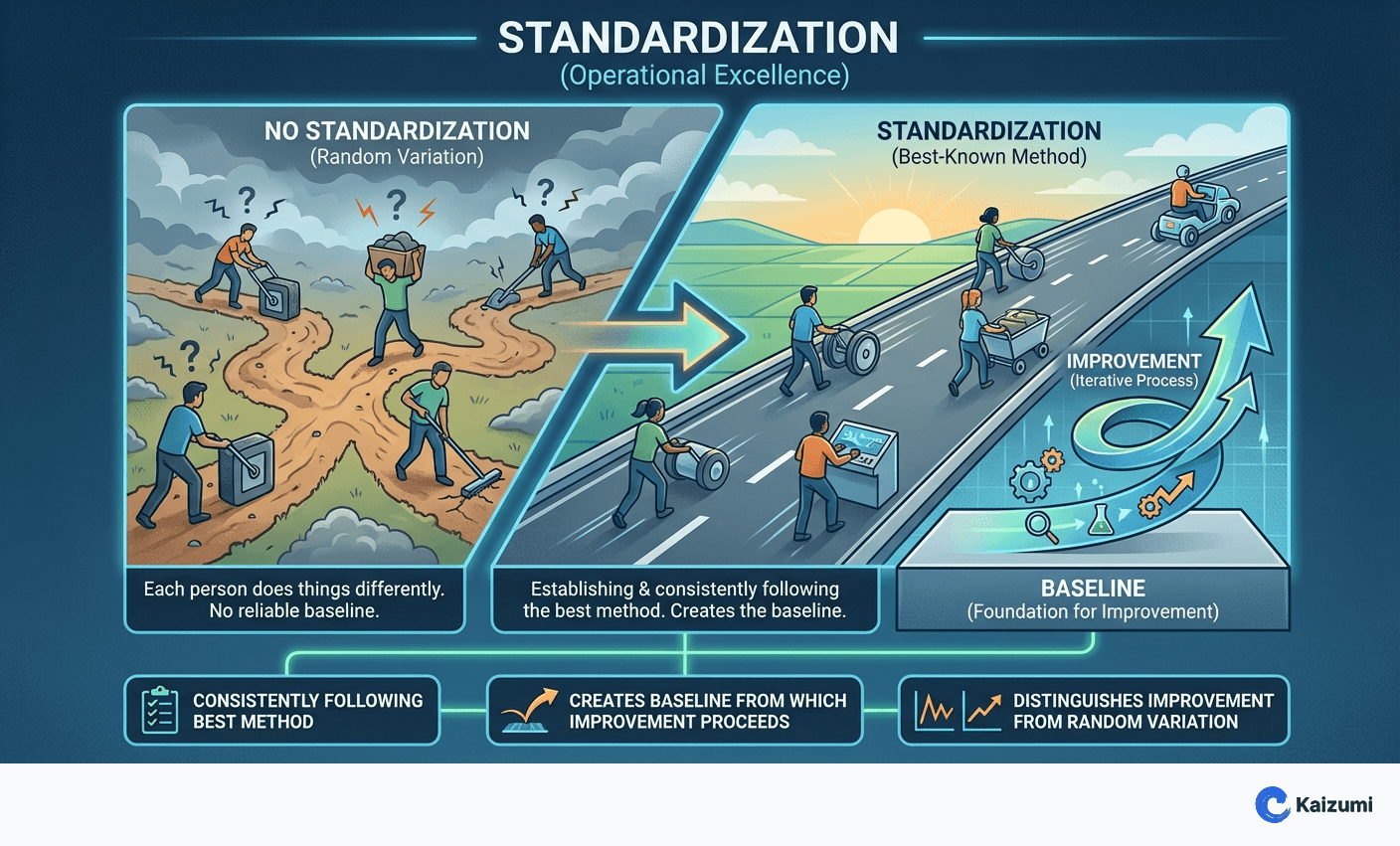
Standardization is establishing and following the current best-known method for performing work consistently and predictably.
Definition
Standardization is the practice of establishing and consistently following the best-known method for performing work. It creates the baseline from which improvement proceeds. Without standardization, there's no way to distinguish improvement from random variation—each person does things differently, so outcomes vary unpredictably. Standardization isn't about rigid rules that prevent thinking; it's about capturing current best practice so that everyone benefits from what's been learned and so that improvements can be systematically tested against the standard.
Examples
An assembly process had quality issues because each operator used slightly different methods. Standardization documented the best-known sequence and technique. Quality improved immediately as everyone used the superior method. Further improvements were tested against the standard and incorporated when proven better.
Key Points
- Standardization captures current best-known method, not permanent rules
- Standards should be changed when better methods are discovered
- Without standardization, you cannot systematically improve
- Standards must be visual, accessible, and actively followed
Common Misconceptions
Standardization prevents creativity. Good standardization creates a foundation for creativity by establishing what's known. Innovation happens by testing improvements against standards, not by random variation.
Standardization is bureaucratic compliance. Lean standardization is owned by the people doing the work, updated frequently as improvements are discovered, and serves as a tool for improvement rather than a constraint.
Try It
A standard has to be precise enough to argue with, and the table below is that level of precision. Enter each work element with its manual time, machine time, and walking time, and the timeline draws itself against takt. Waiting and walking show up as their own bars rather than getting folded into the total. Those bars are the parts of the standard worth changing next. (Also available as a standalone tool.)
See Also
- Standard Work - The application of standardization to work sequences