
Supermarket
A supermarket is a dedicated buffer that holds controlled inventory between decoupled manufacturing processes in a pull system. Positioned on the shop floor, it allows downstream customer processes to withdraw required parts in standard container quantities. Each withdrawal releases a kanban card that authorizes upstream suppliers to replenish only what was consumed. By physically restricting lane capacities and circulating cards, a supermarket caps work in progress, enforces first-in, first-out rotation, and prevents overproduction across decoupled steps.
- FIFO lanes on rollers
- Roller tracks utilize gravity to advance inventory forward automatically as items are removed from the front. This physical mechanism guarantees first-in, first-out stock rotation without requiring manual sorting or computerized tracking. The oldest container is always presented directly to the downstream operator.
- Small, fixed quantities
- Each lane is designed to hold a fixed capacity of two to three blue totes, preventing bulk accumulation. The physical dimensions of the rack enforce strict maximum inventory boundaries for every part number. Storage space cannot expand without deliberate structural alterations.
- A card on every container
- Every tote carries an attached kanban card identifying the part number, container quantity, and storage address. When an operator withdraws a tote for production, the card is detached from the container. The freed card serves as the formal signal that authorizes the replenishment of that exact item.
- The card post
- Detached kanban cards are placed into a central card post located at the supermarket. Material handlers collect these cards at regular intervals during scheduled milk runs and deliver them to upstream supplying processes. This post organizes and standardizes the flow of production signals.
- Withdrawal is the trigger
- Upstream manufacturing processes are authorized to produce parts only when a kanban card is released through actual withdrawal. Production never begins based on demand forecasts or arbitrary scheduling targets. This strict pull mechanism eliminates overproduction by tying upstream work directly to real consumption.
Key facts
- Origin
- Taiichi Ohno at Toyota Motor Corporation (1950s)
- Trigger mechanism
- Detached kanban card
- Inventory rotation
- First-in, first-out (FIFO)
- Common physical design
- Gravity flow racks with roller tracks
- Replenishment method
- Scheduled milk run delivery routes
By Matthew Savas — Founder of Kaizumi. Reviewed 1 September 2026.
A supermarket is a dedicated storage structure that manages controlled inventory between decoupled manufacturing processes within a just-in-time production environment. In a pull system, the supermarket acts as an authorized buffer where downstream customer processes withdraw the exact components they require at the moment of consumption. This withdrawal frees a kanban signal that directs the upstream supplier process to produce or deliver replacement items. By physically capping the maximum allowable inventory through dedicated lane capacities and standard container quantities, a supermarket prevents overproduction, stabilizes lead times, and maintains orderly material flow across production steps that cannot be linked in continuous one-piece flow.
Origins and concept
The supermarket concept was developed by Taiichi Ohno at the Toyota Motor Corporation during the 1950s as part of the Toyota Production System. Ohno studied the operations of American retail supermarkets, observing how retail customers selected required items directly from shelves in specific quantities, while store personnel replenished only the items and quantities that had been removed.
Ohno adapted this operational logic to discrete manufacturing. In traditional batch manufacturing, upstream processes produce goods according to an advance schedule and push completed lots into storage regardless of the downstream process's immediate operational state. This push mechanism frequently results in excess inventory, extended lead times, parts shortages, and high scrap rates when design changes occur. Ohno used the supermarket structure to invert this relationship: the downstream process becomes the customer, the upstream process becomes the supplier, and no production occurs upstream without an explicit withdrawal signal from the supermarket.
Core operating principles
A supermarket functions as a controlled inventory store positioned between two decoupled operations. Decoupling is necessary when two adjacent processes operate with different cycle times, require differing batch sizes due to machine changeover times, or exhibit different operating schedules and uptime percentages.
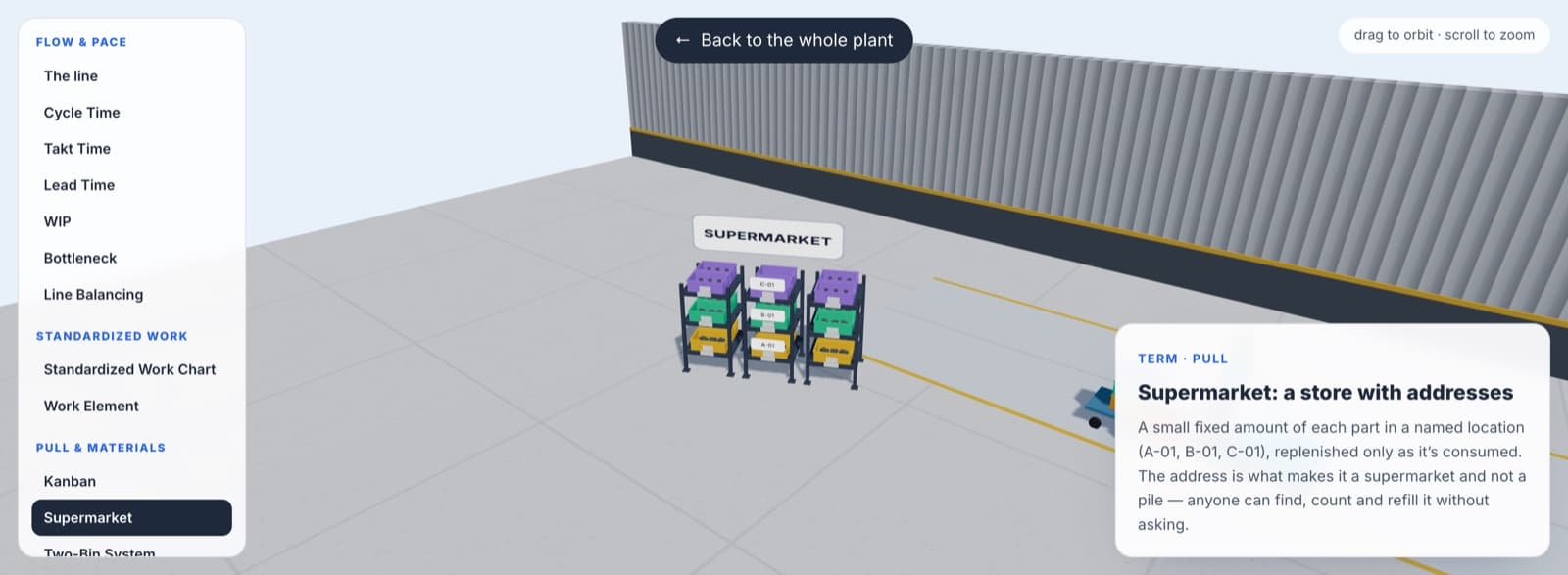
The supermarket operates on a set of standardized rules:
- Specific storage addresses: Every part number assigned to the supermarket has a designated lane or shelf location. Parts cannot be placed in unassigned locations or mixed within a single storage lane.
- Defined container quantities: Parts are stored in standard containers or totes, each holding a fixed, predetermined quantity of items.
- One-to-one kanban attachment: Exactly one production or withdrawal kanban card is attached to each container in the supermarket. The total number of circulating kanban cards represents the upper boundary of inventory that can exist for that part number.
- Customer withdrawal: The downstream operator or material handler retrieves the required parts from the front of the supermarket lane.
- Signal release: When a container is removed for consumption, the associated kanban card is detached and placed into a collection post or dispatch queue.
- Upstream authorization: The detached kanban card returns to the upstream process, serving as the sole authorization to manufacture or retrieve an identical container of parts.
- Fixed physical capacity: The physical dimensions of the storage rack prevent the insertion of additional containers beyond the engineered maximum level.
To understand the sequence of production triggers and card loops in detail, review the reference on How kanban actually works.
Physical design and FIFO management
Supermarkets are commonly constructed using gravity flow racks equipped with roller tracks, inclined shelving, or flat lane dividers. These physical configurations enforce strict first-in, first-out material rotation without requiring computerized inventory tracking.
In a gravity flow rack configuration, material handlers load replenished containers from the rear access aisle, and gravity feeds the totes forward toward the front retrieval aisle. Downstream operators withdraw containers exclusively from the front face. This mechanical design ensures that the oldest parts in the supermarket are always consumed first, preventing part obsolescence, dust accumulation, surface degradation, and the concealment of quality defects over time.
Physical lane dimensions cap inventory levels mechanically. A lane sized for three totes cannot accommodate a fourth tote; if an upstream operator produces excess parts, there is no physical location to place them in the supermarket. This physical constraint enforces production discipline and prevents unauthorized work in progress from accumulating on the shop floor. Visual indicators such as color-coded minimum and maximum level markers, clear part number placards, and address labels are placed on each lane to allow supervisors and operators to identify inventory status immediately.
Supermarket sizing and calculation
The storage capacity of a supermarket lane must be engineered to prevent downstream part shortages while minimizing working capital and floor space usage. Sizing a supermarket lane requires five operational variables:
- Daily demand: The average quantity of parts consumed by downstream processes per operating period.
- Replenishment lead time: The total elapsed time required from the moment a kanban card is released until the replacement container is manufactured, inspected, and placed into the supermarket lane. This lead time includes card collection time, upstream setup and processing time, wait time, and internal transportation time.
- Safety stock factor: A planned buffer percentage added to protect against demand variation, minor equipment stoppages, or transport delays.
- Container capacity: The standard quantity of parts contained in a single tote or bin.
- Minimum lane depth: The minimum number of physical containers required to ensure uninterrupted FIFO movement.
To determine the total number of containers required in the supermarket loop, calculate the demand during the replenishment lead time, add the safety stock quantity, and divide that total by the container capacity. When the resulting figure contains a fractional value, round up to the nearest whole integer.
Consider a practical example in a mechanical assembly facility:
- Downstream assembly operates for 8 hours per shift and consumes 480 units of a machined bracket per shift, resulting in a consumption rate of 60 brackets per hour.
- The upstream computer numerical control machining cell requires a replenishment lead time of 2 hours, which includes card collection, machine cycle time, and material transport.
- The plant management sets a safety stock policy of 20 percent of lead time demand to account for cutting tool replacements.
- The standard tote capacity is fixed at 30 brackets per tote.
To calculate the supermarket size:
First, multiply the consumption rate of 60 brackets per hour by the replenishment lead time of 2 hours, which yields a lead time demand of 120 brackets.
Second, calculate the safety stock by multiplying the lead time demand of 120 brackets by the safety stock factor of 0.20, which equals 24 brackets.
Third, add the lead time demand of 120 brackets to the safety stock of 24 brackets to determine the total required inventory of 144 brackets.
Fourth, divide the total required inventory of 144 brackets by the container capacity of 30 brackets per tote, which yields 4.8 totes.
Fifth, round 4.8 totes up to the next whole integer, resulting in 5 totes.
The supermarket lane for this machined bracket is physically constructed to hold 5 totes. Five kanban cards are placed into circulation for this part number. Under standard operating conditions, the lane will contain between 2 and 5 full totes, depending on the number of containers currently in production or transit upstream.
For warehousing applications and storage replenishment configurations, see the operational details in Kanban replenishment in a warehouse.
Material handling and replenishment routing
Material movement to and from a supermarket is managed by dedicated material handlers rather than production operators. Keeping production operators at their workstations maintains continuous cycle times and reduces ergonomic fatigue.
Material handlers execute standardized replenishment routes on fixed time intervals, such as every 20, 30, or 60 minutes. During each scheduled cycle, the handler completes a sequence of tasks:
- The handler arrives at the supermarket retrieval face and collects all detached kanban cards from the card post.
- The handler delivers these cards to the corresponding upstream production cells, placing them in the cell production queue boards.
- The handler retrieves completed totes from the upstream cell output areas, verifying that each tote has the corresponding kanban card attached.
- The handler transports the completed totes back to the supermarket using a planned milk run delivery route.
- The handler loads the totes into the rear of the designated supermarket gravity flow lanes.
This cyclical material handling routine decouples physical transportation from production timing, ensuring steady parts delivery without creating floor congestion.
Comparison with other inventory models
Manufacturing facilities use several methods to store and control materials between operations. A supermarket differs from alternative models in its control mechanisms, capacity limits, and product variety capabilities.
Supermarket versus central warehouse
A central warehouse stores high volumes of inventory in pallet racks, often managed through an enterprise resource planning system or warehouse management system. Material is pushed into the warehouse based on long-range forecasts and batch production schedules.
In contrast, a supermarket is situated directly on or adjacent to the production floor between specific consuming and supplying operations. It holds minimal, calculated inventory levels governed entirely by physical kanban signals rather than software forecasts. Supermarkets eliminate travel distance, automate replenishment signals mechanically, and highlight production delays immediately.
Supermarket versus FIFO lane
A FIFO lane is a dedicated line, chute, or conveyor that holds a sequence of parts between two linked processes without allowing part selection or reordering. FIFO lanes are applied when parts are produced in a strict sequence, or when downstream processes consume components in the exact order they were manufactured upstream.
A supermarket is required instead of a simple FIFO lane when the upstream process produces multiple part variants that are consumed downstream in unpredictable, varying sequences. The supermarket allows the downstream operator to choose any designated part number from its specific lane, while each individual lane maintains its own internal FIFO flow.
Implementation challenges and operational maintenance
Maintaining supermarket integrity requires continuous operational adherence. Several operational errors can degrade supermarket performance if left unmanaged:
- Capacity overfilling: Storing containers in aisles or stacking them on top of flow racks breaks the maximum inventory limit and conceals upstream overproduction.
- Lost or delayed kanban cards: If an operator fails to detach a card upon withdrawal, or if a material handler misplaces a card, the upstream process receives no signal to produce, leading to stockouts.
- Stale sizing parameters: Changes in customer demand, takt time, scrap rates, or upstream changeover times alter the required inventory volume. If supermarket lane sizes and card counts are not recalculated periodically, the supermarket will either accumulate excess inventory or run out of parts.
- Quality defect propagation: If an upstream process produces a batch of non-conforming parts that fills an entire supermarket lane, the defect is not discovered until the downstream process consumes preceding containers. Regular visual inspections and small container sizes limit the total defective quantity exposed to this delay.
Supermarkets require daily auditing by team leaders to verify that parts match lane addresses, container quantities match standard pack definitions, and the sum of full totes, transit totes, and active kanban cards matches the total authorized loop quantity.
Frequently asked questions
- Why is this manufacturing buffer called a supermarket?
- Taiichi Ohno developed the concept at Toyota Motor Corporation during the 1950s after studying American retail grocery stores. In a retail supermarket, customers retrieve the specific items they need from shelves, and store staff replenish only what has been taken. Ohno applied this pull logic to discrete manufacturing so upstream operations produce only what downstream customer processes have already consumed.
- What is the difference between a supermarket and a FIFO lane?
- A FIFO lane holds parts in a single strict sequence, forcing downstream processes to consume items in the exact order upstream manufactured them. A supermarket stores multiple part variants across dedicated, separate lanes, allowing downstream operators to pick whichever part number they need in varying sequences. Each individual lane within the supermarket still maintains its own first-in, first-out order.
- How does a supermarket differ from a central warehouse?
- A central warehouse stores large volumes of inventory in pallet racks based on long-range forecasts and enterprise resource planning software. In contrast, a supermarket is situated directly on the shop floor between specific processes, holding calculated, minimal inventory governed strictly by physical kanban signals. Supermarkets eliminate material travel distance and use mechanical lane limits rather than digital schedules to trigger replenishment.
- How is the storage capacity of a supermarket lane calculated?
- Sizing requires calculating downstream part demand during the upstream replenishment lead time, then adding a safety stock factor to protect against operational variability. That total required quantity is divided by the standard container capacity, and any fractional result is rounded up to the nearest whole integer. This calculated container count sets both the physical capacity of the rack lane and the number of kanban cards placed into circulation.
- How does a supermarket physically enforce first-in, first-out rotation without software?
- Supermarkets are typically constructed using gravity flow racks equipped with roller tracks or inclined shelving. Material handlers load newly replenished containers exclusively from the rear access aisle, and gravity moves the totes forward toward the front retrieval aisle. Downstream operators withdraw containers only from the front face, ensuring the oldest parts are always consumed first without computerized tracking.