
Kanban
A kanban is a physical or electronic signal that authorizes the production or withdrawal of a specific quantity of material in a lean pull system. Developed by Taiichi Ohno at Toyota, kanban ensures that upstream processes only produce or move parts when downstream processes consume them. Operating in a closed loop, the system caps work-in-process inventory, aligns manufacturing directly with customer demand, and enforces the core operational rule that no production occurs without an authorizing signal.
- Part number and name
- Exactly one part per card. The number matches the bin label, the store address, and the drawing — a mismatch anywhere stops the loop from working.
- Quantity per container
- The fixed count this card authorizes — always one full container, never a partial. Fixed quantity is what makes counting cards equal counting inventory.
- Producing process
- Who makes the part and which store lane it waits in. When this card comes off an emptied bin, it returns here as the order to make sixty more.
- Consuming process
- Where the full bin gets delivered — down to the rack address. A material handler can run the route with zero tribal knowledge.
- Card 3 of 5
- Five cards circulate in this loop, so work-in-process can never exceed five bins of sixty — 300 pieces. The card count controls the inventory level: removing a card lowers the maximum by one bin.
- Barcode
- Scanning marries the physical card to the ERP record, so electronic and physical inventory agree without a cycle count.
Key facts
- Developer & origin
- Taiichi Ohno at Toyota (late 1940s)
- Literal meaning
- Japanese for 'signboard' or 'billboard'
- Signal types
- Production kanban and withdrawal kanban
- Foundational rule
- No kanban, no production
- Initial safety factor
- 20% to 30% to absorb variability
By Matthew Savas — Founder of Kaizumi. Reviewed 17 August 2026.
A kanban (Japanese: 看板, meaning "signboard" or "billboard") is a physical or electronic signal that authorizes the production or withdrawal of a specific quantity of material. Operating within a closed loop, kanban restricts work-in-process inventory by ensuring that upstream processes only produce or move parts when downstream processes have consumed them. By converting downstream consumption into an upstream production schedule, kanban forms the operational backbone of a pull system, enforcing the principle that production must strictly mirror customer demand. One rule governs the system: no kanban, no production.
Origins and core philosophy
Developed by Taiichi Ohno at Toyota in the late 1940s, the concept was inspired by how traditional American supermarkets restock shelves: items are replaced only after consumers purchase them, preventing excess stock from accumulating. In a conventional push manufacturing environment, central planning schedules determine production based on forecasts, which frequently leads to overproduction, intermediate storage waste, and long lead times. Ohno recognized that treating downstream assembly stations as retail shoppers and upstream fabrication cells as restocking clerks would eliminate the need for speculative scheduling.
Within just-in-time production, kanban provides direct shop-floor control without relying on complex centralized tracking. Rather than pushing parts forward regardless of whether the next workstation is ready, downstream operators initiate a withdrawal signal when an item is consumed. To explore the foundational mechanics of these signals in detail, see the guide on How kanban actually works, as well as a tour Inside a Toyota assembly line.
Types of kanban signals
Kanban systems rely on two primary categories of signals to coordinate material movements and fabrication:
- Production kanban (in-process kanban): Authorizes an upstream workstation or cell to produce a fixed container of parts. A production kanban remains with the container while it is filled and travels with the finished goods to the local storage point.
- Withdrawal kanban (move kanban): Authorizes the transfer of a standard container of parts from an upstream storage point or buffer to a downstream consuming process.
In practice, these two signals interface at intermediate transfer points, often designed as a supermarket. When an operator at a downstream station removes the first part from a container, the attached withdrawal kanban is released and placed in a collection post. A material handler collects these cards, travels to the upstream supermarket, exchanges the withdrawal kanban for a production kanban attached to a full container, and brings the full container to the line. The detached production kanban is deposited in the upstream queue, signaling the supplying station to fabricate a replacement container.
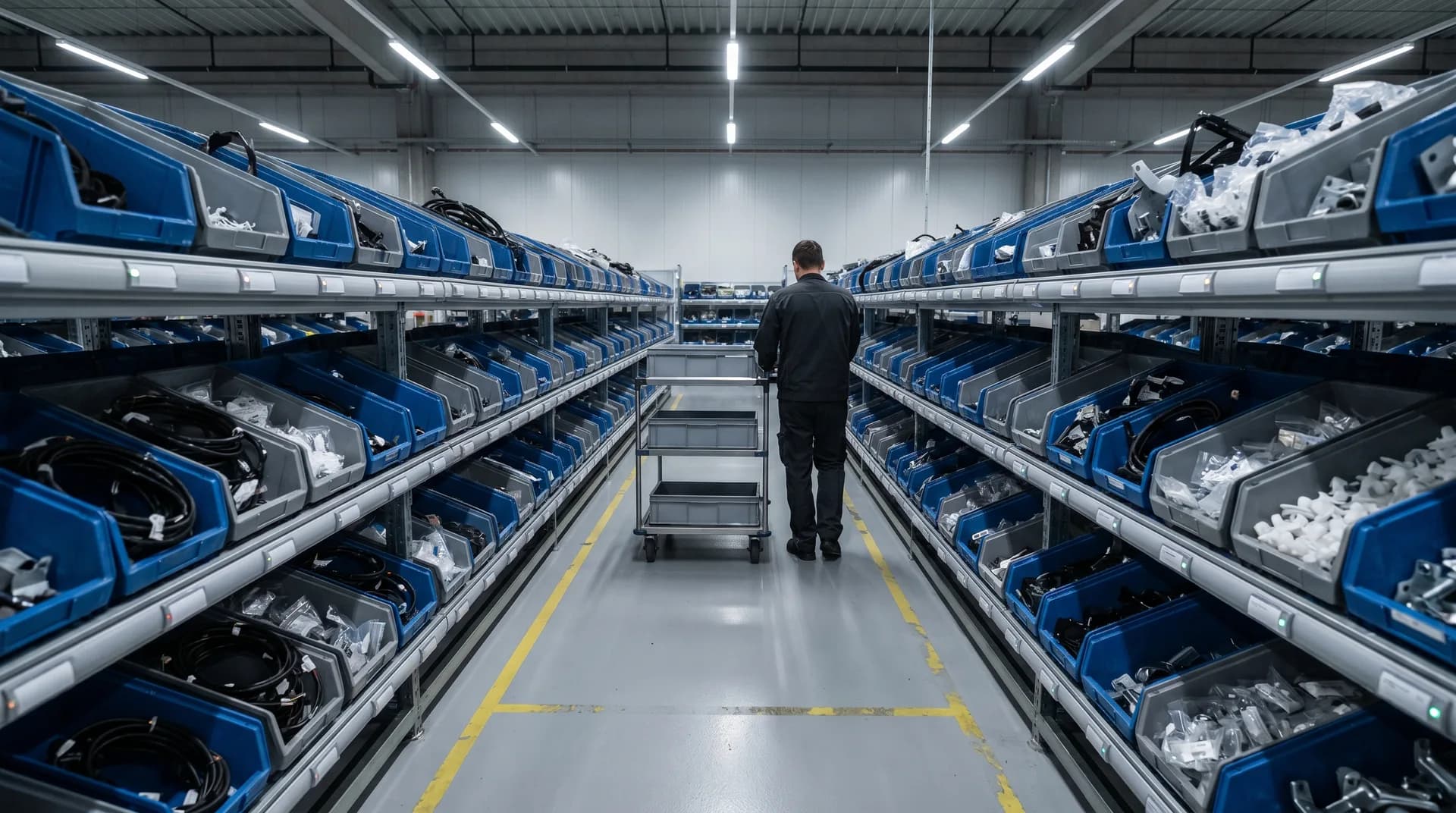
While rectangular laminated cards are the classic medium, kanban signals can take several forms, including marked floor squares, empty standardized totes, rolling racks, or digital transactions generated by barcode scans and RFID readers. Modern facilities deploy these methods across distinct domains; see Kanban in manufacturing for fabrication environments and Kanban replenishment in a warehouse for distribution facilities.
The six rules of kanban
Taiichi Ohno codified six operational rules. A kanban loop only works when every one of them holds.
- Defective parts must not be passed on to the following process. A defect stops the line so the cause is found and fixed, rather than circulating through the loop.
- The following process withdraws the necessary parts. The downstream station takes only the part, quantity, and timing its kanban specifies. Nothing moves because an upstream process decided to send it.
- The quantity of parts produced must equal the quantity withdrawn by the following process. One card authorizes one container, one for one. Producing ahead of the card is overproduction, whatever the reason.
- Do not produce or convey parts without a kanban. No card means no work and no movement. This rule is what caps work-in-process across the whole plant.
- Kanban must be attached to the actual parts. The card travels with the material it describes, so the signal and the physical stock can never drift apart.
- The number on the kanban must agree with the number of actual parts. A card marked 101 pieces accompanies exactly 101 pieces. Miscounts break the arithmetic every downstream calculation depends on.
The rules assume a stable process underneath them. Demand must be leveled with heijunka, containers must move in FIFO order, and cycle times must be repeatable. Without that foundation, the loop absorbs variation by growing, and the card count creeps upward until it holds as much inventory as the push schedule it replaced.
Calculating the number of kanban cards
The card count in any closed loop must provide enough inventory to cover consumption during one refill cycle, plus a safety allowance for minor disruptions. Calculating the required number of cards involves determining demand during the total replenishment lead time, adding a safety factor, and dividing that total by the standardized container capacity.
To calculate the card count, multiply average consumption per unit of time by the total replenishment lead time to find demand during lead time. Next, calculate the safety buffer by multiplying demand during lead time by the safety factor. Add the safety buffer to the demand during lead time to obtain the total required stock. Finally, divide the total required stock by the container capacity and round up to the next whole integer. You can automate these calculations using the Kanban card calculator.
Consider a process with an average consumption rate of 120 pieces per hour, a total replenishment lead time of 2 hours, a container size of 60 pieces, and a safety factor of 20 percent (0.20):
- Demand during lead time: 120 multiplied by 2 equals 240 pieces.
- Safety buffer: 240 multiplied by 0.20 equals 48 pieces.
- Total required stock: 240 plus 48 equals 288 pieces.
- Card calculation: 288 divided by 60 equals 4.8 cards.
- Round up: 5 cards.
Operating this loop with 5 cards caps the maximum inventory at 300 pieces (5 cards multiplied by 60 pieces per container), representing 2.5 hours of buffer stock.
If the replenishment lead time in the previous scenario is reduced from 2 hours to 1 hour through setup reduction or improved material handling:
- Demand during lead time: 120 multiplied by 1 equals 120 pieces.
- Safety buffer: 120 multiplied by 0.20 equals 24 pieces.
- Total required stock: 120 plus 24 equals 144 pieces.
- Card calculation: 144 divided by 60 equals 2.4 cards.
- Round up: 3 cards.
Halving the lead time lowers the loop cap from 300 pieces (2.5 hours of supply) to 180 pieces (1.5 hours of supply).
Safety factor selection
The safety factor provides a temporary buffer for variability in transit, processing, or consumption, functioning as integrated safety stock within the loop. Selecting the right safety percentage depends on the stability of the operating environment:
- Initial implementation: A buffer of 20 percent to 30 percent is typical when stabilizing a new loop to absorb startup variations, unproven transit times, and minor process fluctuations.
- Mature operations: As delivery reliability improves and scrap rates decline, the buffer is systematically lowered toward 10 percent to expose hidden wastes.
- High variability: Requiring a safety factor above 30 percent typically indicates underlying issues with machine reliability, quality yields, or scheduling consistency, which must be solved at the root rather than masked with extra inventory.
Anatomy of a kanban card
A standardized kanban card functions as a direct work order containing eight essential data elements:
- Part name.
- Part number.
- Container capacity and quantity.
- Source or supplying process address.
- Destination or consuming process address.
- Card index number: The specific card number and total loop count (such as Card 3 of 5).
- Barcode, QR code, or RFID identifier for automated tracking.
- Container type and packaging routing information.
Numbering cards sequentially enables immediate visual management on the shop floor. If a five-card system is operating with only four cards present, 20 percent of the planned inventory buffer is missing, indicating a lost card, an unregistered production delay, or an untracked container.
Replenishment loops and material handling
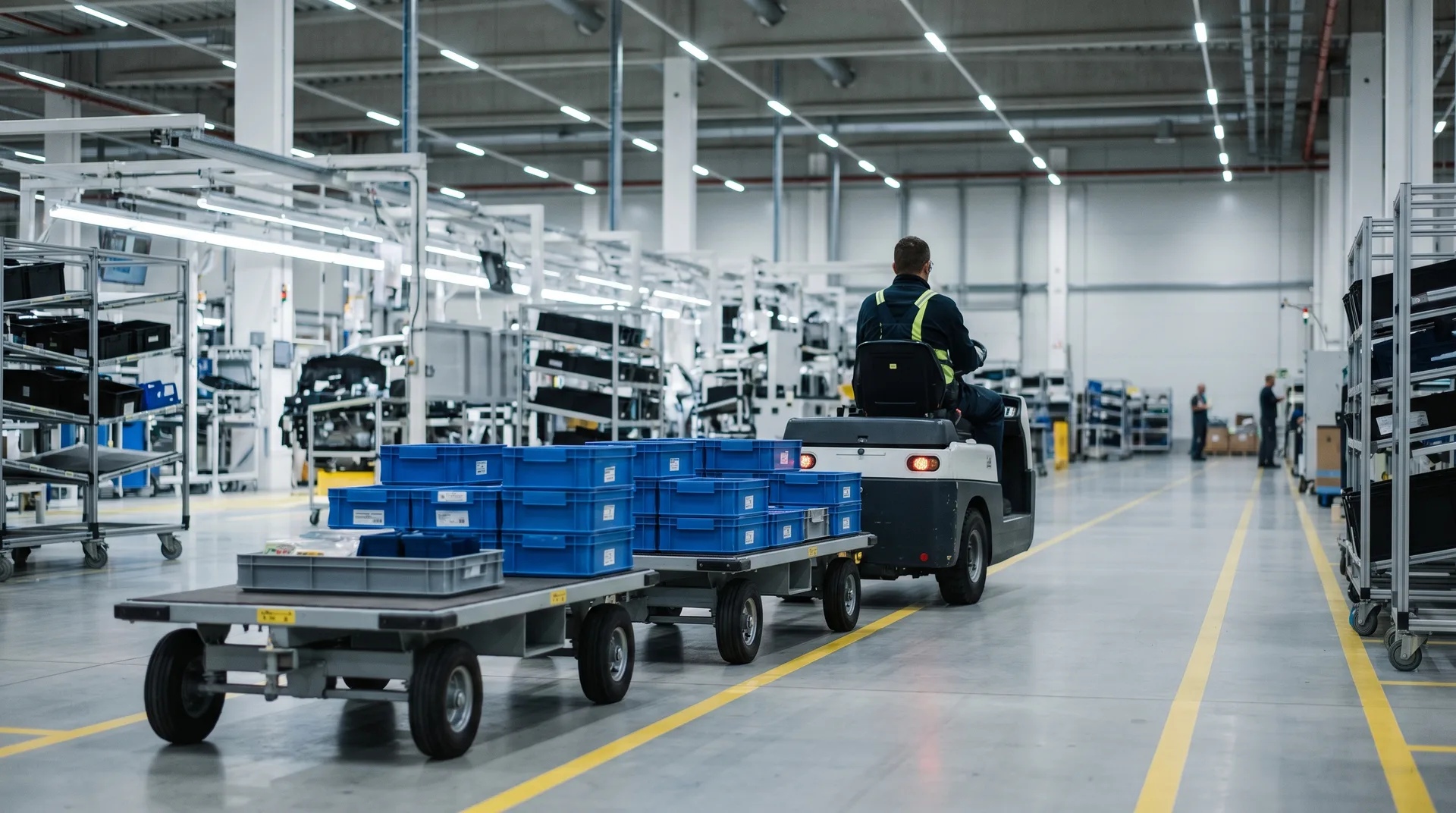
To keep lead times short and predictable, withdrawal kanban loops are tightly integrated with scheduled material handling routes, commonly known as a milk run. Instead of dispatching a material handler on demand when an individual bin runs empty, a tugger train travels along a fixed route at fixed time intervals (such as every 20 or 30 minutes).
During each run, the material handler collects detached kanban cards from collection posts, drops off replenishment bins ordered on the previous cycle, and returns cards to upstream supermarkets. Designing these routes requires balancing loop frequency with transport capacity; operations teams can size these circuits with the Milk run planner.
Upstream production cadence is synchronized to consumption through changeover discipline. To avoid building large batches that disrupt pull loops, supplying machines must achieve high changeover frequency, measured by EPEI (every part every interval). Teams evaluate these setup rhythms using the EPEI calculator to align batch sizes with container volumes.
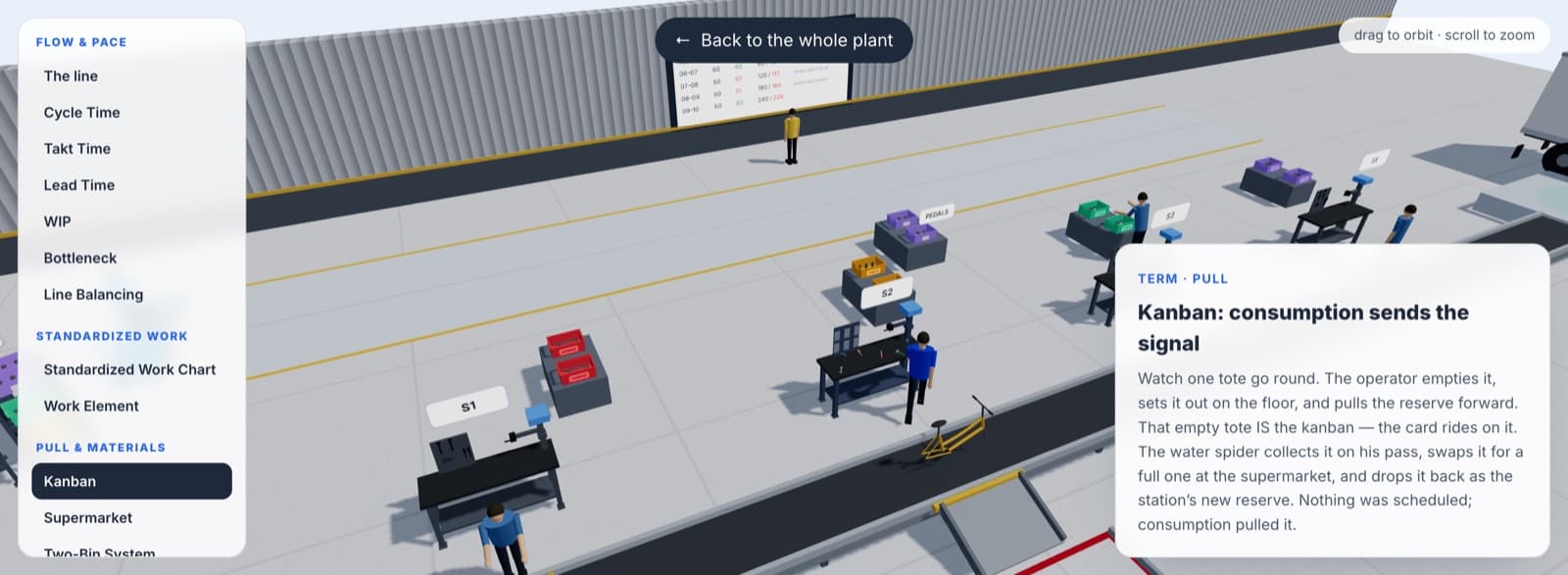
To experiment with these dynamics and see how card limits control work-in-process in a simulated production environment, run the E-bike factory simulation.
Continuous improvement through card reduction
Inventory hides operational problems: long machine changeovers, unreliable equipment, late vendor deliveries, and quality defects. A loop carrying enough cards absorbs all of them, so nobody has to fix any of them.
A kanban loop makes the buffer adjustable. Once a loop operates smoothly at a given card count, plant leadership deliberately removes one card from circulation. Removing a card lowers the inventory buffer, tightening the loop. If the system continues to operate without starving the line, the removed inventory was pure waste. If line stoppages or shortages occur, the underlying bottleneck is exposed.
Engineers and operators do not solve the stoppage by permanently returning the card; instead, they conduct root-cause problem solving on the newly surfaced failure mode. Once the process issue is resolved, the loop runs stably at the lower inventory ceiling. Through this continuous cycle of lowering card counts, kanban transforms passive inventory into an active driver of process improvement.
Frequently asked questions
- What is the difference between a production kanban and a withdrawal kanban?
- A production kanban authorizes an upstream workstation to fabricate a fixed container of parts and remains with the goods until they reach storage. A withdrawal kanban authorizes the transfer of a standard container of parts from an upstream storage point or supermarket to a downstream workstation. Working together at intermediate transfer points, the two signals coordinate parts replenishment without centralized scheduling.
- How is the number of kanban cards in a loop calculated?
- To calculate the card count, multiply average consumption per unit of time by the total replenishment lead time, then add a safety buffer based on that lead-time demand. Divide this total required stock by the standardized container capacity and round up to the next whole integer. Operating with this calculated total caps the maximum allowable inventory in circulation across the loop.
- Why do facilities deliberately remove kanban cards from an active system?
- Removing a card lowers the inventory ceiling and tightens the loop, which exposes operational issues such as long changeovers, machine breakdowns, or defective parts. If the system continues operating normally without starving downstream workstations, the removed inventory represented pure waste. When line stoppages occur, teams perform root-cause problem solving on the newly surfaced failure mode rather than permanently returning the card.
- What essential information must appear on a standardized kanban card?
- A kanban card functions as a direct work order that lists the part name, part number, container capacity, supplying process address, and consuming process address. It also specifies the container type, packaging routing, and a barcode or RFID identifier for automated tracking. Sequential index numbers, such as Card 3 of 5, are printed on the cards to make missing stock or production delays immediately visible.
- How should a team select the safety factor for a kanban calculation?
- Initial implementations typically use a safety factor between 20 percent and 30 percent to absorb startup variations, unproven transit times, and minor process fluctuations. As delivery reliability improves and scrap rates decline, mature operations systematically reduce the buffer toward 10 percent to reveal hidden wastes. Requiring a safety factor above 30 percent indicates underlying issues with machine reliability or scheduling consistency that should be fixed at the root.