
Vibration Analysis
Personalize This
Get insights for your role
Vibration analysis is a condition monitoring technique that detects equipment problems by analyzing mechanical vibration patterns and frequencies.
Definition
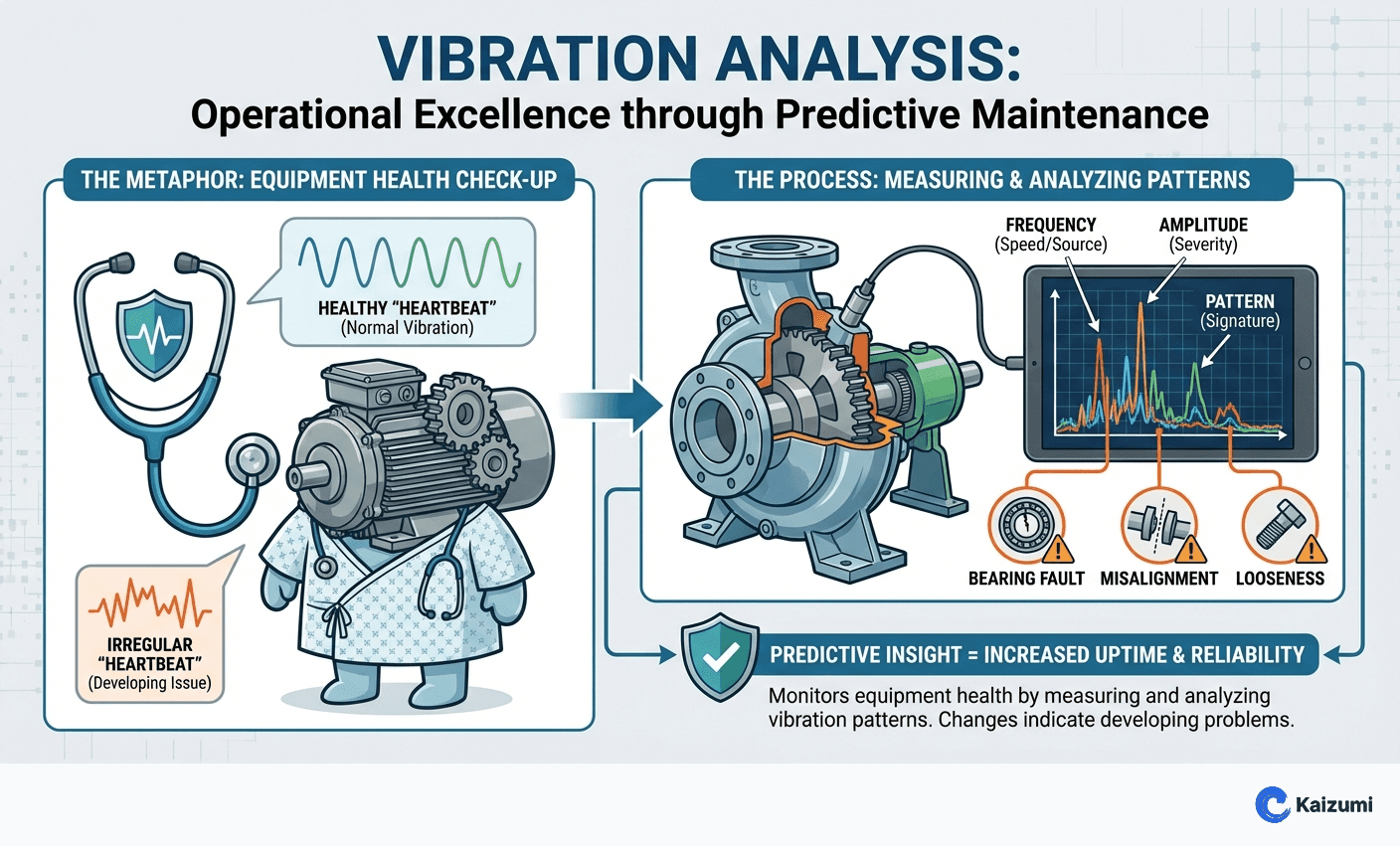
Vibration analysis is a predictive maintenance technique that monitors mechanical equipment health by measuring and analyzing vibration patterns. All rotating and reciprocating equipment produces vibration signatures. Changes in amplitude, frequency, or pattern indicate developing problems: bearing wear, imbalance, misalignment, looseness, or gear damage. By detecting these changes early, maintenance can be scheduled before failure occurs. Vibration analysis is one of the most powerful and widely used condition monitoring technologies.
Examples
Monthly vibration readings on pump bearings showed gradual amplitude increase in a specific frequency band—the bearing defect frequency. The pattern indicated outer race wear with approximately 6 weeks until failure. Bearing replacement was scheduled during the next planned shutdown, avoiding unplanned failure.
Key Points
- Measures amplitude, frequency, and patterns of mechanical vibration
- Detects bearing wear, imbalance, misalignment, looseness, gear damage
- Enables scheduling maintenance before failure
- Requires baseline data to detect meaningful changes
Common Misconceptions
Vibration analysis is only for large equipment. While most valuable for large, critical equipment, portable analyzers and now wireless sensors enable vibration monitoring on smaller machines cost-effectively.
High vibration always means imminent failure. Vibration levels indicate condition, not timing. A machine with elevated vibration might run weeks or months depending on severity and failure mode. Trending matters more than absolute levels.