
Voice of Customer
Personalize This
Get insights for your role
Voice of Customer (VOC) is the structured process of capturing customer needs, expectations, and preferences to guide product and process design.
Definition
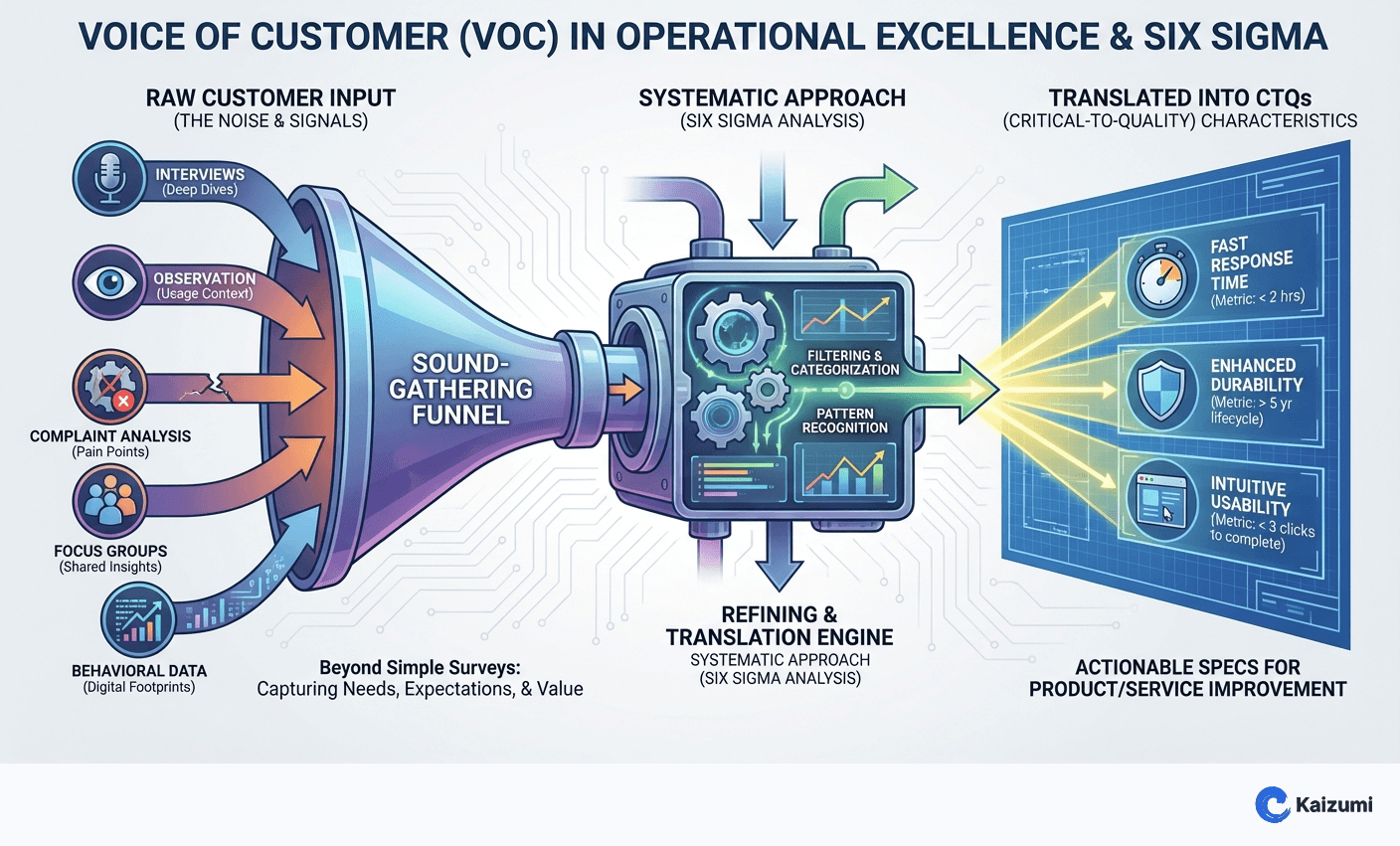
Voice of Customer (VOC) is a systematic approach to capturing what customers truly need, expect, and value from a product or service. VOC goes beyond simple surveys to include interviews, observation, complaint analysis, focus groups, and behavioral data. In Six Sigma, VOC data is translated into CTQs (Critical to Quality characteristics) that drive improvement projects. The goal is to understand not just what customers say they want, but what they actually need—including needs they may not articulate.
Examples
An appliance maker analyzed warranty claims, call center logs, and online reviews. VOC revealed that customers valued "quiet operation" far more than the "powerful motor" marketing had emphasized. This insight redirected R&D investment toward noise reduction.
Key Points
- Collect VOC from multiple sources: surveys, interviews, complaints, observations, sales data
- Distinguish between stated needs (what customers say) and latent needs (what they don't articulate)
- Use affinity diagrams to organize and prioritize VOC data
- Translate VOC into measurable CTQs before starting improvement work
Common Misconceptions
VOC is just customer surveys. Surveys capture stated preferences but miss latent needs. Comprehensive VOC includes observation, complaint analysis, competitive analysis, and behavioral data. Customers often can't articulate what they really need.
VOC is a one-time exercise. Customer needs evolve. Effective organizations continuously collect VOC data and refresh their understanding. Annual or project-based VOC quickly becomes outdated.