
QFD (Quality Function Deployment)
Personalize This
Get insights for your role
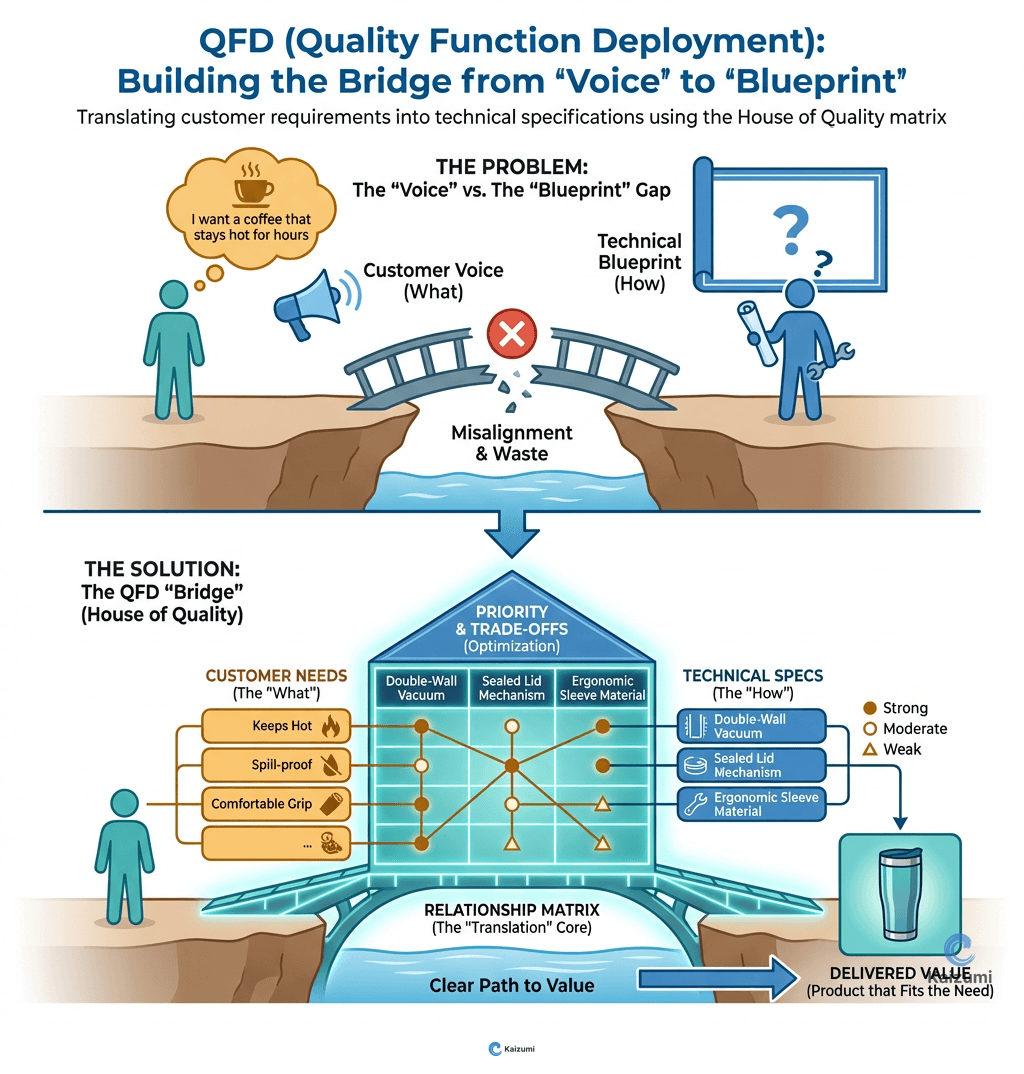
QFD is a structured method for translating customer requirements into technical specifications through the 'House of Quality' matrix.
Definition
Quality Function Deployment (QFD) is a structured methodology for translating customer requirements (voice of customer) into technical specifications at each stage of product development. The primary tool is the "House of Quality"—a matrix that maps customer requirements (the "whats") against technical characteristics (the "hows"), showing the strength of relationships between them. QFD ensures customer needs drive design decisions rather than engineer preferences, identifies trade-offs between technical choices, and provides a systematic way to prioritize development efforts. The process cascades through product planning, part design, process planning, and production planning.
Examples
A hospital designing a new clinic used QFD to translate patient requirements (short wait, clear communication, convenient access) into facility and process characteristics (room layout, signage systems, scheduling protocols). The structured approach ensured patient needs drove design decisions.
Key Points
- Systematically translates customer voice into technical specifications
- Reveals relationships and trade-offs between design choices
- Cascades through multiple levels of design detail
- Forces prioritization based on customer impact
Common Misconceptions
QFD is just a matrix exercise. The matrix is the output; the real value is the cross-functional dialogue required to build it. QFD's power comes from forcing engineers, marketers, and customers to align on priorities.
QFD guarantees good products. QFD is garbage-in, garbage-out. Poor understanding of customer requirements or weak technical relationships produces matrices that don't improve decisions.