
Customer Focus
Personalize This
Get insights for your role
Customer focus is the practice of understanding and prioritizing customer needs as the basis for all operational decisions.
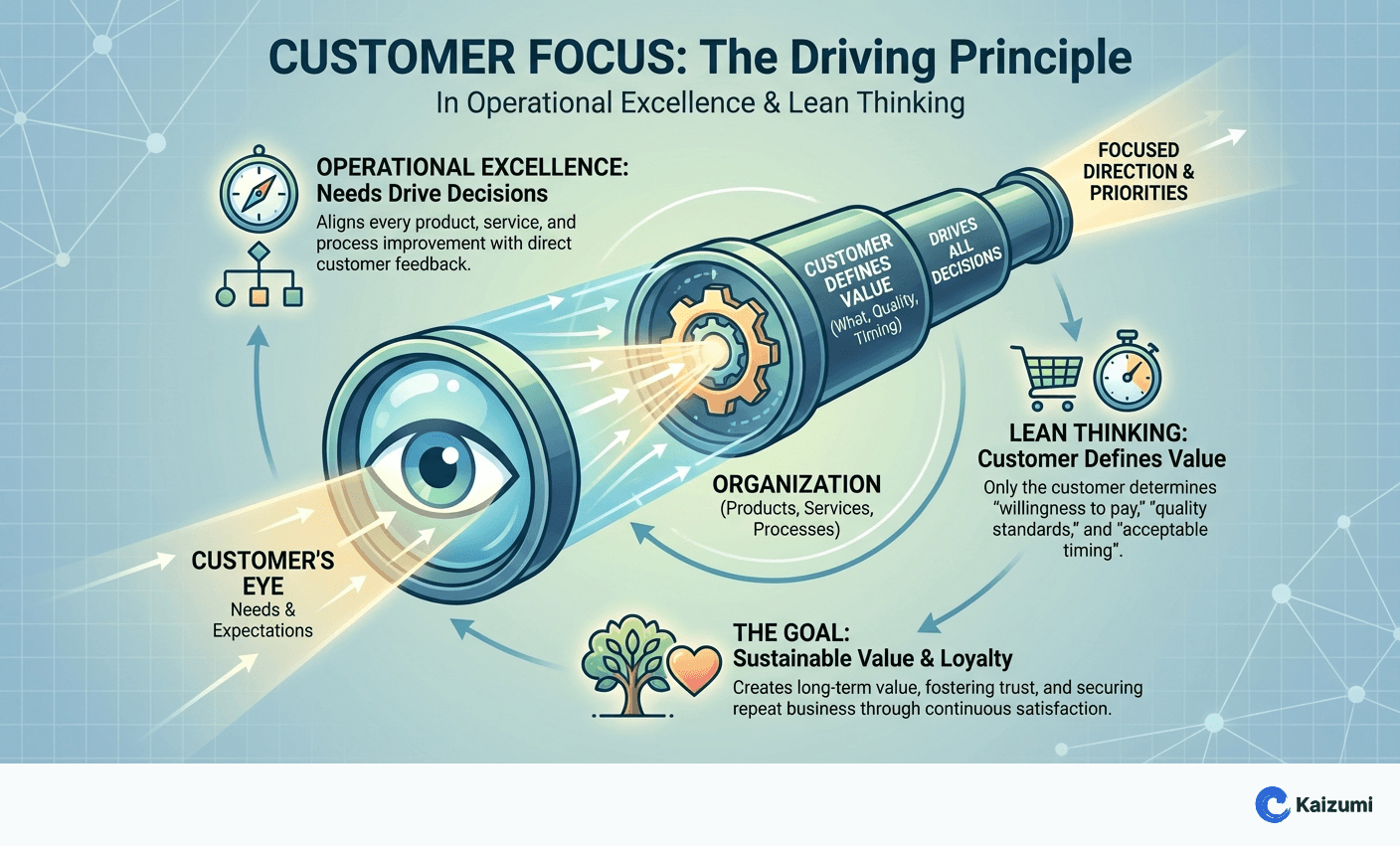
Definition
Customer focus is the operational principle that customer needs and expectations should drive all decisions about products, services, and processes. In lean thinking, the customer defines value—only the customer can say what they're willing to pay for, what quality means to them, and what timing meets their needs. Customer focus requires actively understanding customer requirements, translating them into operational specifications, and continuously verifying that what's delivered matches what's needed. Internal perspectives on value are subordinate to what customers actually want.
Examples
A supplier discovered that their customer didn't actually need the tight tolerance they were struggling to hold. By asking about how the part was used, they learned that a wider tolerance was acceptable if surface finish improved. Customer focus meant asking what mattered, not assuming.
Key Points
- Only the customer can define value; internal views are assumptions to be tested
- Customer focus requires active listening and investigation, not passive data collection
- Internal customers exist in support processes; their needs matter too
- What customers say they want and what they actually need may differ—both matter
Common Misconceptions
Customer focus means giving customers whatever they ask for. True customer focus includes understanding underlying needs, which may differ from stated wants. Customers sometimes request solutions when what they need is for a problem to be solved.
All customers are equal. Customer segmentation matters. Different customers have different needs, and optimizing for one segment may disappoint another. Understanding which customers to focus on is part of customer focus.
See Also
- Voice of Customer - Methods for understanding customer needs