
Batch Size
Personalize This
Get insights for your role
Batch size is the quantity of items processed together before moving to the next step - smaller batches enable faster flow.
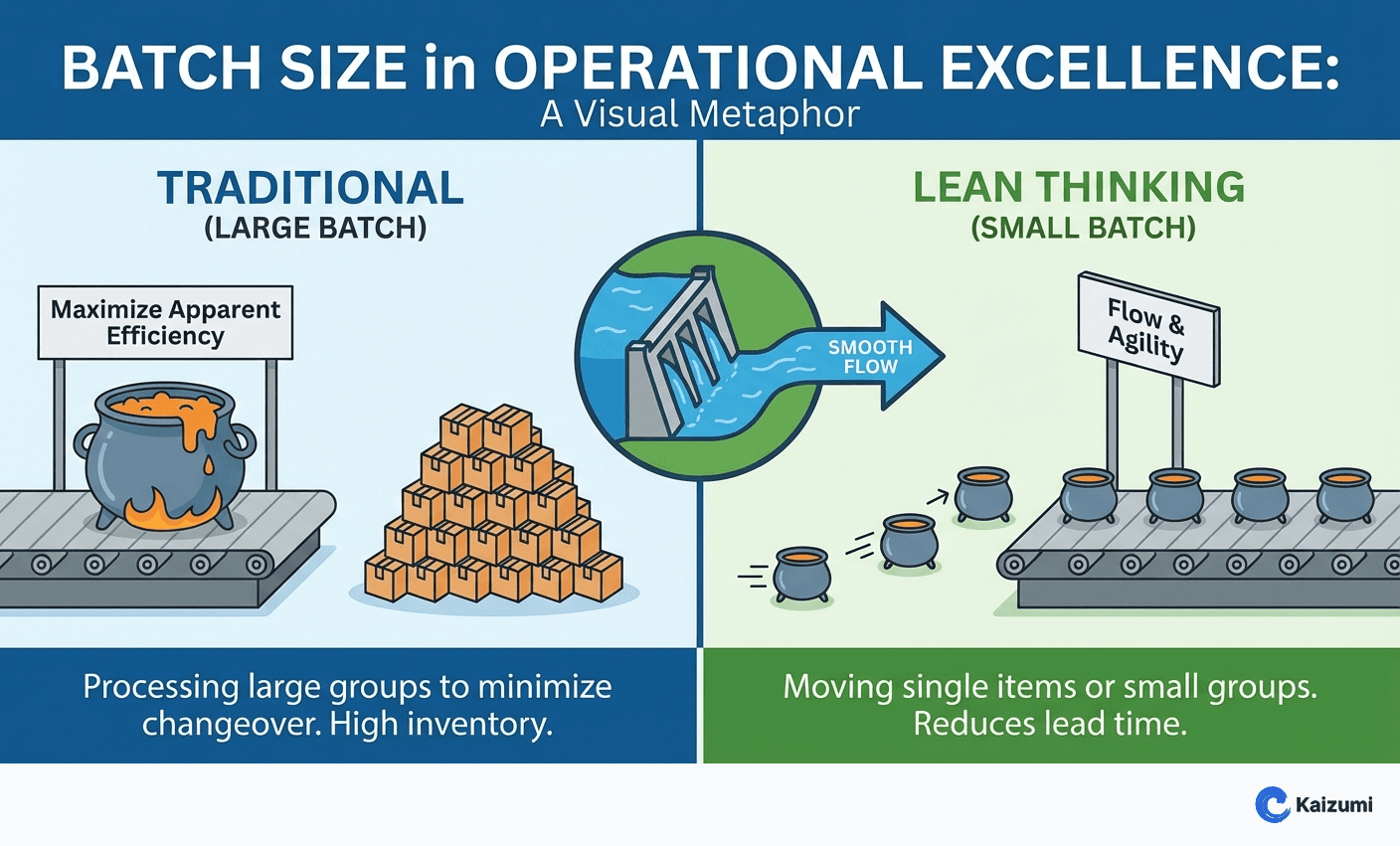
Definition
Batch size is the number of items processed, moved, or inspected together as a group before proceeding to the next step. Traditional operations favor large batches to minimize changeover costs and maximize apparent efficiency at each step. Lean thinking challenges this by recognizing that large batches create waste: waiting (items wait for the batch to complete), inventory (WIP accumulates), quality issues (defects multiply before detection), and long lead times. Smaller batch sizes, ideally approaching one-piece flow, dramatically improve flow and responsiveness.
Examples
A stamping operation traditionally ran batches of 5,000 pieces to minimize the impact of hour-long changeovers. By applying SMED to reduce changeover to 10 minutes, they economically produced batches of 500. Lead time dropped from weeks to days, and defective parts were caught after 500 rather than 5,000.
Key Points
- Batch size directly affects lead time—smaller batches mean faster flow
- Large batches hide quality problems by delaying detection
- Reducing batch size requires addressing changeover time and other barriers
- The ideal batch size is one—true one-piece flow
Common Misconceptions
Large batches are more efficient. Large batches optimize local step efficiency while sub-optimizing total system flow. The "efficiency" of large batches ignores the waste created by waiting, inventory, and delayed feedback.
Batch size is determined by technology. While some equipment has minimum batch requirements, batch size is often chosen, not forced. Many batch-size constraints are self-imposed conventions that can be challenged.