
Work in Process
Personalize This
Get insights for your role
Work in Process (WIP) is all the material, information, or work that has started but not yet completed - inventory between process steps.
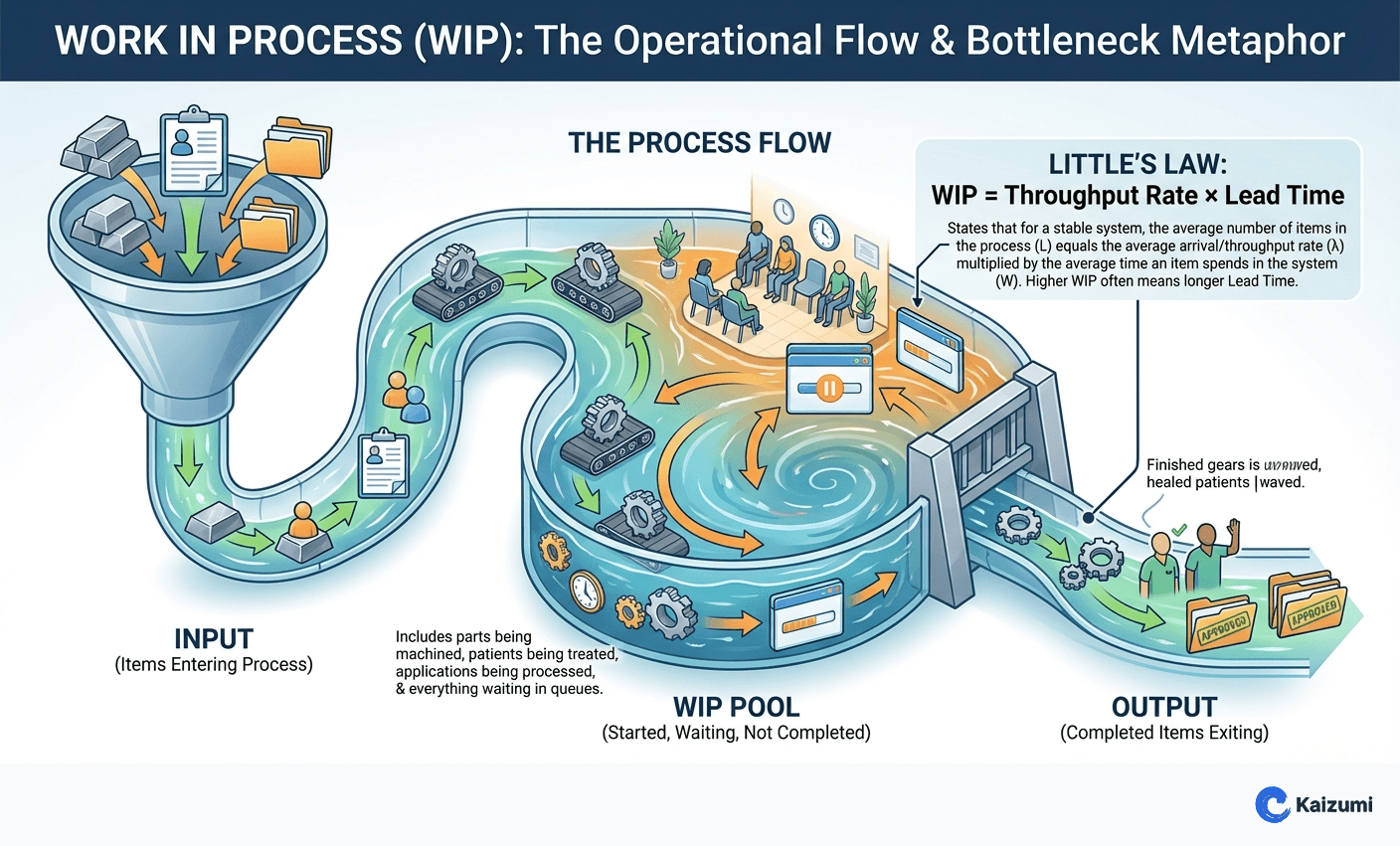
Definition
Work in Process (WIP) represents all items that have entered a process but haven't yet exited—work that's been started but not completed. WIP includes parts being machined, patients being treated, applications being processed, and everything waiting in queues between steps. Little's Law establishes that lead time equals WIP divided by throughput, meaning that reducing WIP directly reduces lead time. High WIP levels indicate flow problems, hide quality issues, and consume resources (space, capital, attention) without yet delivering value.
Examples
A machining department has 500 parts in various stages of completion—some on machines, most waiting in queues between operations. This WIP represents three weeks of lead time. By reducing batch sizes and improving flow, they cut WIP to 100 parts and lead time to three days.
Key Points
- WIP and lead time are directly related through Little's Law
- High WIP hides problems by buffering between processes
- Reducing WIP exposes problems that must then be solved
- WIP consumes resources (space, capital, attention) without delivering value
Common Misconceptions
High WIP keeps everyone busy. Keeping people busy with WIP that customers haven't yet received isn't productive. The goal is throughput, not busyness. Lower WIP with same throughput is more efficient.
WIP provides safety against disruption. While some buffer may be needed, high WIP often masks the disruptions that should be fixed. Lower WIP forces problem-solving that improves the underlying process.