
Breakdown Maintenance
Personalize This
Get insights for your role
Breakdown maintenance is reactive repair performed only after equipment fails, addressing problems after they cause production stoppage.
Definition
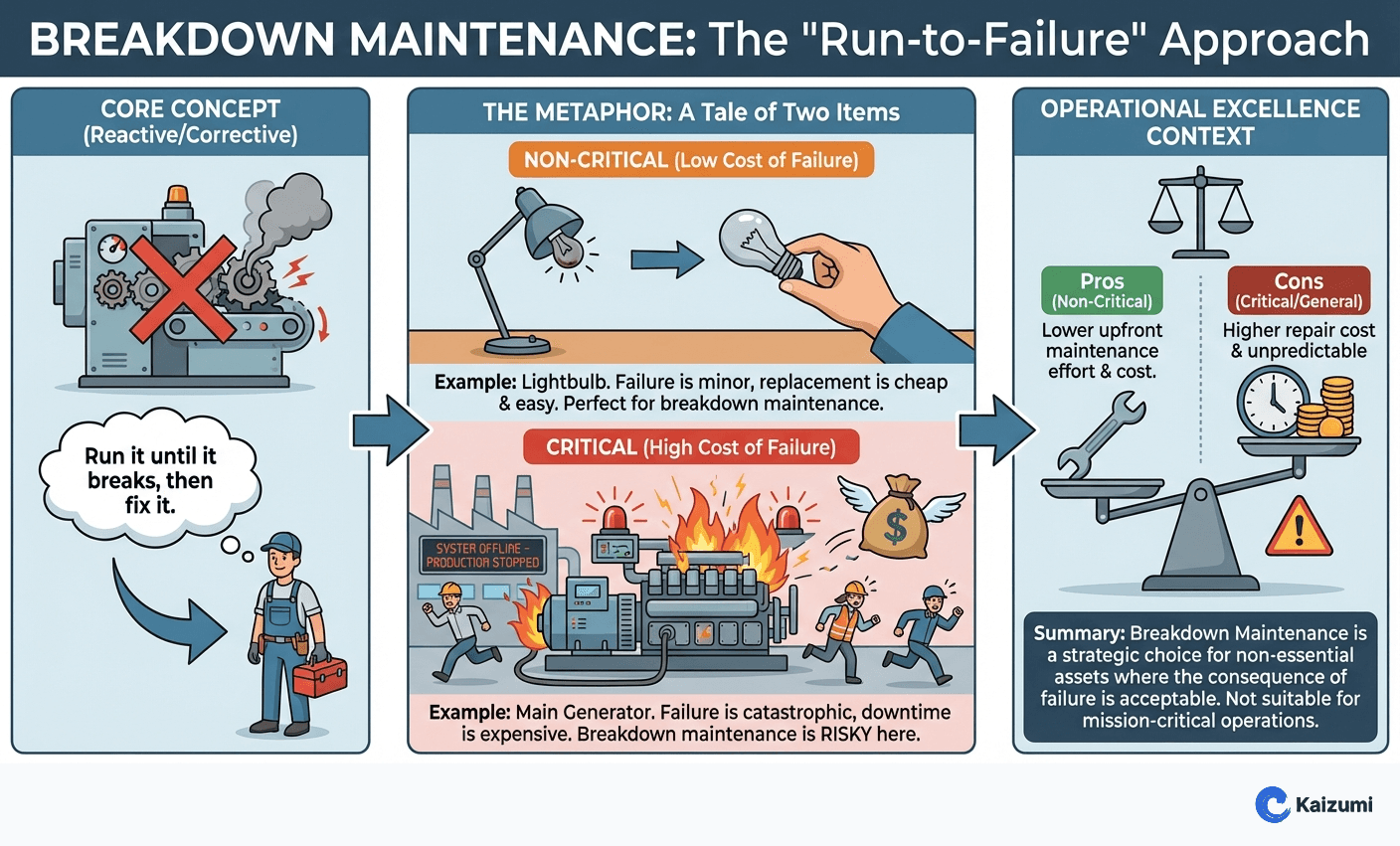
Breakdown maintenance (also called reactive or corrective maintenance) is maintenance performed only after equipment has failed. The approach is "run it until it breaks, then fix it." While seemingly inefficient, breakdown maintenance is appropriate for non-critical equipment where failure cost is lower than prevention cost, redundancy provides backup, or failure modes are unpredictable. TPM aims to minimize unplanned breakdown maintenance on critical equipment while accepting it for appropriate applications.
Examples
A plant ran non-critical conveyor motors until failure—MTBF of 5 years made preventive replacement uneconomical. When failures occurred, standard motors were replaced in 30 minutes from on-site inventory. Breakdown maintenance was the right strategy for this low-criticality, easily replaced equipment.
Key Points
- Maintenance only after failure—"run to fail"
- Appropriate for non-critical, easily replaced, unpredictable failure equipment
- Inappropriate for critical equipment where failure cost is high
- TPM reduces breakdown maintenance on critical assets, not all assets
Common Misconceptions
Breakdown maintenance is always bad. For low-criticality equipment with low failure impact and high prevention cost, reactive maintenance is economically optimal. TPM applies preventive approaches selectively to critical equipment.
TPM eliminates all breakdown maintenance. TPM targets zero unplanned breakdowns on critical equipment. Planned breakdown maintenance (running known non-critical items to failure) may be appropriate strategy. The goal is eliminating surprises, not all reactive repairs.