
Cost of Quality
Personalize This
Get insights for your role
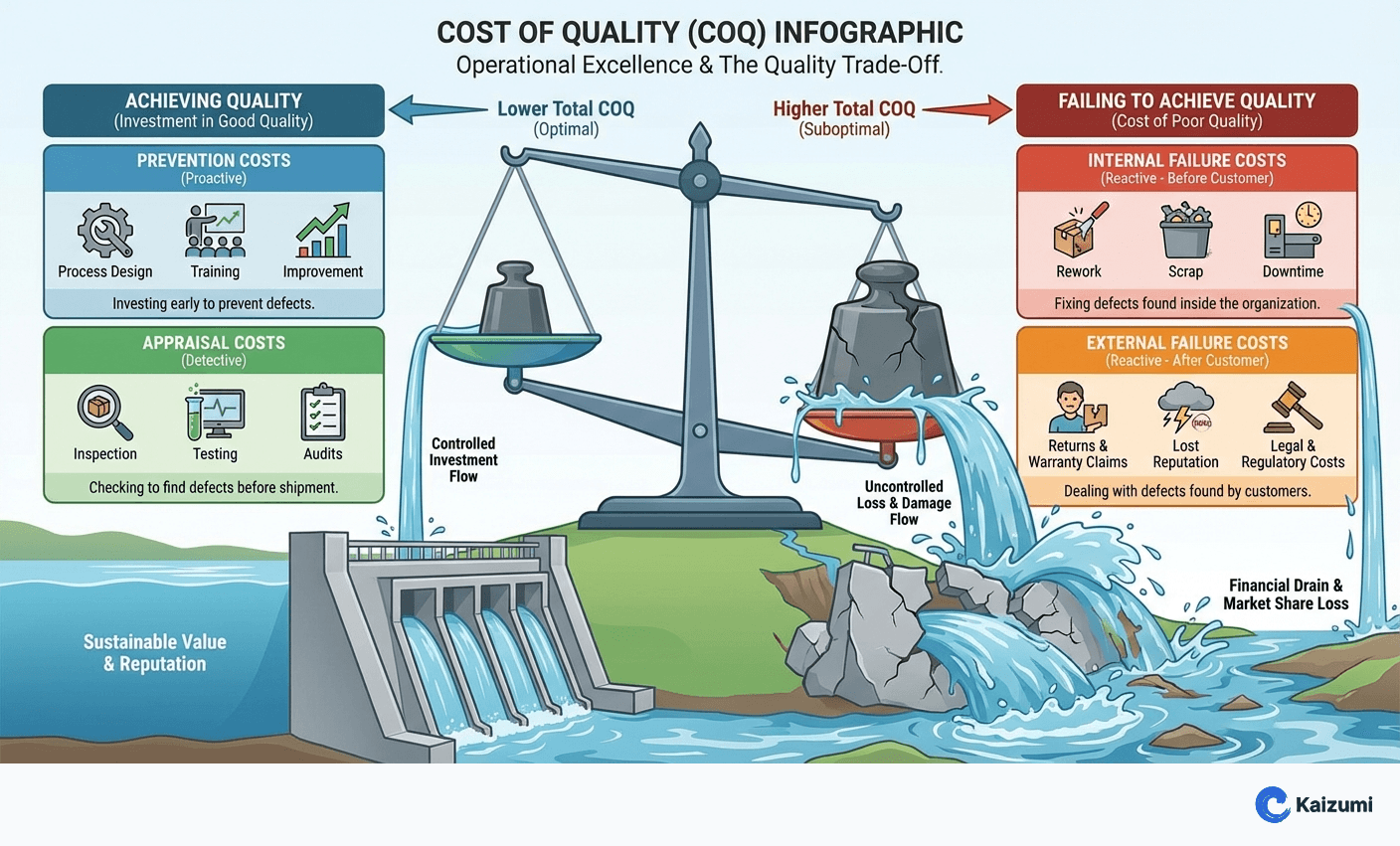
Cost of Quality (COQ) measures the total cost of ensuring quality and the cost of failing to achieve it—prevention, appraisal, and failure costs.
Definition
Cost of Quality (COQ) is a methodology for quantifying the total organizational cost related to quality—both the cost of achieving quality and the cost of failing to achieve it. COQ includes four categories: Prevention costs (training, process design, improvement), Appraisal costs (inspection, testing, audit), Internal failure costs (scrap, rework, retesting), and External failure costs (warranties, returns, reputation damage). Understanding COQ reveals the business case for quality investment and guides improvement priorities.
Examples
A COQ analysis revealed: Prevention 8%, Appraisal 12%, Internal Failure 25%, External Failure 55% of total quality costs. The heavy external failure costs (warranty claims, returns) justified significant investment in prevention and earlier detection—the analysis shifted quality strategy.
Key Points
- Four categories: Prevention, Appraisal, Internal Failure, External Failure
- Total COQ often 15-25% of revenue in typical organizations
- Optimal balance: invest more in prevention to reduce failure costs
- Makes quality improvement a financial argument, not just moral one
Common Misconceptions
Lower COQ is always better. Zero COQ would mean no quality investment and 100% defects. The goal is optimizing the mix—typically increasing prevention to dramatically reduce failure costs, lowering total COQ while improving quality.
COQ only applies to manufacturing. Any organization has quality costs—service errors, rework, customer complaints. The categories apply universally even though specific costs vary by industry.