
Hidden Factory
Personalize This
Get insights for your role
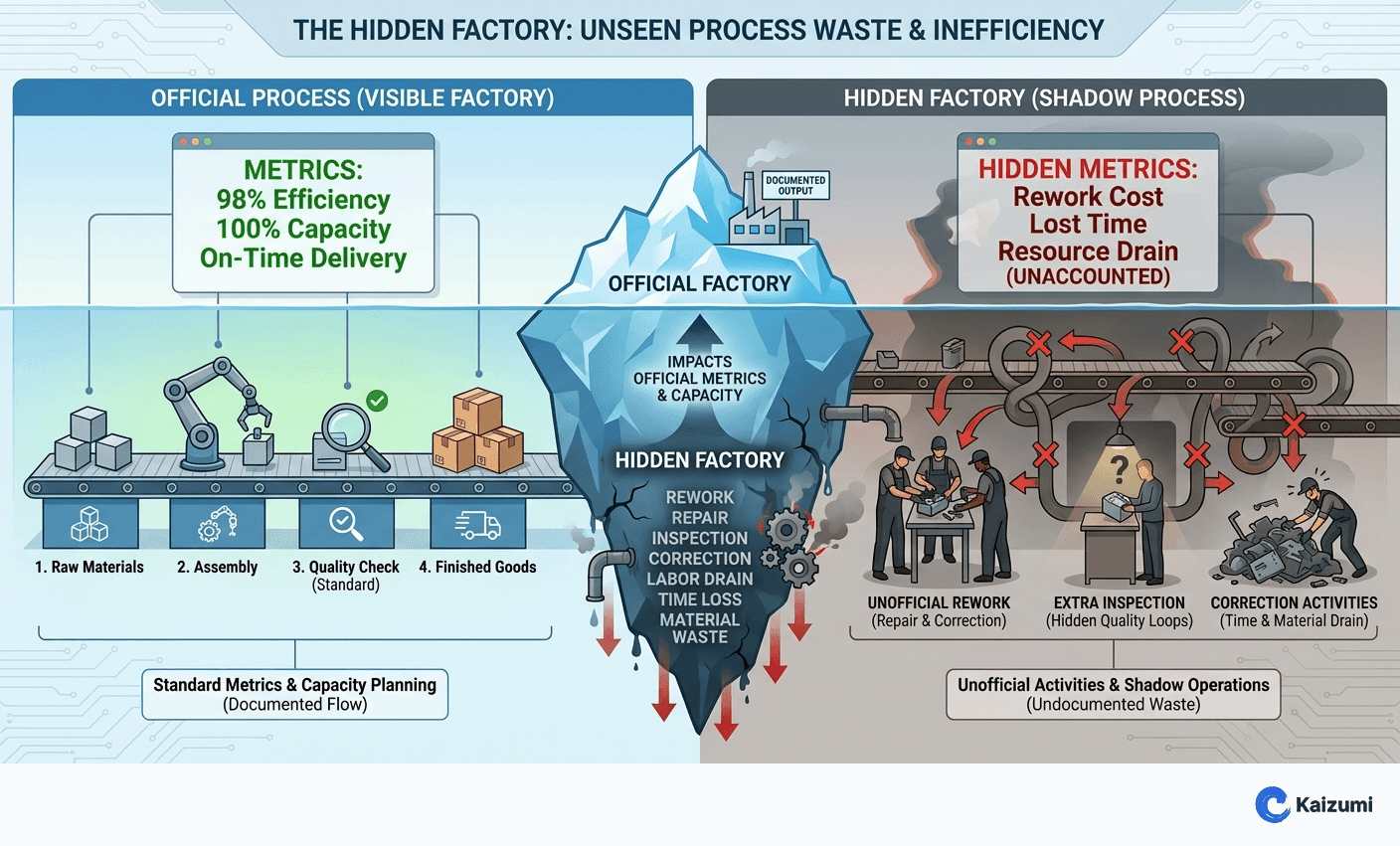
The hidden factory is the informal collection of rework, repair, and correction activities that consume resources but don't appear in official metrics.
Definition
The hidden factory refers to all the unofficial rework, repair, inspection, and correction activities that occur within a process but don't appear in standard metrics or capacity planning. Like a shadow factory running parallel to the official process, these activities consume labor, time, and materials while remaining invisible to management reports. The hidden factory explains why actual throughput falls short of theoretical capacity and why processes seem understaffed despite adequate headcount.
Examples
A production line was rated for 100 units per hour but consistently produced only 75. Investigation revealed the hidden factory: operators spending 20% of time on touchups, an unofficial inspector catching defects before final test, and a "save station" for repairing units that failed test. None appeared in official metrics.
Key Points
- Hidden factory activities consume resources but don't appear in official metrics
- Often accepted as "how we do things" and never questioned
- Rolled Throughput Yield analysis exposes hidden factory scope
- Eliminating hidden factory work frees capacity for value-added activities
Common Misconceptions
The hidden factory is impossible to measure. While hidden factory work isn't captured in standard metrics, it can be measured through time studies, RTY analysis, or simple observation. The first step is acknowledging it exists.
Hidden factory work shows employee dedication. While people working around problems show commitment, the hidden factory represents process failure. Good employees shouldn't need to fix bad processes—the processes should be fixed.