
DFSS
Personalize This
Get insights for your role
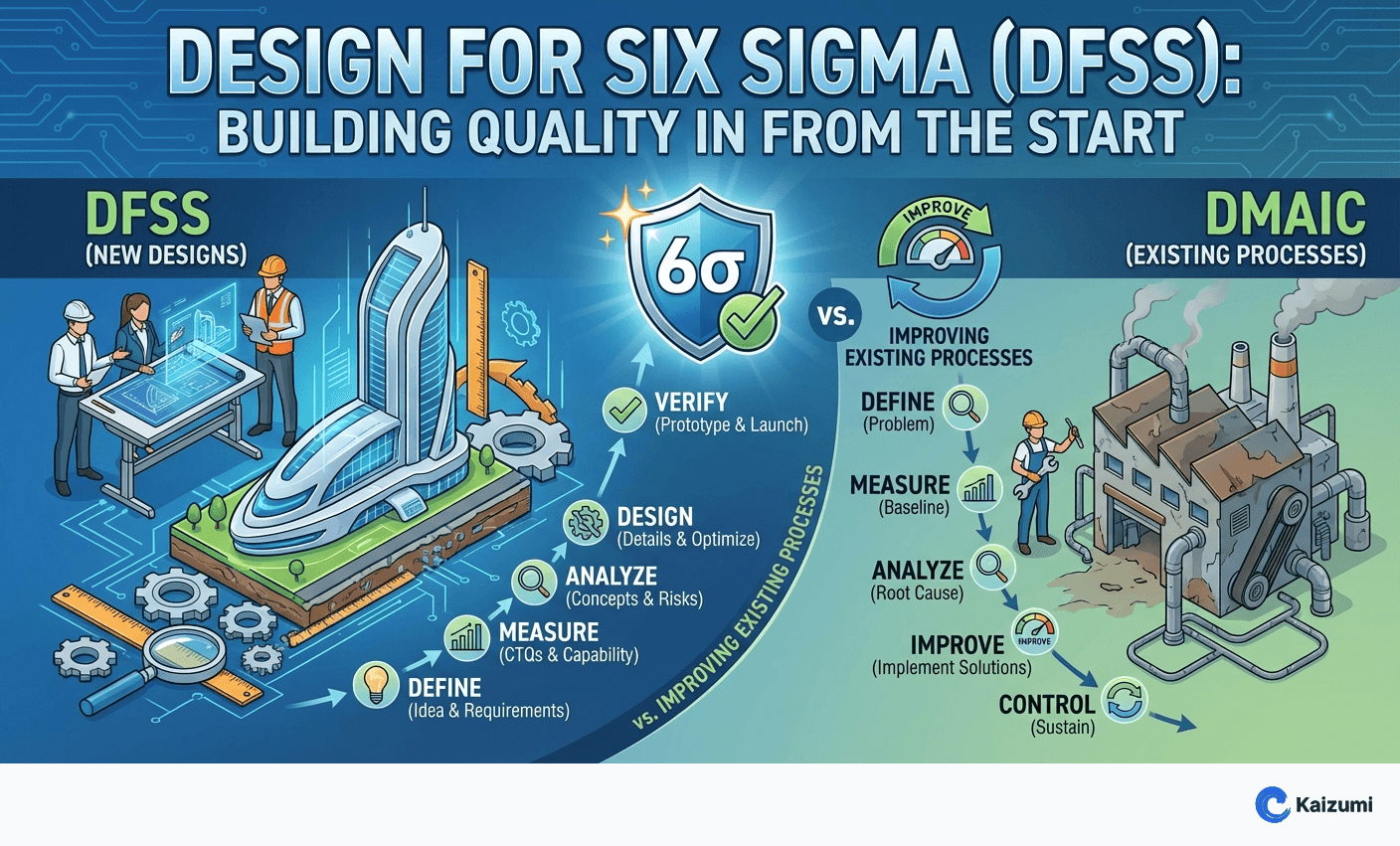
DFSS (Design for Six Sigma) is a methodology for designing new products or processes to achieve Six Sigma quality levels from the start.
Definition
Design for Six Sigma (DFSS) is a methodology for designing new products, processes, or services that achieve Six Sigma quality levels from launch. While DMAIC improves existing processes, DFSS builds quality into new designs from the beginning. DFSS uses structured approaches—most commonly DMADV (Define, Measure, Analyze, Design, Verify)—to translate customer requirements into robust designs that perform reliably under real-world variation. The goal is preventing defects by design rather than detecting and correcting them afterward.
Examples
An automotive supplier used DFSS when designing a new fuel injector. Through customer requirements analysis, tolerance studies, and design optimization, they achieved 4 DPMO at launch—far exceeding the target of 100 DPMO. The design required no engineering changes in its first two years of production.
Key Points
- DFSS prevents defects through design; DMAIC reduces defects in existing processes
- Common DFSS methodologies: DMADV, IDOV (Identify, Design, Optimize, Verify)
- Emphasizes understanding customer requirements before design begins
- Uses tools like QFD, tolerance analysis, and simulation to optimize designs
Common Misconceptions
DFSS is just DMAIC for new products. DFSS uses fundamentally different tools—QFD, tolerance analysis, robust design—focused on optimization rather than problem-solving. Applying DMAIC to new designs misses the preventive design opportunities DFSS captures.
DFSS guarantees perfect launches. DFSS significantly improves launch quality but doesn't eliminate all issues. The methodology reduces predictable failures; unpredictable problems still occur. DFSS raises the floor, not eliminates risk entirely.