
Subordinate
Personalize This
Get insights for your role
Subordinate is the third of TOC's Five Focusing Steps—aligning all non-constraint resources to support and never impede constraint performance.
Definition
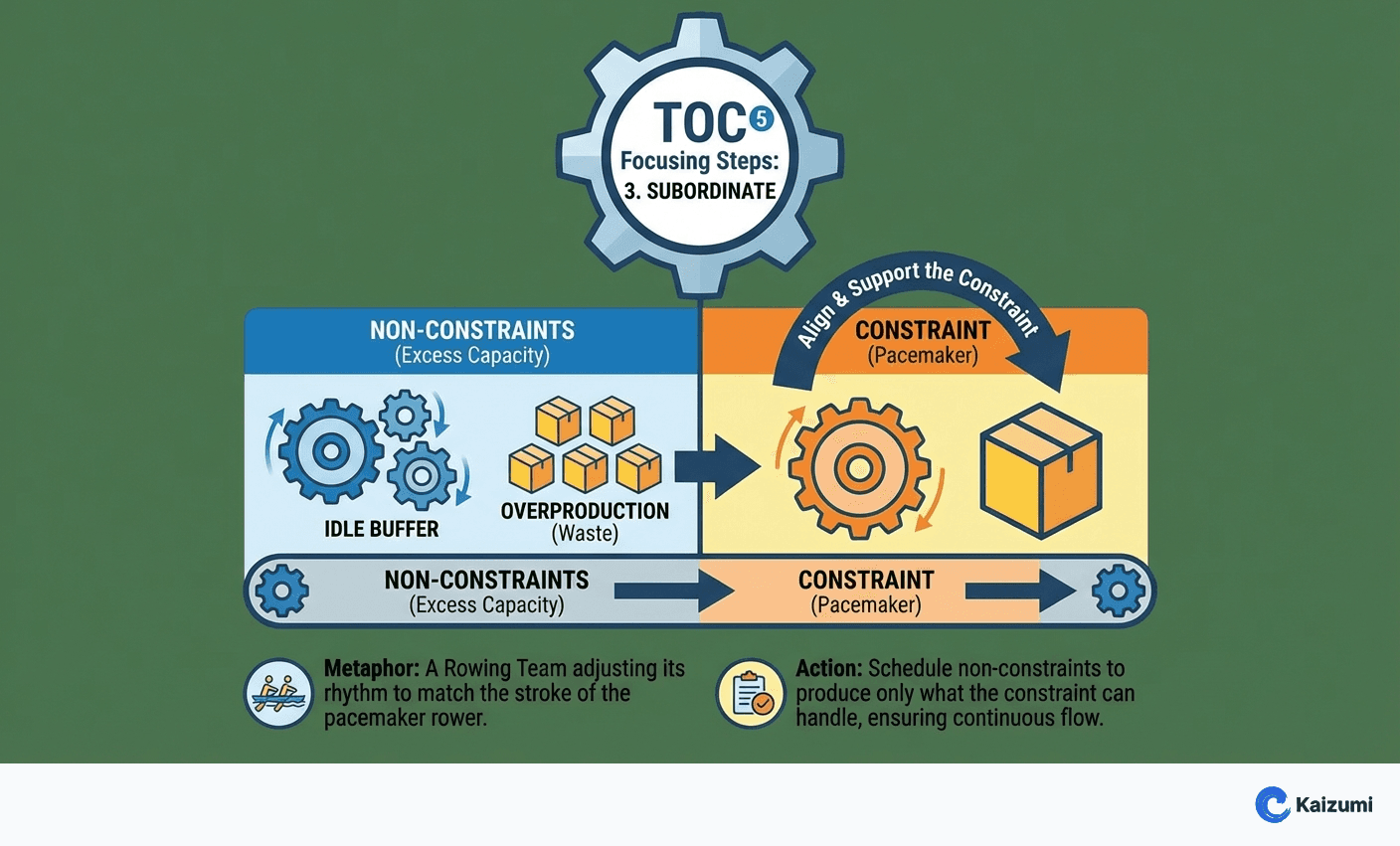
Subordinate is the third step in TOC's Five Focusing Steps—aligning everything else in the system to support the constraint. Non-constraints have excess capacity by definition; the question is how to use that excess to maximize constraint performance. Subordination means scheduling non-constraints to maintain constraint buffers, not optimizing non-constraint efficiency at the expense of constraint throughput, and changing policies that hinder constraint performance. The system serves the constraint, not the other way around.
Examples
Non-constraint operations were measured on individual efficiency, causing them to build inventory regardless of constraint needs. Subordination: changed metrics from local efficiency to buffer health; scheduled upstream work to maintain 2-day buffer at constraint; allowed non-constraints to idle when buffer was full.
Key Points
- Third of Five Focusing Steps—follows Exploit
- Non-constraints align to serve the constraint, not optimize locally
- May require changing metrics, schedules, and policies
- Non-constraint idle time is acceptable if constraint is protected
Common Misconceptions
Subordinate means slowing down non-constraints. Subordination means aligning non-constraint behavior—which might mean speeding up, building buffers, or changing priorities. The goal is constraint support, not universal slowdown.
Local inefficiency is waste. In TOC, non-constraint efficiency that doesn't support the constraint is meaningless. A non-constraint building excess inventory is actually harming the system even if it looks "efficient" locally.