
Focused Improvement
Personalize This
Get insights for your role
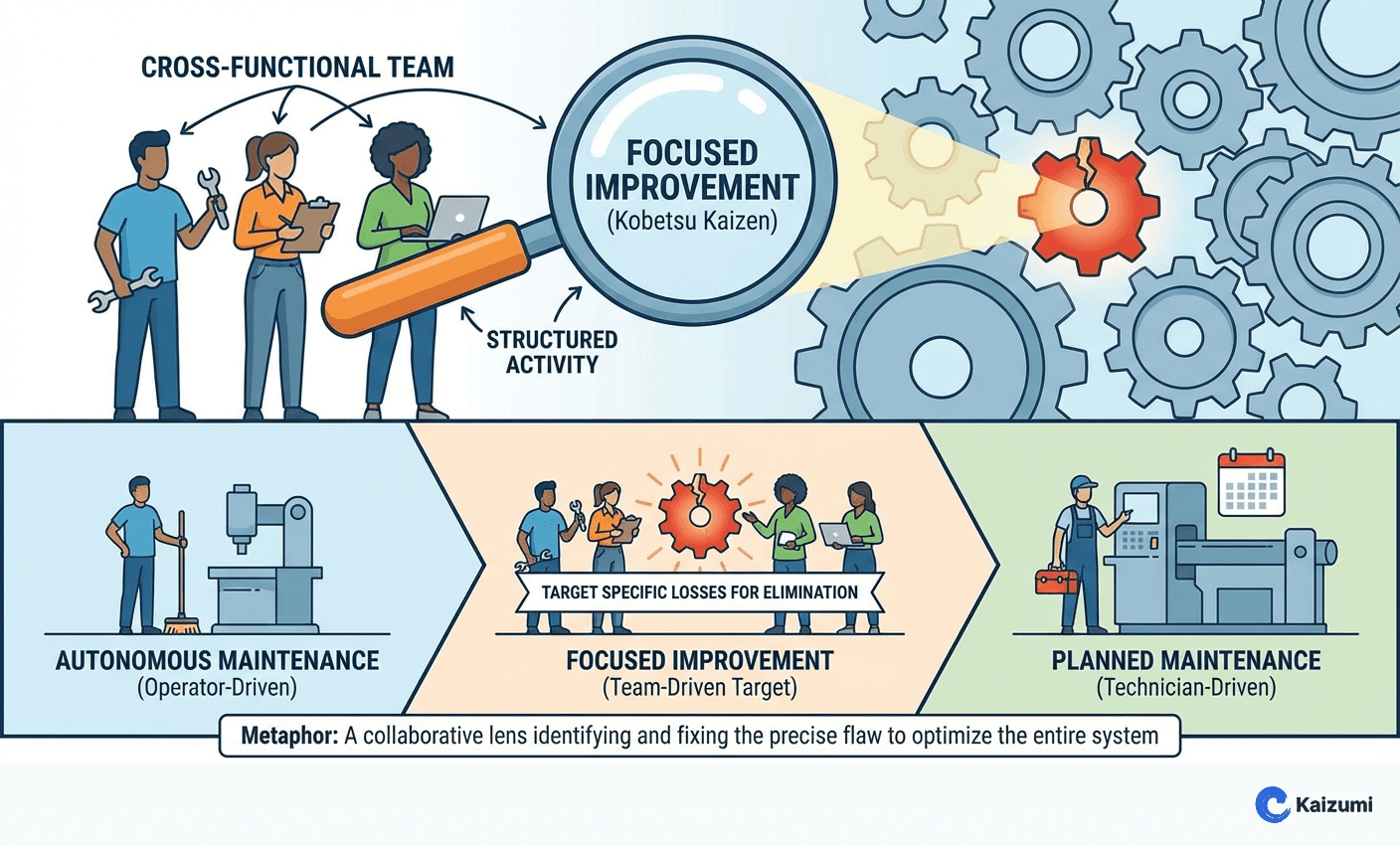
Focused improvement (Kobetsu Kaizen) is the TPM pillar that uses cross-functional teams to eliminate specific equipment and process losses systematically.
Definition
Focused improvement (Kobetsu Kaizen) is a TPM pillar that targets specific losses for elimination through structured, cross-functional team activities. Unlike autonomous maintenance (operator-driven) or planned maintenance (technician-driven), focused improvement brings together operators, maintenance, engineering, and others to attack chronic problems that no single function can solve alone. Teams use loss data to prioritize targets, analyze root causes, implement countermeasures, and standardize solutions. The approach borrows from Six Sigma and traditional kaizen.
Examples
OEE data showed chronic minor stops consuming 12% of capacity on a filling line. A focused improvement team of operators, mechanics, and engineers investigated, finding that product buildup caused sensor misreads. A redesigned cleaning schedule and sensor guard eliminated 80% of stops, recovering 10% capacity.
Key Points
- Cross-functional teams address losses no single function can solve
- Uses OEE and loss data to prioritize improvement targets
- Structured problem-solving: analyze, countermeasure, standardize
- Also called Kobetsu Kaizen (individual equipment improvement)
Common Misconceptions
Focused improvement is just maintenance doing kaizen. The "cross-functional" aspect is essential. Chronic losses typically have causes spanning operations, maintenance, and engineering. Single-function teams miss root causes in other domains.
Any improvement counts as focused improvement. True focused improvement follows data-driven target selection and rigorous problem-solving. Ad-hoc improvements without measurement and standardization may help but don't build systematic capability.