
Six Big Losses
Personalize This
Get insights for your role
The six big losses are the primary categories of equipment productivity loss that TPM targets: breakdowns, setup, idling, speed loss, defects, and startup.
Definition
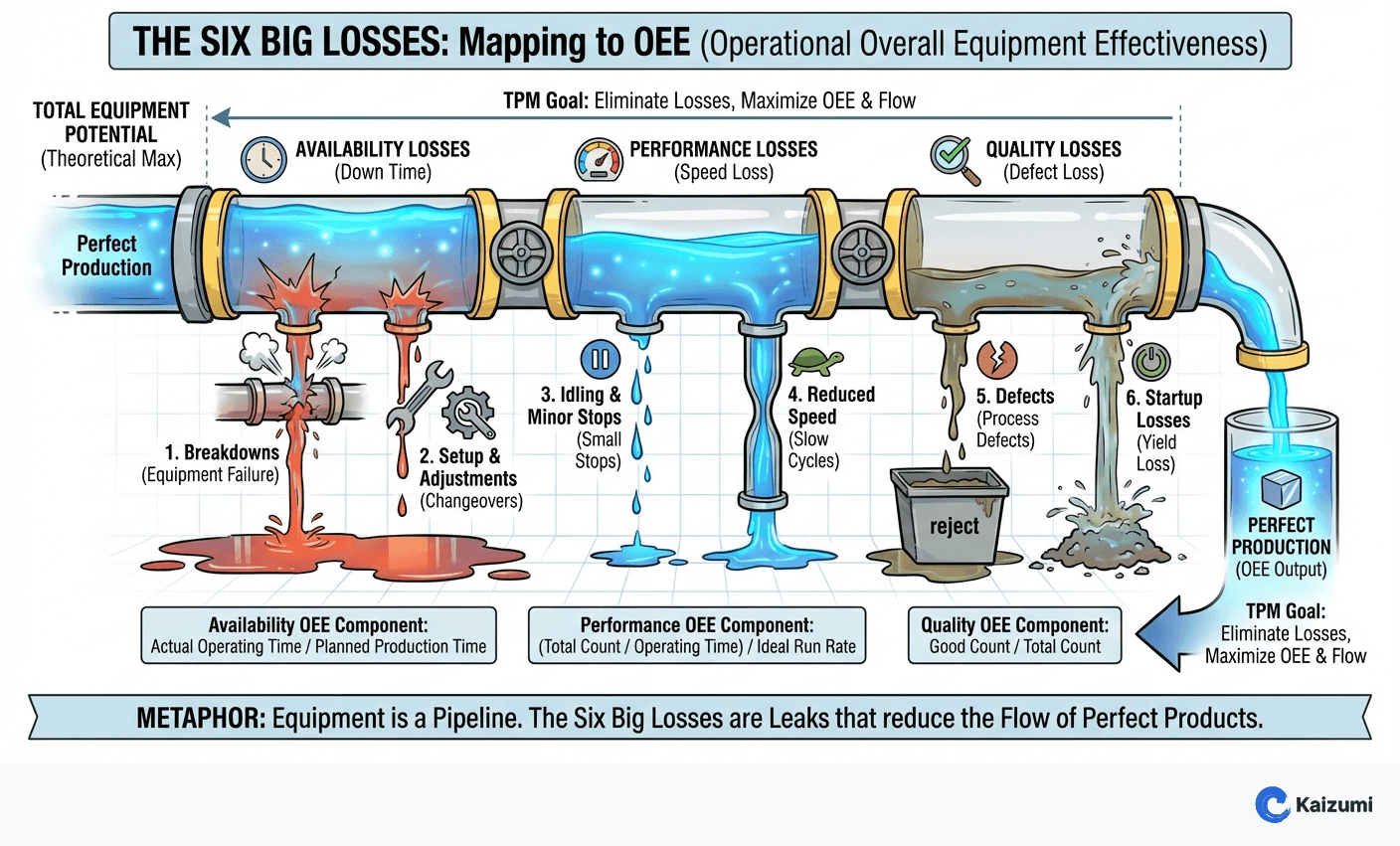
The six big losses are the major categories of equipment productivity loss that TPM aims to eliminate. They map directly to OEE components: Availability losses include breakdowns and setup/adjustment time. Performance losses include idling/minor stops and reduced speed. Quality losses include defects/rework and startup losses. By categorizing losses, organizations can prioritize improvement efforts and track progress systematically. Eliminating these losses is the path to achieving OEE improvement.
Examples
A bottling line tracked the six big losses over a month: Breakdowns: 8%, Setup: 12%, Idling: 6%, Speed: 5%, Defects: 2%, Startup: 3%. Total losses: 36%. Setup time was the dominant loss—SMED techniques became the improvement priority.
Key Points
- Availability losses: Breakdowns (equipment failures) and Setup/Adjustments
- Performance losses: Idling/Minor Stops and Reduced Speed
- Quality losses: Defects/Rework and Startup/Yield Losses
- Data collection enables prioritization of improvement efforts
Common Misconceptions
All losses are equally important. Losses vary dramatically in magnitude and improvability. A 15% setup loss with proven SMED solutions differs from a 3% defect rate requiring major quality investigation. Prioritize by impact and feasibility.
The six losses are the only losses. The framework covers equipment-related losses but not all productivity losses. Material shortages, labor absences, and scheduling issues affect output but fall outside the six big losses. Comprehensive improvement addresses all loss categories.
Try It
See how the losses hit OEE right here. Enter planned time, downtime, cycle time, and unit counts to get Availability, Performance, and Quality — the three buckets the six big losses fall into. (Also available as a standalone tool.)