
Go and See
Personalize This
Get insights for your role
Go and See is the practice of personally observing work at the actual location rather than relying on reports or secondhand information.
Definition
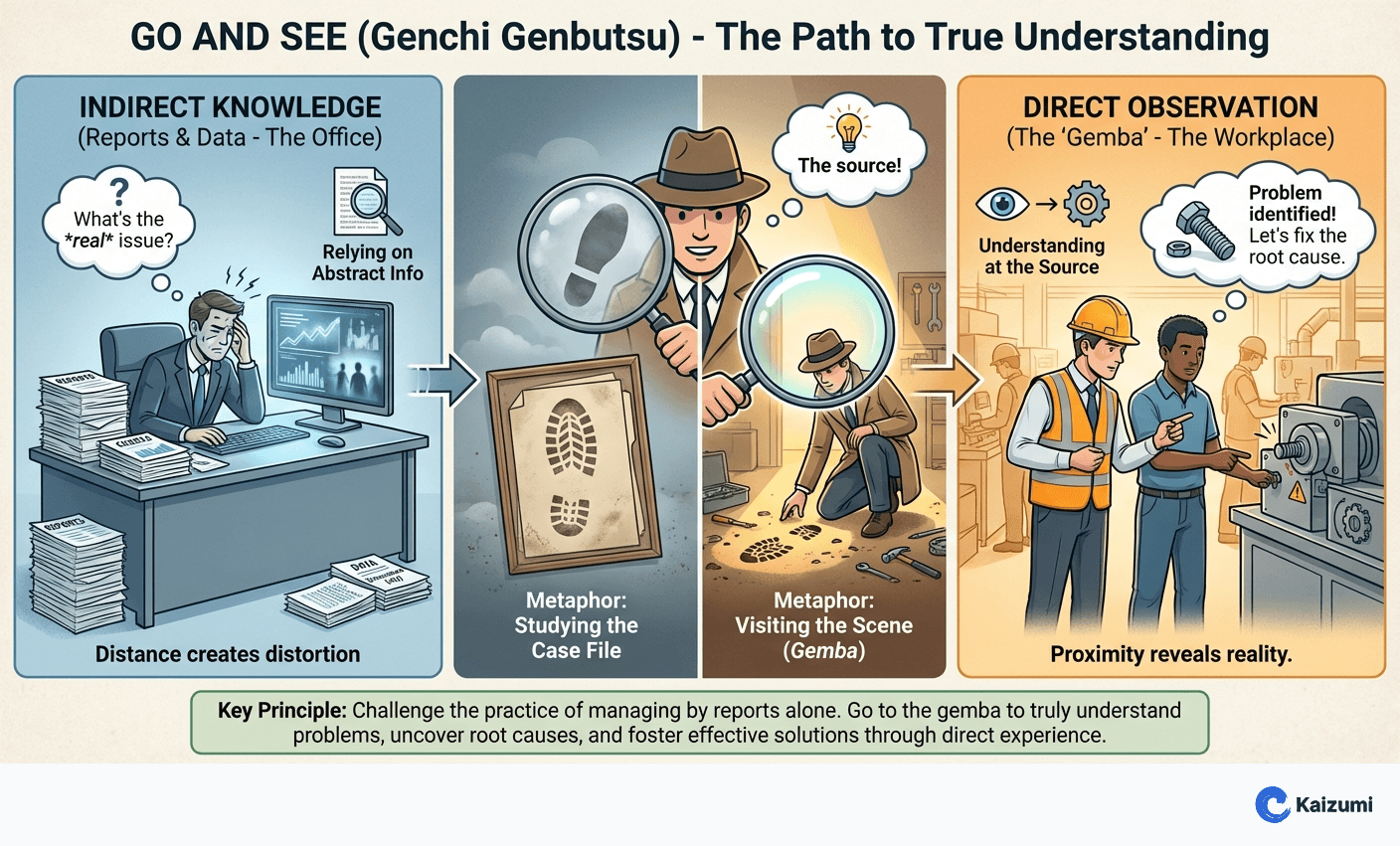
Go and See is the English translation of the lean principle that problems can only be truly understood through direct observation at the place where work happens (gemba). This principle challenges the common management practice of relying on reports, data, and secondhand information. Reports are abstractions that lose context and can't reveal what wasn't measured or anticipated. By going to see personally, leaders gain authentic understanding that enables better decisions and demonstrates respect for frontline workers.
Examples
When quality defects increased, the quality manager's first action was to go and see rather than request data. Standing at the process for two hours, he observed that a recent fixture modification had created a subtle alignment issue—something that data would never have revealed because no one thought to measure it.
Key Points
- Go and see should be the first response to any problem, before data requests
- Personal observation reveals context and nuance that reports cannot capture
- The practice requires humility—admitting that reports don't tell the whole story
- Going to see regularly builds leader understanding and worker trust
Common Misconceptions
Go and see is inefficient when data is available. Data analysis is valuable but can't reveal what wasn't anticipated when data collection was designed. Direct observation often discovers the root cause in minutes rather than the days or weeks of data analysis.
Go and see means micromanaging. The purpose is understanding, not control. Leaders observe to learn, then engage workers as partners in problem-solving rather than imposing solutions based on brief observation.