
Heijunka Box
Personalize This
Get insights for your role
A heijunka box is a visual scheduling tool that levels production by distributing work evenly across time periods.
Definition
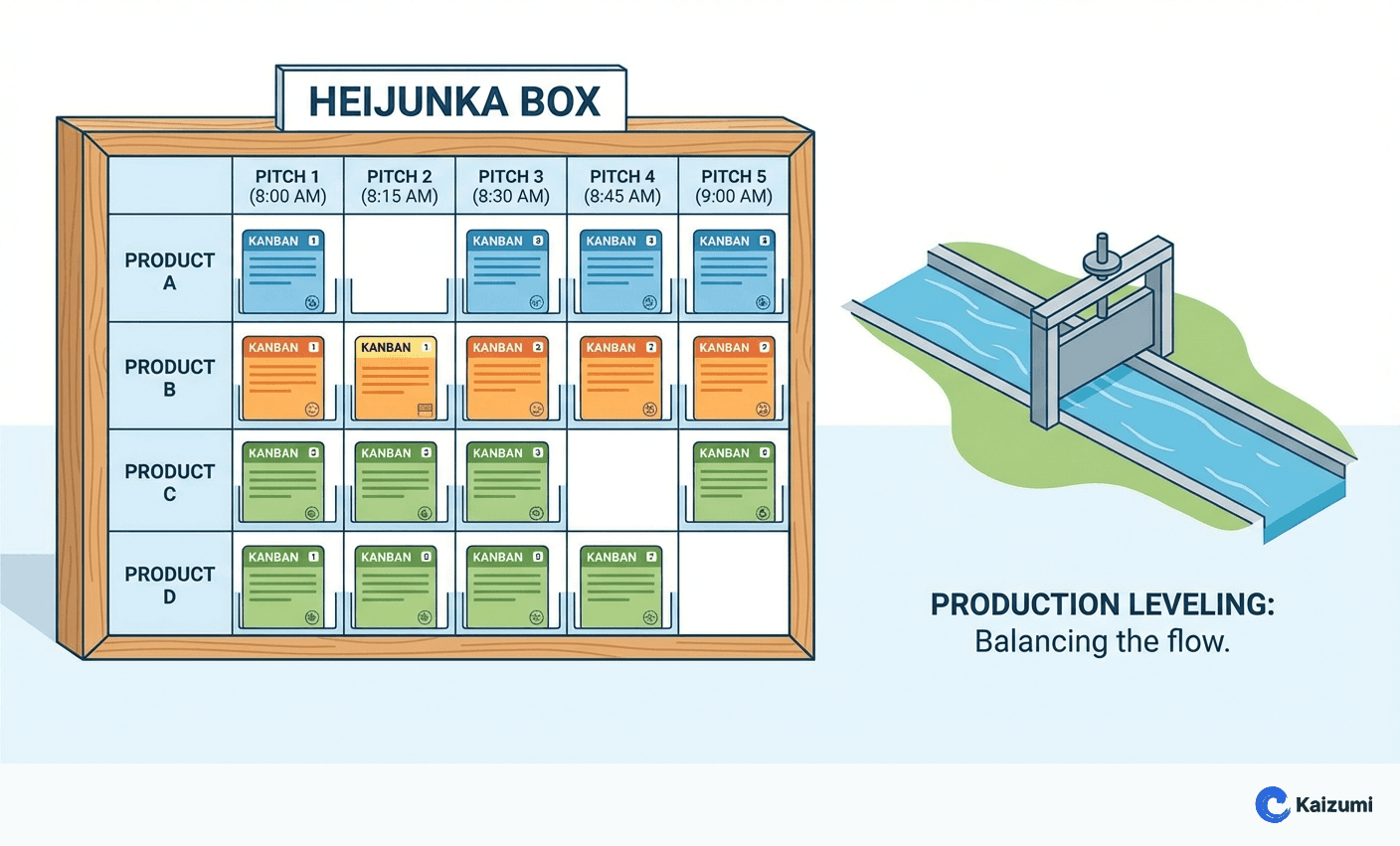
A heijunka box is a physical scheduling tool that implements production leveling (heijunka). The box has a grid of slots: columns represent time periods (often pitch increments—the time to produce a defined quantity), and rows represent different product types. Kanban cards placed in the slots specify what to produce in each period. The visual layout distributes different products across time rather than batching, creating level mix and volume. Production workers draw cards from the box in sequence, following the leveled schedule.
Examples
A heijunka box for an assembly cell has columns for each 30-minute period and rows for three product types. Rather than producing all of Type A, then all of Type B, the box shows mixed production: A, B, A, C, A, B... This levels demand on upstream processes and smooths workload.
Key Points
- The heijunka box makes the leveled schedule visual and tangible
- Cards are withdrawn in sequence, pacing work to the leveled plan
- Levels both volume (consistent quantity per period) and mix (product variety)
- Requires quick changeover to make frequent product changes economical
Common Misconceptions
Heijunka boxes are obsolete with digital scheduling. The visual, physical nature of heijunka boxes provides value beyond data management. Cards physically pacing work creates different dynamics than screens. Many lean factories maintain physical boxes.
Any schedule is a heijunka box. True heijunka boxes implement leveling—distributing volume and mix evenly. A schedule that batches work isn't heijunka regardless of format.
See Also
- Heijunka - The leveling concept the box implements