
Kaikaku
改革·kaikaku·"radical change, reformation"
Personalize This
Get insights for your role
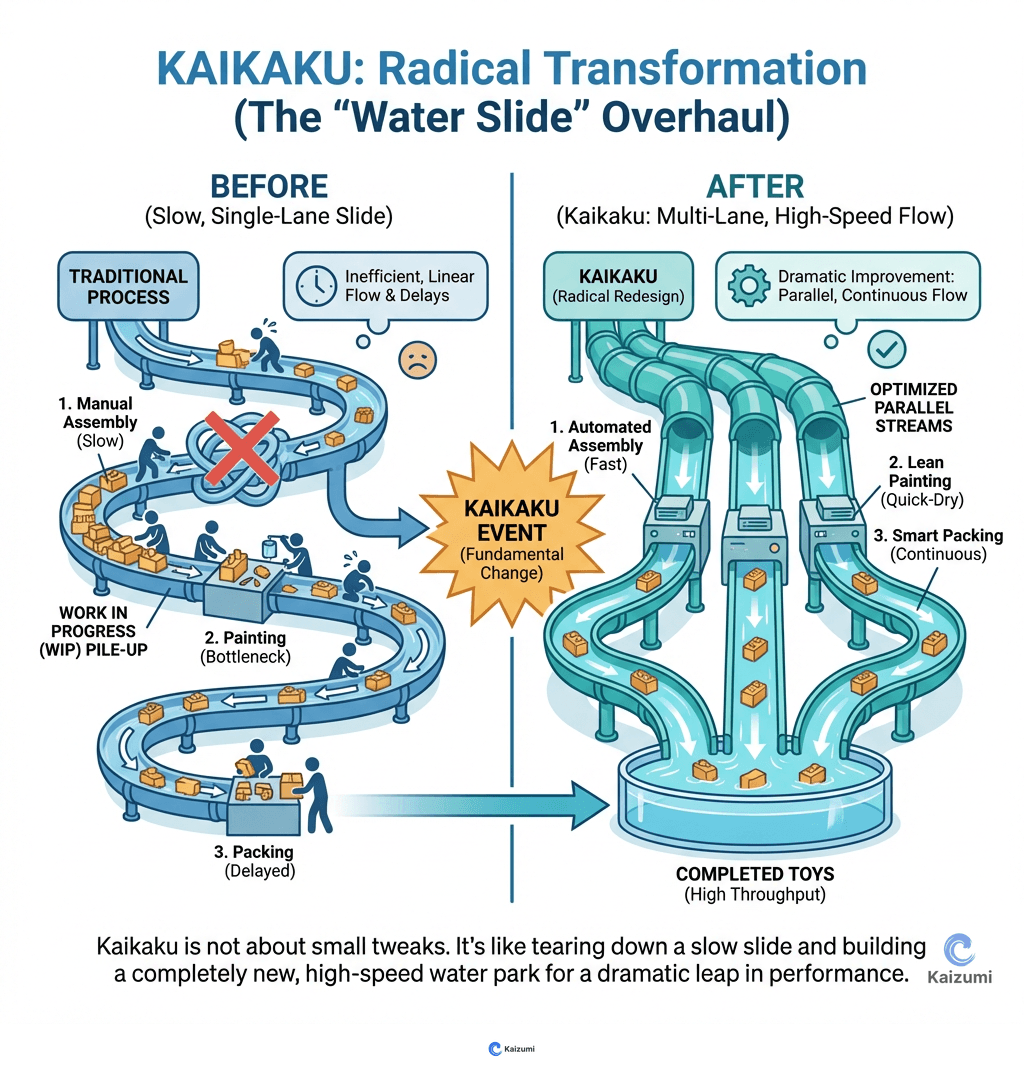
Kaikaku is radical, breakthrough improvement that fundamentally transforms a process, contrasted with incremental kaizen improvements.
Definition
Kaikaku is radical, breakthrough improvement that fundamentally transforms how work is done—as opposed to kaizen's continuous, incremental improvements. Kaikaku might mean eliminating an entire process, completely redesigning a layout, replacing a technology, or fundamentally rethinking a value stream. While kaizen makes existing processes better, kaikaku questions whether those processes should exist at all. Both approaches are necessary: kaikaku creates step-change improvement; kaizen maintains gains and continues incremental progress. Organizations need the creativity to envision kaikaku and the discipline to sustain it with kaizen.
Examples
A company performed kaizen on their painting process for years, reducing cycle time from 60 to 45 minutes. Kaikaku asked: "Do we need to paint at all?" By switching to pre-colored materials and powder coating for necessary surfaces, they eliminated the paint line entirely—a 45-minute process became zero.
Key Points
- Step-change improvement versus incremental improvement
- Questions whether processes should exist, not just how to improve them
- Typically requires investment, redesign, or technology change
- Must be sustained through ongoing kaizen after implementation
Common Misconceptions
Kaikaku replaces kaizen. Both are needed. Kaikaku without sustained kaizen deteriorates. Kaizen without occasional kaikaku plateaus. The rhythm alternates between breakthrough and continuous improvement.
Kaikaku is just big kaizen. Kaikaku fundamentally questions the process; kaizen improves the existing process. A 50% improvement through process redesign might be kaikaku; the same improvement through incremental refinement is kaizen.
See Also
- Kaizen - Continuous incremental improvement
- Value Stream Mapping - Tool for identifying kaikaku opportunities