
Flow
Personalize This
Get insights for your role
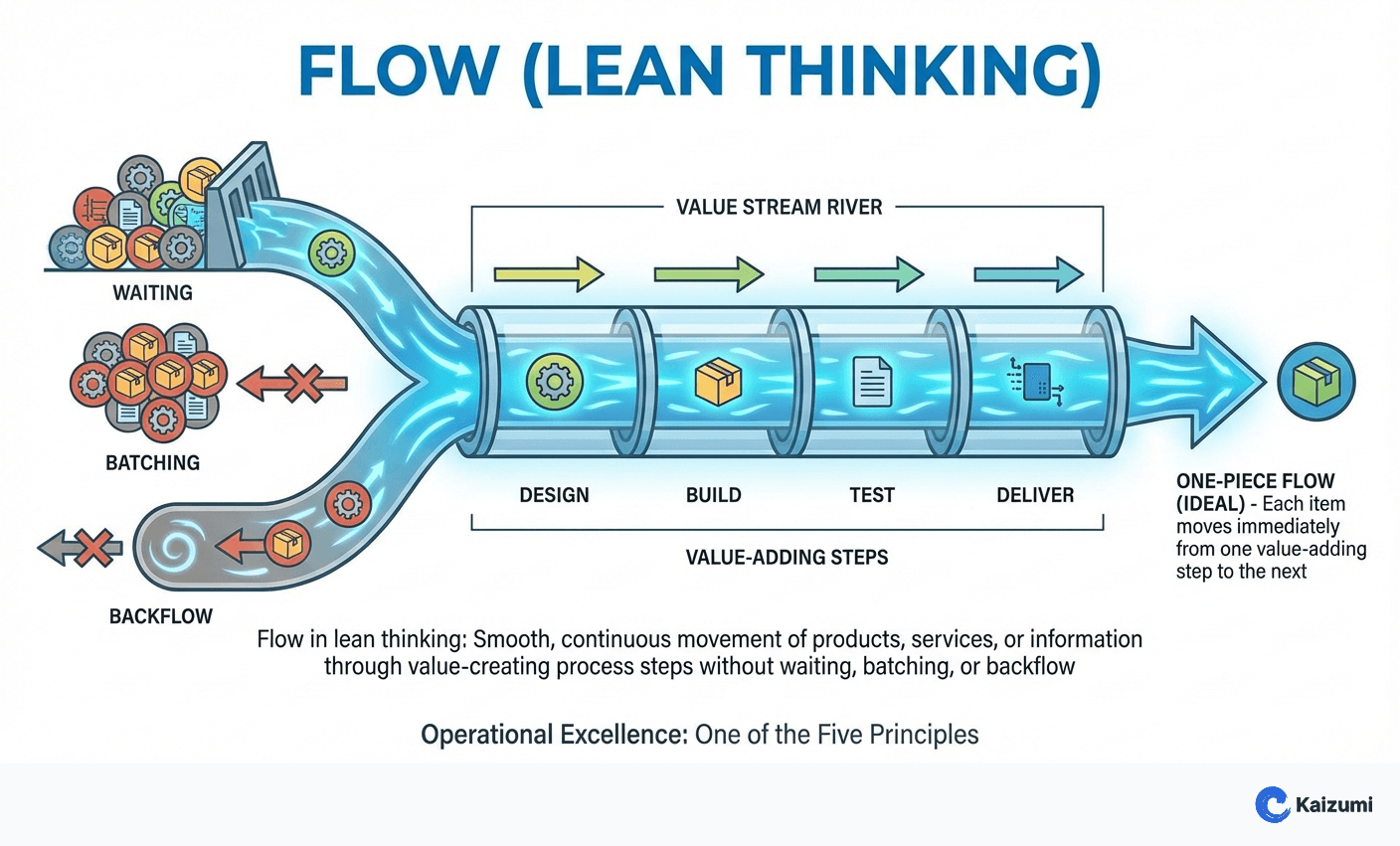
Flow is the continuous movement of products, services, or information through value-creating steps without interruption, batching, or backflow.
Definition
Flow in lean thinking refers to the smooth, continuous movement of products, services, or information through value-creating process steps without waiting, batching, or backflow. Ideal flow is one-piece flow—each item moves immediately from one value-adding step to the next. Flow is one of the five lean principles (along with value, value stream, pull, and perfection) and is essential for reducing lead time, exposing problems, and eliminating the waste that accumulates when work sits idle between process steps.
Examples
A machine shop transformed from batch processing (run all Type A parts, then all Type B) to cellular flow where each part moved through all operations in sequence. Lead time dropped from three weeks to three hours because parts no longer waited in queues between machines.
Key Points
- Flow exposes problems because there's no inventory buffer to mask them
- Achieving flow requires addressing all obstacles—equipment reliability, changeover time, quality issues
- Flow applies to information and services, not just physical products
- Improved flow reduces lead time more dramatically than individual step improvements
Common Misconceptions
Flow requires expensive automation. Flow is primarily about process design—connecting steps, eliminating batching, synchronizing pace. Automation may help but isn't required. Manual processes can achieve excellent flow through layout and work design.
Flow means everyone must work faster. Flow actually enables sustainable pace because there's no expediting or heroic recovery from batch delays. Better flow often allows slower individual steps because total lead time improves so dramatically.