
Minor Stops
Personalize This
Get insights for your role
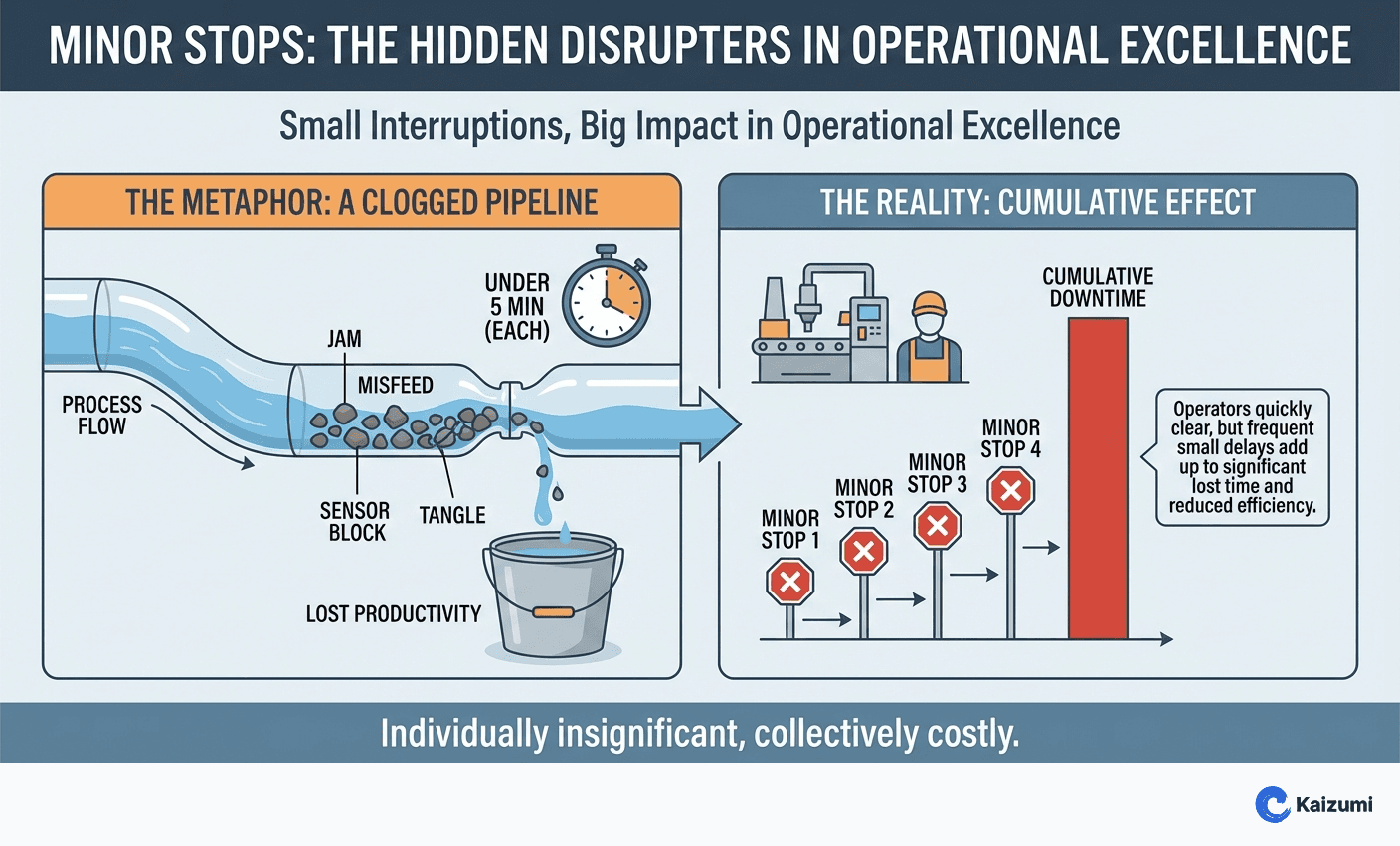
Minor stops are brief equipment interruptions lasting under 5 minutes that individually seem insignificant but collectively cause major productivity loss.
Definition
Minor stops (also called small stops or micro-stops) are brief equipment interruptions typically lasting under 5 minutes that operators quickly clear without calling maintenance. Examples include jams, misfeeds, blocked sensors, and material tangles. Individually insignificant, minor stops often go unrecorded and unaddressed. Collectively, they can consume 10-20% of available capacity—a massive hidden loss. Because they're brief and frequent, they fall through the cracks of both operator awareness and maintenance attention.
Examples
A packaging line experienced 80 minor stops per shift, averaging 30 seconds each—40 minutes of lost production daily. No individual stop seemed worth investigating, but total impact was 8% OEE loss. Systematic tracking revealed that 60% came from one recurring jam point.
Key Points
- Brief stops (under 5 minutes) that operators quickly clear
- Rarely tracked, making them invisible in traditional metrics
- Collectively can represent 10-20% capacity loss
- Often a few root causes drive most minor stops
Common Misconceptions
Minor stops aren't worth tracking. The cumulative impact often exceeds major breakdowns. A few major issues typically cause most minor stops—finding them requires systematic tracking even of brief interruptions.
Operators should just work around minor stops. Accepting minor stops as normal ensures they continue forever. Brief focused improvement projects often eliminate chronic minor stops, recovering hidden capacity permanently.
Try It
Minor stops rarely appear as downtime, because nobody logs a 30-second jam. They surface as a low Performance score instead: the equipment ran, but slower than its rated cycle. Enter your planned time, logged downtime, cycle time, and unit count below, then look at the gap between Availability and Performance. That gap is where your minor stops are hiding.