
Out-of-Cycle Work
Personalize This
Get insights for your role
Out-of-cycle work is any task an operator must perform that doesn't occur every cycle, disrupting standard work rhythm and timing.
Definition
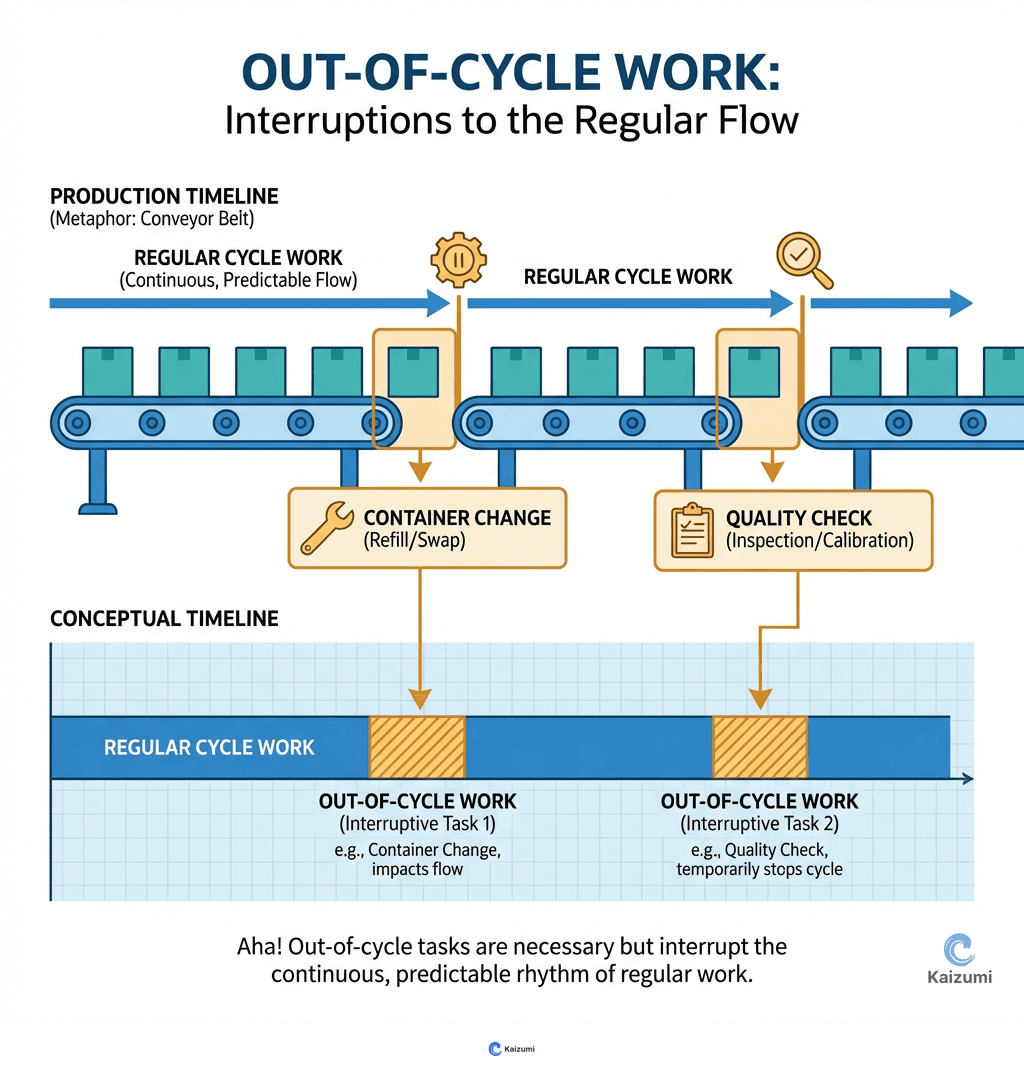
Out-of-cycle work is any task that doesn't occur every production cycle—activities like changing empty containers, retrieving new materials, periodic quality checks, equipment adjustments, or responding to abnormalities. While standard work defines what happens every cycle, out-of-cycle work interrupts that rhythm. These interruptions must be planned for in line balancing, or operators will periodically fall behind and struggle to catch up. Excessive out-of-cycle work makes cycle times unpredictable and destabilizes flow.
Examples
An assembly operator's standard work takes 55 seconds per cycle against a 60-second takt time—seemingly 5 seconds of slack. But every 10 cycles, they must change the parts bin (30 seconds), and every 20 cycles, perform a quality check (45 seconds). Without accounting for this out-of-cycle work, the operator falls behind unpredictably. Proper analysis averages the out-of-cycle time across cycles and adjusts workload accordingly.
Key Points
- Must be identified, timed, and included in workload calculations
- Can be reduced through better workplace organization and material presentation
- Should be smoothed—spreading out-of-cycle tasks rather than clustering them
- Often handled by team leaders or water spiders to protect operator cycle time
Common Misconceptions
Out-of-cycle work is waste to be eliminated. Some out-of-cycle work is necessary (quality checks, material replenishment). The goal is to minimize, standardize, and plan for it—not pretend it doesn't exist.
Cycle time analysis captures total work. Analysis often focuses on the repetitive cycle, missing the out-of-cycle burden. Complete work measurement must include both.
Try It
Out-of-cycle work hides in the space between the layout and the sequence, which is exactly what the chart below shows. Draw the real work area, then trace the operator's route through it waypoint by waypoint. The trip to fetch a new container or reach a check station appears as path length, not as cycle time. Record takt and cycle time in the header, and the gap between them is the room your out-of-cycle tasks have to fit into. (Also available as a standalone tool.)
Frequently asked questions
```kz-qa q: How do you account for out-of-cycle work during line balancing? a: Out-of-cycle work is accounted for by timing the intermittent tasks, averaging that duration across the cycles between occurrences, and adding it to the baseline workload. For example, periodic tasks that take place only every 10 cycles or every 20 cycles must have their total duration distributed across all units. Factoring this averaged time into the schedule ensures the operator's actual workload fits within takt time instead of causing periodic delays. q: Is out-of-cycle work considered waste that must be eliminated? a: No, out-of-cycle work is not inherently waste to be eliminated. Many non-routine tasks, such as material replenishment, equipment adjustments, and quality checks, are necessary for sustained operations. The operational goal is to minimize, standardize, and systematically plan for this work rather than ignore it. q: Why does an operator fall behind when their cycle time is shorter than takt time? a: An operator falls behind because intermittent tasks interrupt the standard rhythm and quickly consume any apparent slack. For instance, an operator with 55 seconds of standard work against a 60-second takt time appears to have 5 seconds of slack, but an out-of-cycle task like changing a parts bin or running a quality check takes 30 seconds or 45 seconds. When that irregular task occurs, the operator immediately exceeds takt time and struggles to catch up. q: Who should perform out-of-cycle work to protect flow? a: Out-of-cycle work is often reassigned to team leaders or water spiders rather than the primary station operator. Offloading material replenishment and container changes protects the operator's repetitive cycle time and keeps the line balanced. In addition, teams can reduce the operator's out-of-cycle burden through improved workplace organization and better material presentation. q: Why does standard cycle time analysis fail to detect out-of-cycle work? a: Standard cycle time analysis often focuses exclusively on the repeatable work sequence performed on every single piece. Because tasks like retrieving materials, adjusting equipment, or handling abnormalities happen only intermittently, short observation periods frequently miss them entirely. These tasks often lurk in operator travel paths outside the standard sequence rather than in direct processing time. ```
See Also
- Standard Work - Defining the repeatable cycle
- Milk Run - Scheduled delivery routes that take material handling off the operator