
Pack-Out Quantity
Personalize This
Get insights for your role
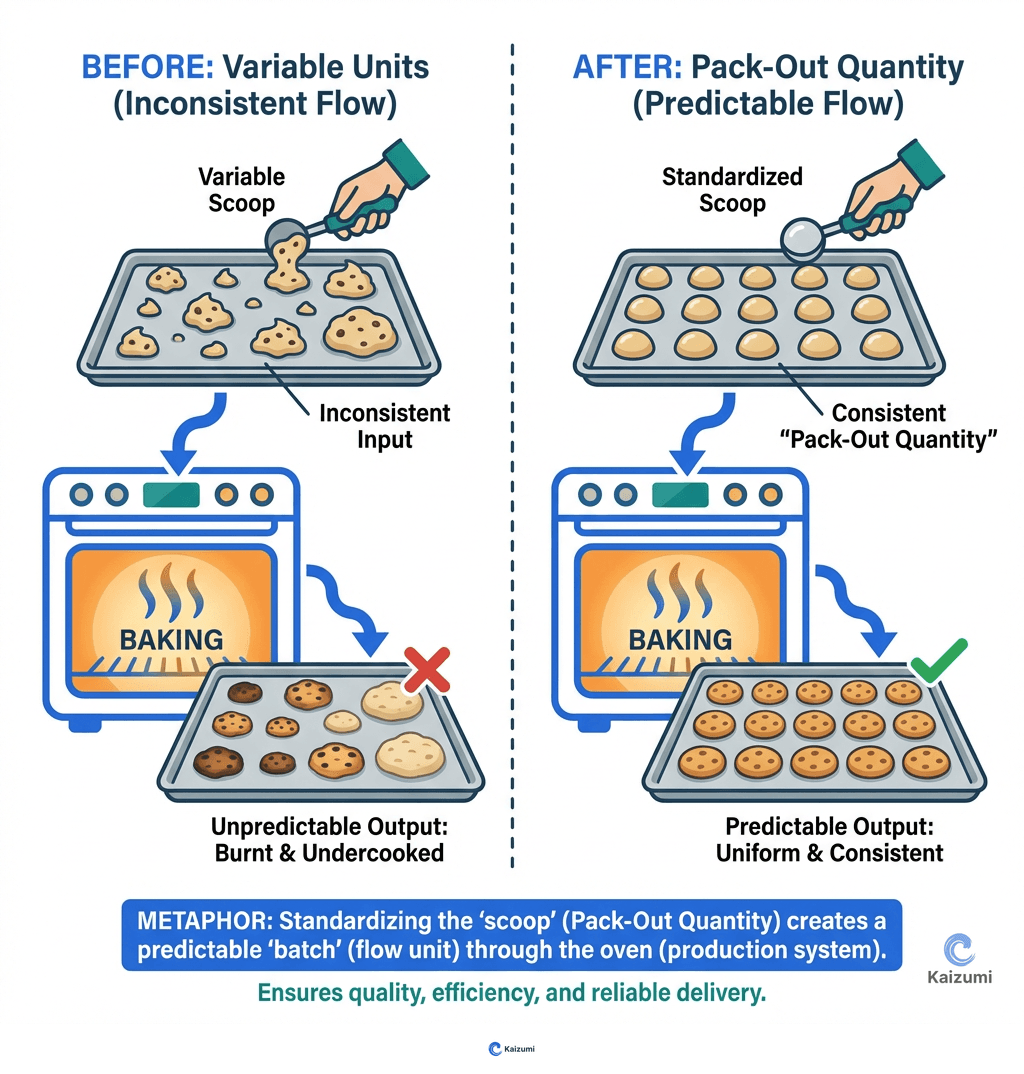
Pack-out quantity is the standard number of units packaged together for shipping or movement between processes.
Definition
Pack-out quantity is the standard number of units placed in a container, tray, or package for shipping to customers or movement between processes. This quantity becomes a fundamental unit of production planning, material handling, and scheduling. Pack-out quantity multiplied by takt time often equals pitch—the time increment for scheduling and material movement. Standardized pack-out quantities enable visual management (full container = correct quantity), simplify counting, and create consistent material handling loads.
Examples
An automotive supplier's pack-out quantity is 24 parts per returnable container, matching the customer's line-side requirement. Takt time is 2.5 minutes per part, so pitch is 60 minutes (24 × 2.5). Every 60 minutes, one container ships. Production schedules in container multiples, and material handlers know exactly what a full container represents.
Key Points
- Creates the fundamental unit for scheduling and material movement
- Enables visual management—full container equals standard quantity
- Should align with customer requirements and internal handling capabilities
- Forms the basis for pitch calculation (pack-out × takt = pitch)
Common Misconceptions
Larger pack-out quantities are more efficient. Larger quantities mean larger batches, more inventory, and less frequent replenishment. The right pack-out balances handling efficiency with flow requirements.
Pack-out quantity is determined by container availability. Containers should be selected to match the ideal pack-out quantity, not the reverse. Right-sized containers support flow; arbitrary containers force awkward quantities.
Try It
Pack-out quantity is the container quantity in the calculator below, and it drives more than counting. Enter your daily demand and replenishment lead time, then run the numbers twice with two container sizes. The larger container needs fewer cards but raises max WIP and days of supply. That trade is the whole argument for right-sizing the container instead of accepting the one you have.
See Also
- Pitch - Time increment for production scheduling
- Supermarket - Inventory points using standard containers