
Set-Based Concurrent Engineering
Personalize This
Get insights for your role
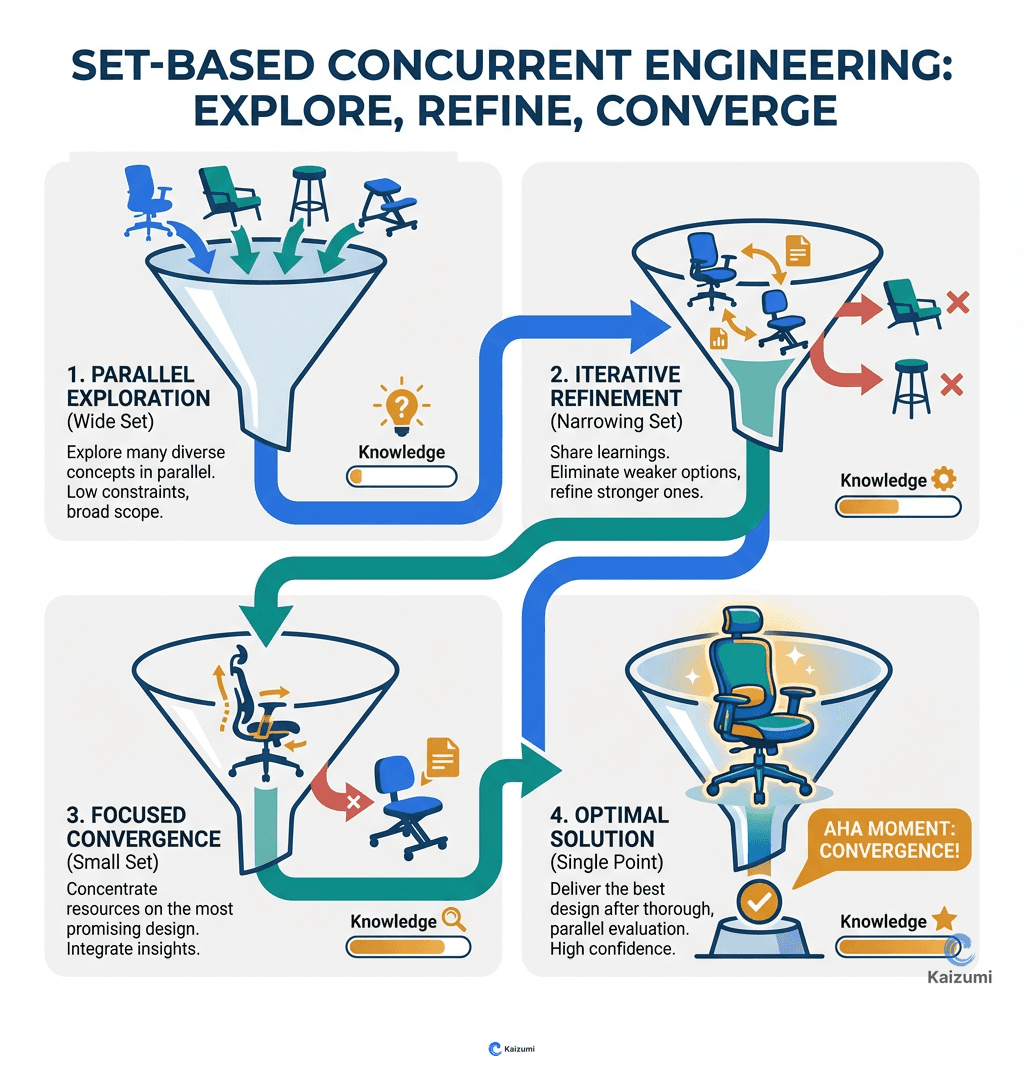
Set-based concurrent engineering explores multiple design alternatives in parallel, gradually narrowing to an optimal solution based on learning.
Definition
Set-Based Concurrent Engineering (SBCE) is a product development approach that explores multiple design alternatives ("sets") in parallel, gradually narrowing options as the team learns more about requirements, constraints, and trade-offs. Rather than selecting a single concept early and iterating on it (point-based design), SBCE keeps options open until the "last responsible moment," making decisions when sufficient information exists. Each function develops its set of feasible solutions; integration happens by finding intersections of these sets. This approach reduces rework, enables innovation, and produces more robust designs.
Examples
Key Points
- Keep options open until you have enough information to decide wisely
- Each function develops sets of feasible solutions; integration finds intersections
- Reduces rework by avoiding premature commitment to flawed concepts
- Requires trade-off curves and knowledge capture to inform narrowing decisions
Common Misconceptions
SBCE is slower because it explores multiple options. Point-based design appears faster initially but often requires extensive rework when the early choice proves wrong. SBCE's total time is often shorter despite the parallel exploration.
SBCE means never making decisions. SBCE delays decisions until the last responsible moment—when you have enough information. It's disciplined decision timing, not decision avoidance.