
Quick Changeover
Personalize This
Get insights for your role
Quick changeover is the practice of reducing the time required to switch equipment or processes from one product to another.
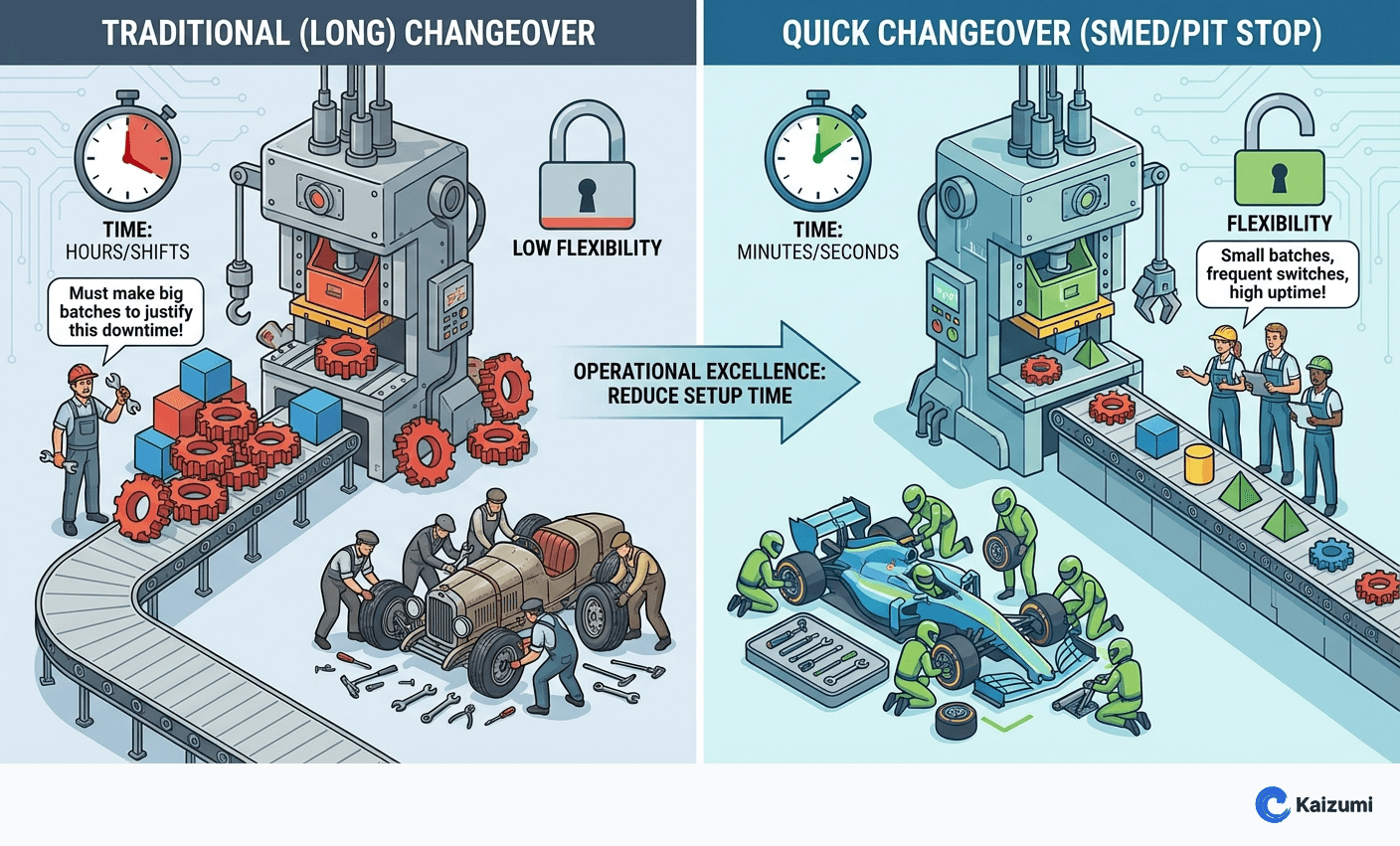
Definition
Quick changeover refers to practices and techniques that reduce the time required to switch equipment, systems, or processes from producing one product or service to another. Changeover time directly affects flexibility and batch size—long changeovers force large batches to amortize the downtime, while quick changeovers enable small batches and mixed-model production. Quick changeover encompasses both the SMED methodology and the broader organizational commitment to treating changeover time as waste to be minimized.
Examples
A packaging line required 90 minutes to change between products due to mechanical adjustments, cleaning, and verification. Quick changeover efforts—standardizing components, creating visual changeover guides, and preparing materials in advance—reduced changeover to 15 minutes, enabling three times as many product changes per shift.
Key Points
- Changeover time directly affects economic batch size
- Quick changeover enables flexibility, mixed-model production, and smaller batches
- Preparation before changeover is typically the largest opportunity
- Standardization of equipment and procedures speeds changeover
Common Misconceptions
Quick changeover requires advanced technology. Most changeover improvements come from organization, preparation, and standardization—not technology. Analyze current changeovers before assuming investment is needed.
Some changeovers are inherently slow. Many "inherent" constraints are actually choices or conventions. Challenging assumptions often reveals significant reduction opportunities.
Try It
Quantify your own changeover right here. Enter current and target stopped time and how often you change over to see time saved per changeover, annual capacity gained, and its dollar value. (Also available as a standalone tool.)
See Also
- SMED - The systematic methodology for quick changeover