
Special Cause Variation
Personalize This
Get insights for your role
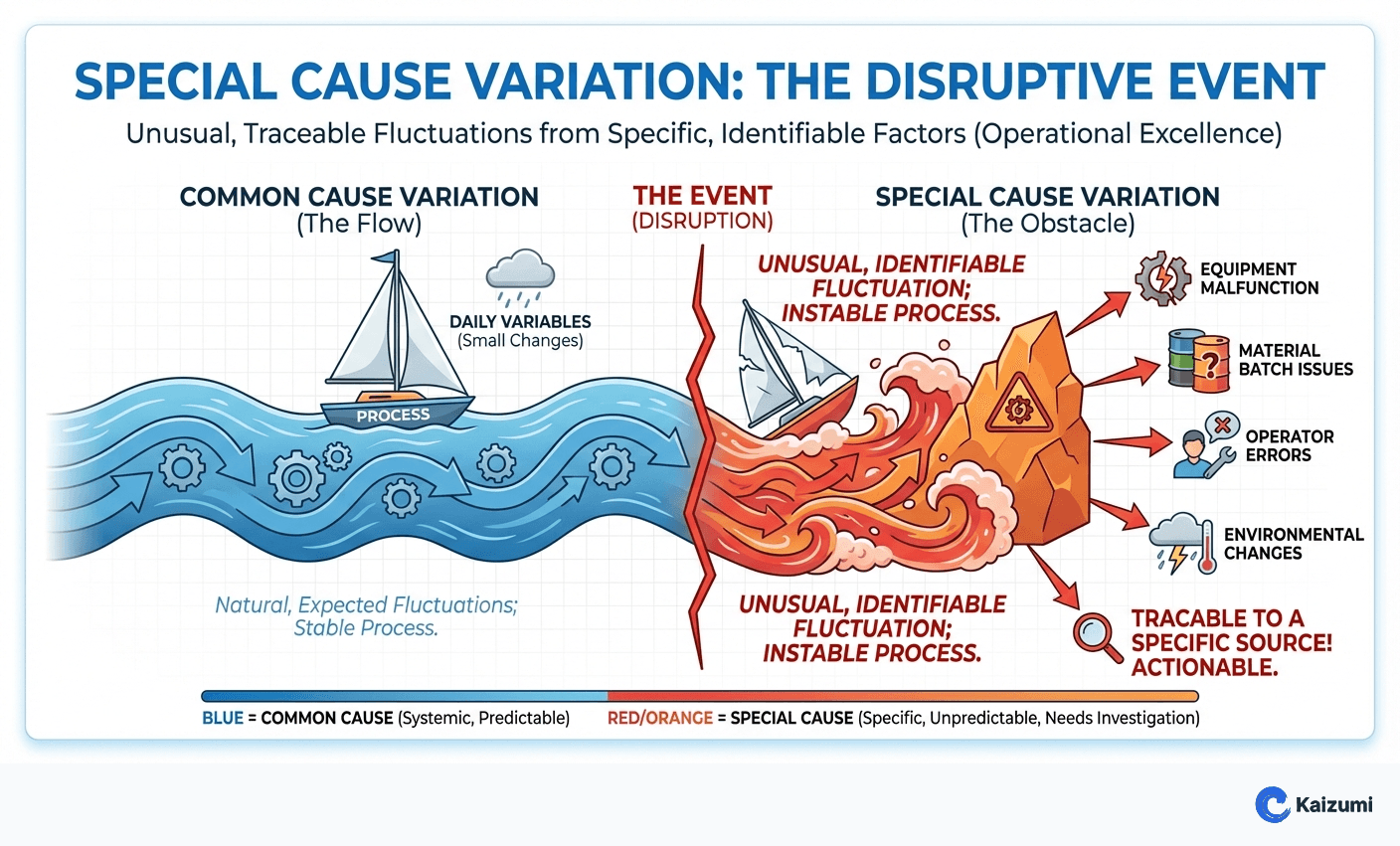
Special cause variation is unusual process fluctuation from specific, identifiable sources that can be investigated and eliminated.
Definition
Special cause variation is unusual process fluctuation resulting from specific, identifiable factors that are not normally present. Unlike common cause variation, special causes can be traced to particular events—equipment malfunction, material batch issues, operator errors, environmental changes. Special causes signal that something different happened and require investigation. On control charts, they appear as points outside control limits or non-random patterns (trends, shifts, runs). Eliminating special causes returns a process to statistical control.
Examples
A control chart shows shaft diameters suddenly shift up by 0.03mm at 2 PM. Investigation reveals the day shift operator set up a new cutting tool incorrectly. This is special cause variation—a specific, assignable event caused the change. Correcting the setup returns the process to its normal range.
Key Points
- Special causes result from specific, assignable events outside normal operation
- Appear on control charts as points outside limits or non-random patterns
- Require investigation to identify and eliminate the root cause
- Once removed, process returns to stable state with only common cause variation
Common Misconceptions
Every point outside control limits is a problem to fix. Statistical theory predicts about 0.27% of points will fall outside 3-sigma limits by chance alone. Control chart rules consider patterns, not just individual points. Investigation should confirm genuine special causes.
Eliminating special causes improves the process. Eliminating special causes returns the process to its baseline state—it doesn't improve that baseline. True improvement requires reducing common cause variation through system changes, not just stabilizing the process.