
Time Observation Sheet
Personalize This
Get insights for your role
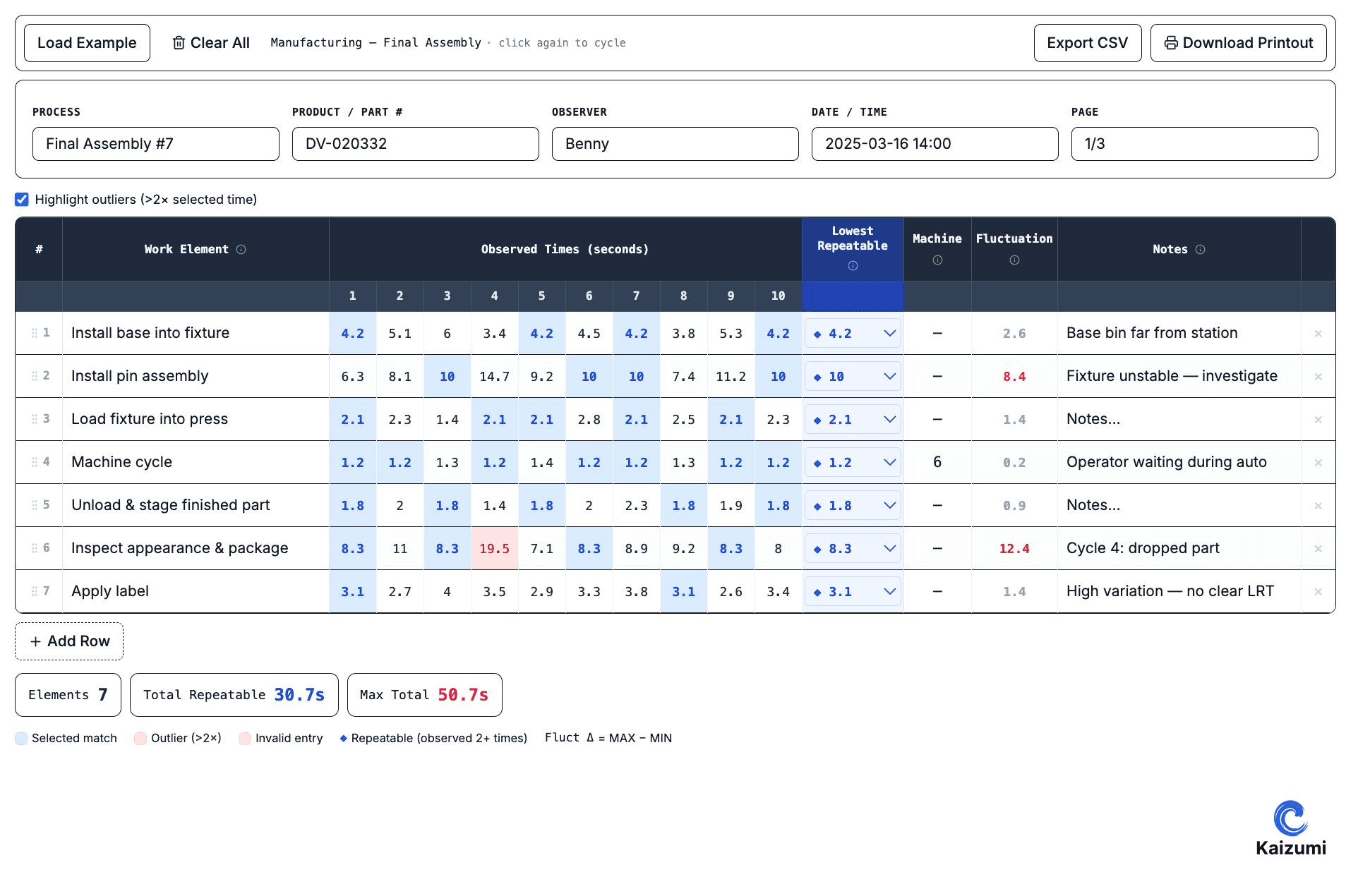
A Time Observation Sheet (TOS) records repeated cycle times for each work element to establish the lowest repeatable time used in standardized work.
Definition
The Time Observation Sheet (TOS) is the raw-data form used to capture repeated cycle times during a lean time study. An observer records at least ten cycles for each work element, then identifies the lowest repeatable time — the shortest time that an experienced operator achieves consistently, excluding outlier fast cycles and slow cycles caused by abnormalities. This lowest repeatable time becomes the manual-time input for the Process Capacity Sheet and the Standardized Work Combination Table. Unlike traditional time study, the TOS is not used to set quotas; it is used to reveal variation, expose problems, and establish honest baselines for kaizen.
Examples
An assembly team ran a TOS across ten cycles at a welding station. Element 4 showed times of 18, 22, 19, 47, 20, 18, 21, 19, 20, 18 seconds. The 47-second cycle was investigated and traced to a jammed fixture, a genuine abnormality worth addressing. The lowest repeatable time was 18 seconds, which the team used as the planning time for standardized work.
Key Points
- Capture at least ten consecutive cycles per element for meaningful variation data
- Record every cycle, including unusually long ones — outliers reveal problems
- The lowest repeatable time (not the average) is the input for standardized work
- Observe at the gemba, not from video or memory
Common Misconceptions
The TOS is used to find the fastest operator and set their time as the standard. Standardized work is built from the lowest repeatable time achieved by a trained operator, not a one-off sprint. The goal is a realistic, sustainable pace — not a personal best.
The TOS is a stopwatch-and-clipboard relic replaced by sensors and software. Automated timing captures cycle data but misses the observer's context — why the 47-second cycle happened, what the operator noticed, which abnormalities are worth fixing. The human observation is the value, not the stopwatch.
Try It
Run your own study right here. Record ten cycles per element, identify the lowest repeatable time, and export a print-ready form. (Also available as a standalone tool.)
See Also
- Time Study — The broader methodology
- Cycle Time — What the TOS measures
- Standard Work — What the TOS feeds
- Process Capacity Sheet — Uses TOS data for manual time input